
Investing in the right asset class is one of the best ways to grow your wealth and achieve financial independence over time. However, with numerous types of investments available worldwide, it can be overwhelming to decide where to invest your money for sustainable growth because each type of investment has its own risks, potential returns, and time horizon. If you’re a beginner or an experienced investor, understanding the various investment options can help you make healthy financial decisions for long-term growth.
In this article, we will explore the different types of investment, their benefits, growth potentials, risks, and how you can get started investing in various options. By the end, you’ll have a clear idea of which investments align with your financial goals.
Understand: What is Investing?
Investing means allocating your capital (money) in an asset, project, or different types of investments so that you can earn a positive return over time. The purpose of investing is to grow your wealth through high-potential assets (such as stocks, bonds, gold, silver, and debt).
You can invest in any type of asset or project that can provide a return on your invested capital. You can also use your money to start a business and develop real estate for profit/rent, and resell it over time as you wish. The primary purpose of investing is to grow your capital either through appreciation (an increase in the asset’s value) or by earning returns such as dividends, interest, or rental income.
Regardless of the asset class you invest in, investing always involves risk and return. You need to understand the balance between risk and return. Just as low-risk assets provide lower returns on your investment, high-risk assets provide higher returns than low-risk asset classes.
Low-risk assets like savings accounts, fixed deposits, or government bonds offer stable but low potential returns. However, higher-risk asset classes, such as equity investments, mutual funds, commodities, or cryptocurrencies, offer higher returns with higher risk.
Some Key Points of Investing:
Risk and Reward – All types of investment options are based on risk and reward. The higher the risk, the higher the return, and the lower the risk, the lower the return. First, you need to clarify your goals and risk tolerance, then start investing in different types of investments based on your goals and risk tolerance.
Diversification – Investing in a variety of asset classes helps you manage your portfolio’s risk. Here, you invest your capital in a variety of investment options, which is called diversification.
Time Frame – Some types of Investments can be both short-term and long-term. This depends entirely on your goals. If you want to accumulate wealth, long-term investments are for you. Whether you’re looking to meet your short-term or long-term goals, there are different investment options available in the market that can meet both your goals.
By understanding the key point of investing, investors can tailor their portfolio to their risk appetite with their help!
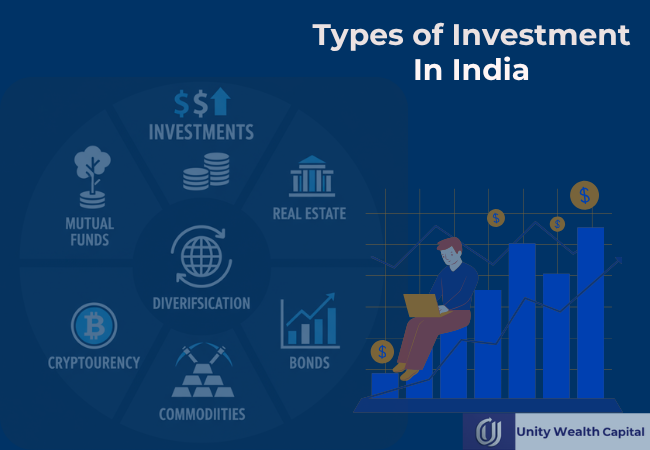
Types of Investments:
1. Stocks (Equity Investments)
Stocks are fractional shares of a company. When you buy shares in a company, you become a partial owner of that company. By becoming a shareholder, you participate in the company’s growth and succeed financially through increases in share price and the dividends the company pays on its regular profits.
Equity investments are considered one of the highest-returning assets over the long term. For example, if you had invested in Reliance Industries shares 20 years ago, your invested capital would have increased 30-fold. This is a substantial return, sufficient to build wealth over the long term.
Types of Stocks:
Common Stocks: Common stocks give shareholders ownership in a company along with voting rights. They may also receive dividends, but these are not guaranteed.
Preferred Stocks: Preferred stocks provide fixed dividend income and receive priority over common stock during profit distributions or liquidation. However, they do not carry voting rights. They are ideal for investors who seek stable returns with low risk.
Growth Stocks: Growth stocks are those of companies that reinvest their profits into their company to expand the business rather than paying dividends.
Dividend Stocks: Dividend stocks pay regular dividends to their shareholders, making them suitable for investors who are looking for passive income.
Blue-Chip Stocks: Blue-chip stocks represent large, financially strong companies with a proven record of stability and consistent performance.
2. Bonds
When companies and government want to raise fund, they issue bonds and investor lend their money to them (companies & government) in the exchange of payment of fixed interest on their capital within a given period of time with their capital amount.
Types Of Bond:
Government Bonds: Government bonds are issued by the central or state government to raise funds from investors. They are considered very safe because their repayment is backed by the government. In India, examples include government securities and sovereign gold bonds.
Corporate Bonds: Corporate bonds are issued by private or public companies to raise funds from investors for business needs. They typically pay higher interest rates than government bonds, but also carry more risk, depending on the company’s credit rating.
Municipal Bonds: Municipal bonds are issued by local government bodies, such as municipalities, to finance public projects. These are generally low-risk investments.
Convertible Bonds: Convertible bonds give investors the option to convert their bonds into company shares after a certain period of time or upon maturity. These bonds pay fixed interest until conversion and allow investors to benefit from future share price appreciation.
3. Mutual Fund:
Mutual funds are operated by AMCs (asset management companies). They pool investor money and invest it in a diversified portfolio of stocks, bonds, or other securities. These funds are managed by professional fund managers who make investment decisions on behalf of investors. Mutual funds provide diversification across various sectors, which helps reduce portfolio risk. Mutual funds are an excellent investment option for those who lack in-depth knowledge of the stock market.
Types of Mutual Fund
Equity mutual fund: – Equity mutual funds invest in company stocks for long-term capital appreciation. They are suitable for investors with a high risk appetite and long-term goals. Over time, these funds have the potential to beat inflation and create wealth.
Debt mutual fund – Debt mutual funds invest in fixed-income instruments like bonds, debentures, and fixed deposits. They offer stable returns on your investment and are considered less risky than equity mutual funds.
Hybrid mutual fund – Hybrid mutual funds invest in a mix of equity and debt funds to maintain a balance between risk and return. They are ideal for investors seeking moderate growth with low volatility.
Index mutual fund – These mutual funds invest money passively in index funds like Nifty 50, Sensex, and many more.
Sector-specific fund – These funds invest only in a particular sector, like IT, Pharma, or Banking. They carry a higher risk but can give good returns if the sector performs well.
PSU fund – PSU funds invest in government-owned companies, bonds, and securities. These funds are relatively safe and ideal for conservative investors seeking stability. When public sector companies perform well, these funds benefit.
4. Real Estate:
Real estate investing involves purchasing land and property with the expectation that its value will increase over time or for rental income. It’s a low-risk investment option and the best investment option for everyone because it provides short-term cash flow or long-term capital appreciation.
But investing in real estate requires a significant amount of capital. And real estate isn’t risk-free; property values can fluctuate due to market conditions, locations, and economic factors. It also requires ongoing maintenance and management, which can increase overall costs.
5. Commodities:
Investing in gold, silver, precious metals, oil, gas, grains, agricultural products, and currencies is called commodity investing. These investments are made through commodity ETFs and futures agreements, which involve buying or selling a certain quantity of a commodity at a fixed price on a specific future date. Commodity buying and selling can be used for risk hedging or speculative purposes.
6. Cryptocurrency:
Cryptocurrencies are digital currencies (such as Bitcoin, Ethereum, and Solana) that are backed by blockchain technology. Investing in crypto coins is called crypto investing. Investors can buy and trade them on crypto exchanges. They have no physical existence; they are digital. Each cryptocurrency runs on blockchain technology and is designed to perform different functions.
Experts call it “crypto is the currency of the future” and “blockchain is the future of technology”.
7. Fixed Deposit (FD):
These are the investment terms of banks where banks offer us a fixed interest rate for a fixed period on our deposits in FD bank accounts. These investment options have been considered the safest investment options for decades.
But banks invest our deposits in many risky asset classes. There are risks here, too, but banks keep our money insured. That’s why people invest here. Otherwise, with the proper knowledge and your own risk, you can invest by yourself in the assets where banks invest our deposited money.
8. Investing in Yourself
It is the best investment you can make in your life. Investing in yourself means developing skills for your goals, communication skills, and personality growth. Developing these skills can help you grow in your life and achieve your financial goals.
Some ways to invest in yourself:
Courses and Education – you can get knowledge from formal education, courses, and certifications. In this world of technology, you can learn any skill with the help of technology with proper guidance.
Skill development – learning a new skill like coding, financial analysis, stock market, and many more, as you want, like your hobbies, these can help you build your wealth.
Health & Well Being – In this fast-paced life, maintaining your physical and mental health is the best thing you can do for yourself.
Reading and personal growth – mentorship, podcast, and reading books can help in your personal growth.
Importance of Diversification:
Understanding the types of investments is important, but building a diversified portfolio is equally crucial. Diversification means spreading your capital across different asset classes, such as equity, debt, gold, and real estate, to minimize portfolio risk. For example, if the stock market falls for any reason, your investments in fixed deposits or gold can protect you from significant losses.
A well-diversified portfolio ensures that you can steadily grow your wealth while mitigating the impact of market volatility. You can create a diversified portfolio based on your financial knowledge and choose mutual funds according to your risk appetite.
The Conclusion:
Understanding the various types of investment is the first step toward our financial goals. You can choose the option of investing where you are comfortable for investing. Whether it can be highly risky (crypto investment) or it can be a low-risk option like FD and bond investing.
And finally, investing in yourself helps you to grow, helps to make your own investment decisions, adapt to the changes in the world, and succeed in this changing world. Always track your risk tolerance, your goal achievement, and time horizon before investing and after investing! So, start investing from today and stay consistent!
Frequently Asked Questions
What are the safest types of investments in India?
The safest investments in India are government-backed options like Public Provident Fund (PPF), National Savings Certificate (NSC), and bank fixed deposits are also considered the safest investments in India.
What are the best types of Investments in India?
The best investments in India are mutual funds, stocks, bonds, fixed deposits, real estate, and the public provident fund (PPF).
Which investment gives the highest return?
Historically, equity investments such as direct stocks and equity mutual funds have given the highest long-term returns, often beating inflation and creating significant wealth for patient investors.
Are mutual funds better than fixed deposits?
Yes, Mutual funds have the potential to offer higher returns than fixed deposits, but they carry market risk. FDs are safer but give lower returns.
Is real estate a good investment in 2025?
Real estate can still be a good investment if chosen wisely in growth areas with high development potential. However, it requires higher capital and has low liquidity compared to other assets.

My name is Prabhat Mehta, and I’m from Jharkhand, India. I’m a CFA Level 1 candidate and currently pursuing a Bachelor of Commerce (B.Com) with a specific academic focus on financial analysis, corporate finance, and investment fundamentals.
I have a passion for studying and analysing financial markets, company valuation, and fundamental analysis. I feel immense joy and energy whenever I engage in these activities. I write articles to explain complex financial concepts simply and clearly, providing practical explanations to help investors avoid common mistakes and make better financial decisions.
Most retail investors struggle not because of a lack of funds, but because of a lack of clear financial understanding—they don’t know what investing is, how to get started, or how to select undervalued stocks with good growth potential. My work is to focus on solving those problems.
Investing isn’t just about investing in a single asset. I believe investing should be logical, disciplined, and knowledge-driven rather than emotional. Through continuous learning and real-world analysis, my aim is to foster sound financial thinking and share information that truly helps investors grow with confidence over time.
11 thoughts on “Types of Investment: A Detailed Guide For Investors”