

The history of the Indian stock market is a remarkable tale of evolution, resilience, and transformation that spans more than two centuries. It was started under a banyan tree in Bombay, and today it is one of the fastest and most dynamic financial markets in the world.
Do you know that their journey to reach here was not easy? The Indian stock market has witnessed wars, economic depressions, financial scams, regulatory reforms, technological revolutions, and global crises. They had to solve many big problems to reach here.
This article explores the historical roots, major milestones, and revolutionary changes that have shaped the Indian stock market into what it is today.
What is the Stock Market?
The stock market is a platform that enables investors to buy and sell shares of a publicly listed company. It is the platform where capital moves from an investor to the company or government. Here company issues shares to raise funds from investors in exchange for equity in the company. Or on the other method company and governments raise funds from bonds. All these financial instruments are known as securities and are traded on stock exchanges.
An efficient and well-growing stock market is the backbone of the economy. It channels savings into productive investments, supports business expansion, generates employment, and contributes to overall economic growth. It enables the movement of capital from those who have it to those who seek it. The Indian stock market is the fifth-largest stock market in the world according to its market capitalisation.
The Birth Of the Indian Stock Market :
The Foundation Of the Indian stock market was laid in the 19th century when the country was under British Colonial rule. During this period, the growth of trade, industries, railways, ports, and banking under British influence created the need for organised capital markets.
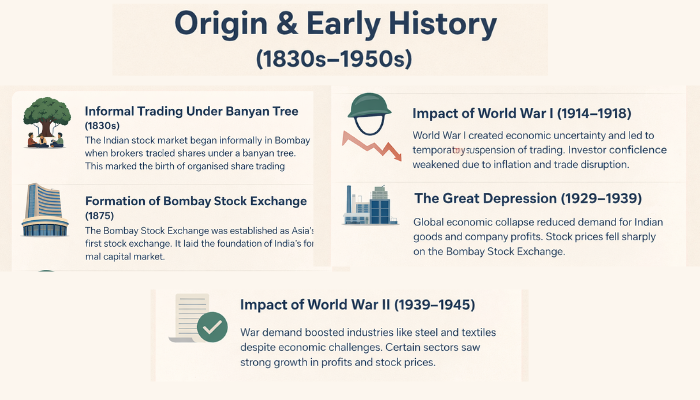
In India Stock market was unofficially organised in the 1830s in Bombay. A small group of brokers used to gather under a banyan tree near the Town Hall to trade shares of companies such as the British East India Company.It was rapidly emerging as a commercial hub due to its strategic location and the presence of the British East India Company. They need capital to fund large-scale infrastructure projects.
1875s: Formation Of The Bombay Stock Exchange (BSE)
In the year 1875, India achieved a milestone in the history of the Indian stock market with the establishment of the “Native Share and Stock Brokers’ Association” (Bombay Stock Exchange). BSE was started by a group of 22 brokers who would meet under the banyan tree to trade shares. The first organised stock exchange not only in India but in the entire Asian continent.
The BSE played a very significant role in the development of the capital market in India by providing a platform where companies and governments raise funds and investors buy the ownership of the companies and other securities.
Today, BSE is the most respected and one of the largest stock exchanges in the world. It continued to operate as the only major exchange in India for more than a century until the creation of the NSE in 1992.
20th century: The Rise of the Indian Stock Market
Impact Of World War 1 (1914-1918):-
World War I started in 1914, and it impacted all economies and financial markets around the world. The Indian economy and stock market were also affected by World War II. India was under British colonial rule at that time and had limited control over its economic decisions.
When the war began, the major countries of the world had to close their stock exchanges due to economic uncertainty. India also paused trading on its stock exchanges for a while to prevent market panic and mass selling by anxious investors.
1930s: Era of The Great Depression
The Great Depression began in 1929 in America, and it spread worldwide. This depression also had a profound impact on the Indian economy and the stock market. It became one of the most challenging periods in Indian stock market history. India was heavily dependent on the global economy at that time. So, when global demand collapsed due to the economic recession, the prices of goods fell. As a result, the share prices of companies on the Bombay Stock Exchange dropped sharply because their business revenues declined.
After the significant downturn, the Indian economy and stock market started to recover in the late 1930s, driven by the growth of new industries like jute, cotton, and tea.
1940s: The Impact Of “World War 2”
World War II (1939-1945) caused a second wave of global economic turbulence. This time, its impact on the Indian stock market was very different from that of World War I and the Great Depression. It had a mixed effect on India’s stock market. On one hand, war disrupted trade and production, leading to economic challenges such as panic among investors, high inflation, and more.
On the other hand, war drives demand for products in specific sectors. India became the largest supplier for the British war effort. They required products like uniforms, steel, chemicals, weapons components, and machinery. As a result, these sectors and industries experienced a significant profit increase. Additionally, the share of companies from these sectors is growing on the stock exchanges.
After The Independence From The British Rule ;
1956: The Formalization Of Stock Trading
In 1956, India passed the Securities Contracts (Regulation) Act, which formalised legally structured and regulated securities trading. This act provides a legal framework for regulating stock exchanges and securities contracts, and it also establishes the legal foundation for how stock trading should be conducted in India. The features of the Securities Contracts (Regulation) Act (SCRA) transformed Indian stock trading from informal to formal.
1964: Introduction Of Mutual Funds
In 1964, the Indian financial market landscape changed with the introduction of mutual funds. In that year, “Unit Trust of India”(UTI) launched the first mutual fund scheme in India, called Unit Scheme 1964 (US-64). It was launched by the Reserve Bank of India through an Act of Parliament. This scheme became highly popular among the Indian middle class and raised 6400 crore rupees by 1988 from Indian investors.
1986: SENSEX Launched By BSE
In 1986, the Bombay Stock Exchange (BSE) introduced the Sensex Index (Sensex) to the Indian stock market. The Sensex is a 30-share index that tracks the top 30 companies listed on the BSE. The Sensex was launched with a base year of 1978-79 and a base value of 100.
The Sensex became the benchmark for the Indian stock market. It brought transparency, structure, and analysis to stock trading, helping investors better understand market trends. Today, the Sensex is not just an index – it is a symbol of India’s economic condition.
1988: Establishment Of “SEBI”
Before the 1980s, the Indian capital market operated without any regulator; therefore, there was a lack of transparency and investor protection at that time. Insider trading, price manipulation, and broker gangs began eroding investor confidence. These activities increased the demand for a dedicated regulatory authority for the Indian capital market.
Hence, this resulted in the establishment of the Securities and Exchange Board of India (SEBI) in 1988. SEBI was established to prevent unfair trade practices, control dodgy brokers, and protect small investors from fraud.
After the Harshad Mehta scam, SEBI was granted full statutory powers under the SEBI Act, 1992, to effectively regulate the securities market.
1992: The Formation Of National Stock Exchange (NSE)
The National Stock Exchange (NSE) was founded in 1992 and became fully operational in 1994. NSE was created to increase transparency and efficiency in the market, and it also introduced a completely technology-driven, automated, screen-based trading system for investing in India, along with a qualified and trusted platform for investors.
1996: NIFTY50 launched by NSE
NIFTY50 was launched by NSE on April 22, 1996. The Nifty 50 index is a benchmark of the Indian stock market that represents the weighted average of the top 50 companies listed on the National Stock Exchange. Nifty 50 was launched on November 3, 1995, with 1000 as the base year and 1000 as the base price. Now, Nifty 50 has become one of the most tracked indices in India and is an important indicator of the country’s economic growth and market conditions.
Some Events Which Shaped The Stock Market
There are many great events that have happened in the journey of the Indian stock market. These events transformed the structure, credibility, and participation of investors and also changed the global standing of the Indian stock market.
The formation of the Bombay Stock Exchange: 1875
Asia’s first and oldest stock exchange (BSE) was established in Bombay in 1875. The Bombay Stock Exchange initiated formal capital markets in India. Despite operating without any regulatory framework for decades, the BSE laid the foundation for share trading and institutional equity investment in India.
Formation of SEBI : (1988-1992)
The Securities and Exchange Board of India (SEBI) was established in 1988. However, it received full statutory powers in 1992 following the Harshad Mehta scam. SEBI was officially designated as the regulator of the capital market in India and was authorised to oversee market activities.
SEBI made rules related to insider trading, broker registration, corporate disclosures, and imposed strict norms for transparency. SEBI’s role is to protect retail investors from scams and ensure fair trading.
The New Economic Policies: 1991
In 1991, the New Economic Policy was considered one of the most significant movements in Indian economic history. At that time, India was facing a balance of payments crisis. Therefore, the government of India, led by Prime Minister P.V. Narasimha Rao and Finance Minister Dr Manmohan Singh, implemented the New Economic Policy of Liberalisation, Privatisation, and Globalisation (LPG) and introduced wide-ranging economic reforms in India.
These economic policies involved delicensing industries, lowering tariffs, and opening up the economy to the world for foreign institutional investment (FII) and foreign direct investment (FDI).
Impacts On the Stock Market :
• These economic policies opened up the Indian stock market to foreign institutional investors (FIIs) for the first time, leading to massive capital inflows into the Indian economy.
• These policies led to an increase in market capitalisation and liquidity due to the massive cash inflows.
• Investor confidence increased as India was now seen as an emerging market with immense potential.
• These policies led to modernisation and increased transparency of the financial system.
The Harshad Mehta Scam: 1992
The Harshad Mehta scam of 1992 was the worst incident for the Indian stock market. Harshad Mehta revealed the flaws in the Indian banking system and used fake bank receipts and leverage to manipulate the stock market by inflating prices.
Effect on Stock Market:
• This scam caused a massive crash in the stock market, and investors lost billions of their wealth and lost faith in the financial system.
• This scam brought out the real transparency in the financial market and the protection of retail investors. As a result, SEBI was given more power to regulate the capital market in India.
The Dot Com Bubble Burst: 2000
In the 1990s to 2000, many people began using the Internet (WWW) during that period. A new era of the “Information Age” started due to the increased use of the Internet. Many Internet-based companies were then formed. The economy started shifting toward information technology. As a result, many investors started buying Internet-based companies at any price, without understanding the fundamentals of any company. People began investing indiscriminately in any company with .com. Thus, there was a boom in technology stocks worldwide, including in India. Therefore, when this bubble burst in 2000, stock markets around the world, including India, experienced a significant decline.
Impact on Stock Market:-
• The Sensex fell from 5,700 points to around 2,600 points in less than a year.
• The burst of the dot-com bubble led to a decline in the value of technology stocks in India and around the world.
• When the dot-com bubble burst, people realised the risks of speculative investing and began to understand the fundamentals of good business.
The Global Financial Crisis (2008)
The collapse of the US bank Lehman Brothers in September 2008 was the largest bankruptcy in American history. The Lehman Brothers failure and the subprime mortgage crisis in the US caused the global financial crisis (2008). The entire world, including India, was impacted by the global financial turmoil in 2008.
Effect on Stock Market:-
• The Sensex fell from its all-time high of over 21,000 in January 2008 to below 8,000 by October. It is considered one of the worst crashes of the Indian stock market.
• FIIs withdrew their money from the Indian market, leading to a sharp drop in equity valuations.
• Retail investors suffered huge losses, so they started panic selling and withdrew their mutual funds.
• Indian regulatory bodies, SEBI and the Reserve Bank of India (RBI), strengthened risk management practices and regulatory frameworks, which helped the market recover rapidly.
• After the global financial crisis in 2008 that resulted in losses of billions of dollars, a new asset class called cryptocurrencies emerged.
The Covid -19 Pandemic (2020-2022)
The COVID-19 pandemic is one of the most unpredictable events in the history of global markets, including the Indian market. During this pandemic, a virus called “Coronavirus” affected the lives and lifestyles of billions of people. This COVID-19 pandemic led to a worldwide lockdown, supply chain disruptions, business closures, and economic uncertainty, which had a profound impact on the Indian stock market.
Impact on the Indian Stock Market:
• In March 2020, the Sensex fell from its January high of 42,000 to 26,000. Also, the Nifty 50 index fell below the 7600 level; this huge drop destroyed trillions of investor wealth in a matter of weeks.
• Heavy selling pressure from FIIs and retail investors created liquidity issues.
• Although the market fell by 40%, it started recovering by the end of 2020 due to government support, monetary easing by the RBI, and vaccine development.
• The stock market recovered from this massive drop within six months. This is one of the fastest recoveries ever in the history of the Indian stock market.
• Retail investor participation skyrocketed as millions of new investors opened new demat accounts and started their investment journey.
Current Situation Of the Indian Stock Market:-
In May 2025, the Indian stock market became the fifth-largest stock market in the world. As of May 2025, the market capitalisation of NSE is US$5.2 trillion, and the market capitalisation of BSE is US$5 trillion.
• From the pandemic of 2020 to now in 2025, the number of demat account holders in India has increased from 4 crores to more than 20 crores across the country.
• A total of 2629 companies are listed on NSE and 5595 companies on BSE. It attracts a lot of foreign investors.
The Future Of the Indian Stock Market:-
The history of the Indian stock market shows a journey of peaks and valleys, reforms and upheavals, scams and achievements. From its modest start in 1875 to becoming one of the world’s leading markets by 2025, it has continually adapted to economic shifts, technological advances, investor habits, and new rules and regulations.
In the future, India’s goal to reach a $10 trillion economy will further boost its capital markets. As more retail investors join the market, financial literacy improves, and fintech innovation speeds up, government initiatives like “Make in India” and “Digital India” have prepared the Indian stock market for continued growth.
With advancements in artificial intelligence, blockchain, and fintech, the Indian stock market is becoming a more efficient and transparent system. Both domestic and global investors view India as a land of opportunities. As they engage more with the equity markets, the prospects for long-term wealth creation appear promising.
The Conclusion
The history of the Indian stock market represents a powerful journey of evolution, reform, and resilience. From its humble beginnings under a banyan tree in colonial Bombay to emerging as one of the world’s largest and most technologically advanced financial markets by 2025, the Indian stock market has continuously adapted to economic changes, global disruptions, and structural reforms. Wars, depressions, scams, and crises tested its stability, but each challenge resulted in stronger regulations, improved transparency, and greater investor protection, ultimately strengthening the foundation of the capital market.
Today, the Indian stock market stands as a critical pillar of the nation’s economic growth and wealth creation. With rising retail participation, expanding market capitalisation, rapid digitalisation, and growing global investor confidence, India’s capital markets are entering a more mature and inclusive phase. Looking ahead, advancements in fintech, artificial intelligence, and supportive government initiatives are expected to further enhance market efficiency and depth, positioning the Indian stock market as a key driver of India’s long-term economic future.
1 thought on “Indian Stock Market History: A Historical Journey From the 19th Century to 2025”