

The participants in the stock market, commonly referred to as stock market participants, are diverse bodies engaged in the buying and selling of financial securities. They are vital components for the stock market ecosystem. Their actions collectively impact market liquidity, price discovery, stability, and overall efficiency.
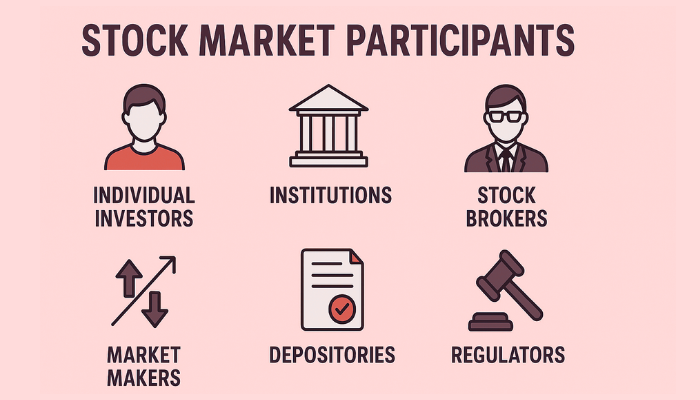
Stock market participants are broadly classified as individual investors, brokers, market makers, institutional bodies, intermediaries, and regulators that actively participate in the buying, selling, analysis, clearing, and regulation of financial instruments such as stocks, bonds, derivatives, and mutual funds.
In this article, we will cover everything in detail, including who the stock market participants are, what roles they play, their responsibilities, and why they are important for the long-term development of the financial markets.
Investors :
Investors are the most fundamental stock market participants. They provide capital to the market, intending to generate returns over time. Investors in the stock market can be both individuals and corporations or organisations coming from different backgrounds. Some groups of investors are classified into the following categories. Such as:
Retail Investors :
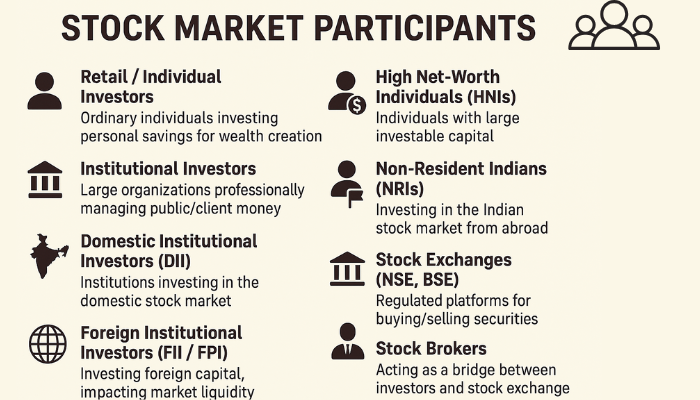
Retail investors are common individuals and one of the most active stock market participants who invest their personal savings in the stock market for wealth creation, retirement planning, income generation, or fulfilling short-term goals or long-term goals. They invest small amounts of capital compared to the institution or operator, but their overall participation is very large in number.
In this modern market, online trading platforms and mobile-based investment apps have made stock market access extremely easy for retail investors. Platforms such as discount brokers and fintech apps allow individuals to invest with minimal capital and documentation. Retail investors’ behaviour can be influenced by market news, social media, financial influencers, economic trends, or emotions such as fear, greed and FOMO (fear of missing out).
Institutional Investors (Powerful Stock Market Participants) :
Institutional investors invest large amounts of capital on behalf of other people’s money. These institutions manage pooled funds and deploy them strategically across different financial instruments. Their investment decisions are based on extensive research, fundamental and technical analysis, macroeconomic data, and advanced forecasting models.
Institutional investors are known for investing large amounts of capital in the market due to the sheer size of their investments.
These funds include mutual funds, hybrid funds, insurance companies, banks, hedge funds, and sovereign wealth funds.
Domestic Institutional Investors (DII) :
Domestic Institutional Investors, commonly known as DIIs, are investors of large amounts of capital within the country and are highly influential stock market participants who invest substantial capital in the domestic financial markets. Domestic Institutional Investors are influenced by domestic economic policy, monetary policy, GDP growth, economic trends, sectoral trends, and company fundamentals.
Unlike retail investors, DIIs operate with professional fund managers, analysts, and research teams who conduct deep fundamental research before allocating capital. heir investment horizon is usually long-term, which brings stability to the market. Over the past few years
Over the past few years, DIIs in India have been growing tremendously with the increasing number of retail participants through mutual fund SIP investments. DIIs drive investment in the stock market, and now they have great power to influence market trends.
Foreign Institutional Investors (FII) :
Foreign Institutional Investors, also known as FIIs, are global stock market participants that are large investment funds that invest in the country’s financial market from outside the country. FIIs are extremely influential for both the country and the market as they bring in large amounts of foreign capital, which adds depth, liquidity and credibility to the domestic markets.
Their buying activity often results in rising stock prices and bullish sentiment, while heavy selling by FIIs can lead to market corrections or even recessions. FIIs analyse various global factors such as interest rate movements, currency fluctuations, inflation trends, geopolitical tensions and global liquidity before making any investment decisions.
Foreign institutional investors include foreign mutual funds, hedge funds, pension funds, insurance companies, investment banks and other large institutions. In India, FIIs are regulated by SEBI under the broader category of foreign portfolio investors (FPIs).
High Net-Worth Individuals (HNIs) :
High Net-Worth Individuals, or HNIs, are individuals who possess a significantly large amount of investable capital. In India, financial institutions generally classify individuals with investable assets of ₹1 crore or more as HNIs. Due to their higher investment capacity, HNIs gain access to exclusive and premium investment products.
These include portfolio management services (PMS), alternative investment funds (AIFs), structured products, private equity opportunities, and unlisted or pre-IPO investments. HNIs often receive personalised wealth management services and play an important role in providing liquidity to both primary and secondary markets.
Non- Resident Indians (NRIs) :
These are Indian citizens or persons of Indian origin who live outside the country for their business, employment or other reasons. Many NRIs continue to actively invest in the Indian stock market to diversify their portfolios, stay connected to the Indian economy or take advantage of India’s growth story.
NRIs invest through specially designated accounts as per RBI and SEBI guidelines. Their investments contribute foreign inflows and long-term capital to the Indian markets.
Stock exchanges (Infrastructure Stock Market Participants) :
A stock exchange provides a legal platform where the buying and selling of financial securities takes place. Stock exchanges in India, such as NSE, BSE or MSEI, provide trading in securities through electronic terminals. They ensure fair price discovery, trade matching, order execution and post-trade settlement and also protect the returns of retail investors.
The stock exchanges provide companies with an opportunity to raise funds from investors through an initial public offering (IPO) for various purposes such as expansion, research, and development.
Stock Brokers (Intermediary Stock Market Participants) :
Stock brokers are registered members of stock exchanges; they facilitate buying and selling transactions for investors on stock exchanges. All secondary market transactions must be done through registered brokers of the stock exchange.
Stock brokers may be individuals, large firms, partnership firms or corporate bodies. They provide electronic platforms where investors can place buy or sell orders like; Groww, Zerodha or Upstocks, etc.
Modern brokers also provide tools such as real-time data, research reports, technical indicators, charting tools, portfolio tracking systems, and trading algorithms.
Brokers generate revenue through commissions for their services, known as brokerage. Individual stock exchanges set the maximum brokerage chargeable from clients for their services.
Market Makers (Liquidity-Providing Stock Market Participants):
Market makers are special stock market participants who provide liquidity and reduce volatility in the market by constantly offering to buy and sell securities at prices that are traded publicly.
In the absence of enough natural buyers or sellers, market makers step in to ensure that trading does not stagnate. They quote both the buying price (bid) and the selling price (ask) and profit from the difference between these prices, called the “spread.”
They reduce volatility, improve liquidity and help maintain orderly markets. On some exchanges, market making is a regulated responsibility given to certain firms to support specific securities.
Depositories and Depositories Participant (Backbone Stock Market Participants):
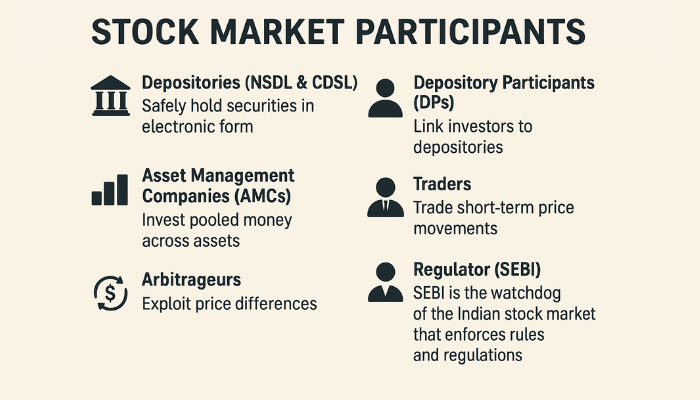
Whatever stocks, bonds and financial products we buy are stored in these depositories. These depositories hold financial securities like shares, debentures, mutual funds, bonds and government securities in electronic form for investors. Depositories provide services related to transactions in dematerialised securities.
there are mainly two SEBI-registered depositories in India:
1. Central Depositories Services Limited (CDSL)
2. National Securities Depositories Limited (NSDL)
Depositories Participants: DPs act like an agent for the two depositories, they facilitate interaction with investors and provide depository services. You cannot interact directly with NSDL or CDSL. You need a DP to open and maintain your demat account.
Intermediaries: NSE or BSE
Stock exchanges, such as the Bombay Stock Exchange (BSE) or the National Stock Exchange (NSE), serve as platforms for trading in securities and ensure transparency and efficiency. Stock exchanges also provide listing platforms for companies that wish to raise capital through a public offering.
They ensure fair price discovery, trade matching, order execution, post-trade settlement and block deals. These intermediaries form a strong support system that facilitates investment and trading activities.
Regulator (Governing Stock Market Participant):
The Securities Exchange Board of India is the main regulator of the stock market in India. SEBI regulates the functions of the stock market while ensuring fairness, transparency and investor protection. Their main function is to set guidelines for stock trading, investment, listing rules and investor protection. It monitors manipulation of stock prices, insider trading, fraud and ensures that all market participants follow the law.
Asset Management Companies (Professional Stock Market Participants) :
Asset management companies are financial institutions that pool money from a large number of investors and then invest those funds in various asset classes in the capital market.
These companies allocate capital across a variety of asset classes, such as equity, debt, hybrid, gold, oil, money market instruments and alternative investments. These companies launch new categories of mutual fund schemes and many other products, intending to generate returns in the future.
AMCs play a pivotal role in the stock market because they provide a stable and long-term source of capital through mutual funds, ETFs, REITs or any other asset class.
Traders and Arbitrageurs (Active Stock Market Participants):
Traders are individuals who take a calculated risk in anticipation of price changes. They do not hold assets as long-term investments, they makes profit from fluctuations in stock prices. Traders usually speculate in stocks, cryptocurrencies, commodities, and currencies.
Arbitrageurs usually exploit the price difference of the same asset in different markets. If the price of a stock is low in one exchange or high in other exchanges, arbitrageurs buy the stock at a lower price from one exchange and sell it at a higher prices in other exchanges. And then they make a profit from the difference.
The Conclusion :
Many market participants play a vital role in making our stock market ecosystem seamless and easy for everyone. From the investors who meet the market demand and shape the market to the companies (issuers) who raise capital for growth and innovation, and the intermediaries such as brokers, portfolio managers, depositories, clearing corporations, and underwriters, who ensure seamless transactions, each participant contributes to the vibrancy and resilience of the market.
The stock market follows SEBI rules and regulations to protect investors and ensure that no one creates turmoil in the sector. SEBI, has played a major role in maintaining the markets, protecting the investors, and creating an atmosphere conducive to more retail participation.
Frequently Asked Question
What are stock market participants?
Stock market participants are individuals and institutions involved in buying, selling, and regulating securities. They help maintain liquidity, price discovery, and smooth market operations.
Who are the main participants in the stock market?
The main participants include investors, traders, brokers, stock exchanges, asset management companies, depositories, and regulators like SEBI.
How are institutional investors different from retail investors?
Institutional investors manage large pools of money and invest based on detailed research and long-term strategies. Retail investors usually invest smaller amounts with limited resources.
Who are High Net-Worth Individuals (HNIs)?
HNIs are individuals with large investable assets. They invest in premium products like PMS, AIFs, and unlisted or pre-IPO shares.
Why are FIIs important for the stock market?
FIIs bring foreign capital that increases liquidity and global confidence in the market. Their buying and selling activities strongly influence market trends.
What are depositories in the stock market?
Depositories hold securities in electronic form and enable paperless trading. In India, NSDL and CDSL are the two registered depositories.
What is a Depository Participant (DP)?
A DP acts as a link between investors and depositories. Investors open and manage their demat accounts through DPs.
What do Asset Management Companies (AMCs) do?
AMCs manage pooled funds from investors and invest across different asset classes. They operate mutual funds, ETFs, and other investment products.
What is the role of SEBI in the stock market?
SEBI regulates the Indian stock market to protect investors and ensure transparency. It prevents fraud, manipulation, and unfair practices.
Who are traders and arbitrageurs?
Traders profit from short-term price movements, while arbitrageurs exploit price differences across markets. Both improve market efficiency.
2 thoughts on “Stock Market Participants: understands every player with detailed”