

Market capitalization means the total real value of outstanding common shares held by shareholders of publicly listed companies. By multiplying the total number of outstanding shares by the current share price of the stock, we find the real value of the company. Market capitalization is helpful for investors to analyse the company’s size, growth prospects, and risks.
Let’s understand what market capitalization is, its calculation, function, and application in various categories.
What is Market Capitalization?
Market capitalization or “market cap” means the current market value of the outstanding shares held by a company’s shareholders. Market capitalization is calculated by multiplying the number of outstanding shares by the current share price. Only publicly owned companies can be valued by this valuation method.
Market capitalization is the most effective way to evaluate the value of companies based on their stocks and stock prices. Market capitalization (market cap) is often used to reflect the size of a company and its total value compared to its peers, allowing for an understanding of the company’s influence within the same industry.
Market capitalization changes daily with the fluctuations of the shares. The sales and revenue of the company indicate whether the market capitalization is overvalued or undervalued.
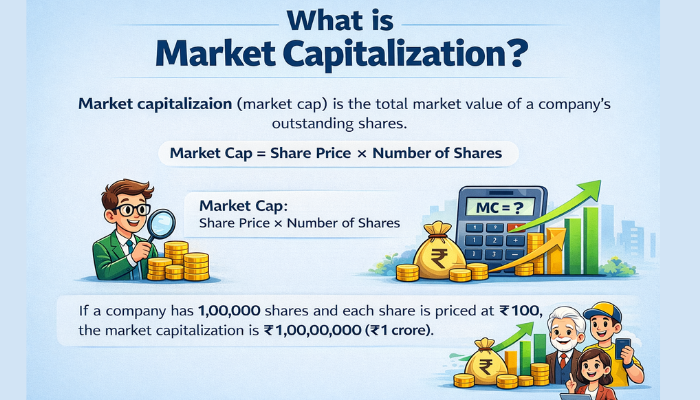
Market Capitalization Formula
Once a company is publicly traded, its share prices change daily due to demand and supply of the stock. As market prices change, the market cap becomes a real-time estimate of the company’s value. The formula for market capitalisation is:
Market Capitalization = Current Share Price * Total Number of Outstanding Shares
Multiplying the current share price by the total number of outstanding shares gives the market capitalization.
For example:
If a company has 1 lakh shares and sells each share at rupee 100, then the market capitalization of the company would be ;
Market capitalization = Number of shares * Price of each share
MC = 1 lakh * 100 rupee
MC = 1 crore
The total market cap of the company is 1 crore
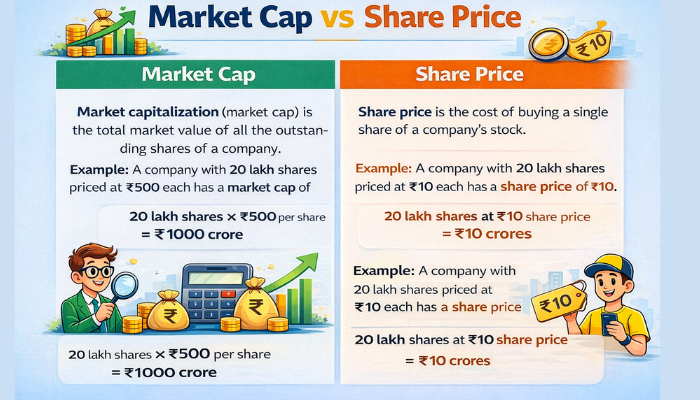
Market Capitalization v/s Share Price
Most investors think, “A ₹50 share is cheap, a ₹2000 share is expensive,” but that’s not true. One should never judge a company’s size or invest in it based on its share price.
For example, in January 2026, SBI’s share price is ₹1,000, and MRF’s share price is ₹147,0000. Based on the price, MRF appears to be a great company, a common mistake some investors make. But in reality, MRF is worth ₹62,000 crore, and SBI is worth ₹925,000 crore, 12 to 15 times larger than MRF. Consider this: We should never invest based on share price. Always analyse and invest based on market capitalization.
Share price ≠ company size
Market capitalization determines size, not share price.
Importance of Market Capitalization:
Market capitalization holds some vital importance and plays a vital role in the financial ecosystem. Market cap allows investors to understand the market as well as its impact on company shares and value.
- It is the most widely accepted method for comparing companies, market cap, making it easier for investors to understand the value of a company.
- Investors classify companies based on market capitalization. Then they select companies according to their risk appetite. Like, high risk means small-cap companies, safety means large-cap stocks, etc.
- Stocks with higher market capitalization get higher weightage in the index, thus they have greater influence on the movements of the index.
- Market cap allows investors to categorise companies based on their size, compare businesses within the same industry and assess investment risks. Unlike revenue or profit, which can be manipulated through fraudulent accounting methods, market cap reflects real-time investor demand.
While market cap is the universally accepted method, investors should also keep in mind that it does not consider the debt and other financial liabilities of a company. Also, it does not take into account various types of returns, such as stock splits, dividends, etc.
Companies Size Based on Market Cap :
Investors categorise companies into 3 major types based on their market capitalisation. Each category comes with its own risk and return profile. Balancing the portfolio with a good combination of all of these can reduce the risk exposure.
- Large Cap Stocks: These are the most stable group of companies in the market. The market capitalisation of these stocks ranges from 50000crores to 5lakh crores. These are considered the safest equity investments as the risk here is minimal. These are stable companies because they are at the peak of their growth, so the returns from these companies are comparatively low.
- Mid Cap Stocks:- Midcap stocks usually have a market cap between ₹10,000 crore and ₹50,000 crore. They represent companies that have passed their startup phase and are on a growth path, with some growth potential still. Investing in these companies can be considered risky as they are in their growth phase. These companies are less risky than small caps and offer higher returns than large caps.
- Small-cap Stocks: – Small-cap firms have a market cap of less than ₹10,000 crore. These are smaller businesses, often in growth or niche markets. They carry a higher risk but can deliver significant returns on your investment if the company grows rapidly. These are the most aggressive investment options.
Market Capitalization vs. Enterprise Value :
Many investors may get confused that market cap and enterprise value are the same factor, but they are different from each other. Market capitalization reflects the total value of the company (total number of shares * current share price). And enterprise value reflects the actual value of the company, including market cap, debt, cash, and cash equivalents.
Enterprise value provides a more realistic view of the company’s actual value as it considers its financial obligations. Market cap, on the other hand, is entirely equity-focused. She tells us how much the company actually costs us.
Market cap = total number of shares * current price per shares
Enterprise value = market cap + Debt -Cash and cash equivalents
Some Limitations of Market Capitalization:
Like other financial terms, market cap has certain limitations. It should not be the only metric used to evaluate a company’s value or make investment decisions.
- Market cap does not consider the financial health of the company; it does not include debt, profitability, or cash levels. Therefore, two companies from the same industry or with the same market cap may have different financial positions.
- A company can have a large market cap despite being unprofitable or generating minimal cash flows.
- The market capitalization tool alone is not enough to determine which company is overvalued or undervalued.
- Market capitalization does not include non-publicly traded companies. Such as privately held subsidiaries or valuable properties, which can be significant for some companies.
Therefore, investors should complement market capitalisation with other financial metrics like P/E ratio, P/B Ratio, enterprise value, return on equity, and debt-to-equity ratio for deeper analysis.
The Conclusion :
Market capitalisation is a tool that investors use to determine the value of companies in the same sector. It reflects investor confidence, the performance of companies, and overall market trends. It is calculated by multiplying the total number of shares outstanding by the current share price of the stock. However, it is not an absolute measure of a company’s value. Market cap is one of the important metrics that evaluate the total value of companies.
This helps us identify suitable companies based on our risk profile and goals. We can also compare businesses in similar industries with market cap. A holistic approach to investing – where market cap is just one of many tools in your toolkit – is the best way to make informed decisions and build long-term wealth.
What is market capitalization in simple words?
Market capitalization means the total market value of a company’s outstanding shares. It shows how big or small a company is in the stock market based on its current share price and total shares available.
Is market capitalization the real value of a company?
Market capitalization reflects the market’s perception of a company’s value, not its actual intrinsic value. It does not include debt, cash reserves, or financial obligations, so it should not be considered the complete value of a business.
Why is market capitalization important for investors?
Market capitalization helps investors understand a company’s size, stability, and risk level. It allows investors to compare companies, select stocks according to their risk appetite, and build a balanced investment portfolio.
What is the difference between market cap and share price?
Share price shows the price of one share, while market capitalization shows the total value of all shares combined. A company with a low share price can still be larger than a company with a high share price if it has more outstanding shares. SO Share price ≠ company size
What is a good market capitaization for beginners?
Beginners usually prefer large-cap or large-cap-oriented mutual funds because they offer lower volatility and more predictable returns compared to mid-cap and small-cap stocks.
Does market cap include company debt?
No. Market capitalization only includes equity value. To include debt and cash, investors use enterprise value.
3 thoughts on “What is Market Capitalization: Definition, calculation and importance for the investors”