
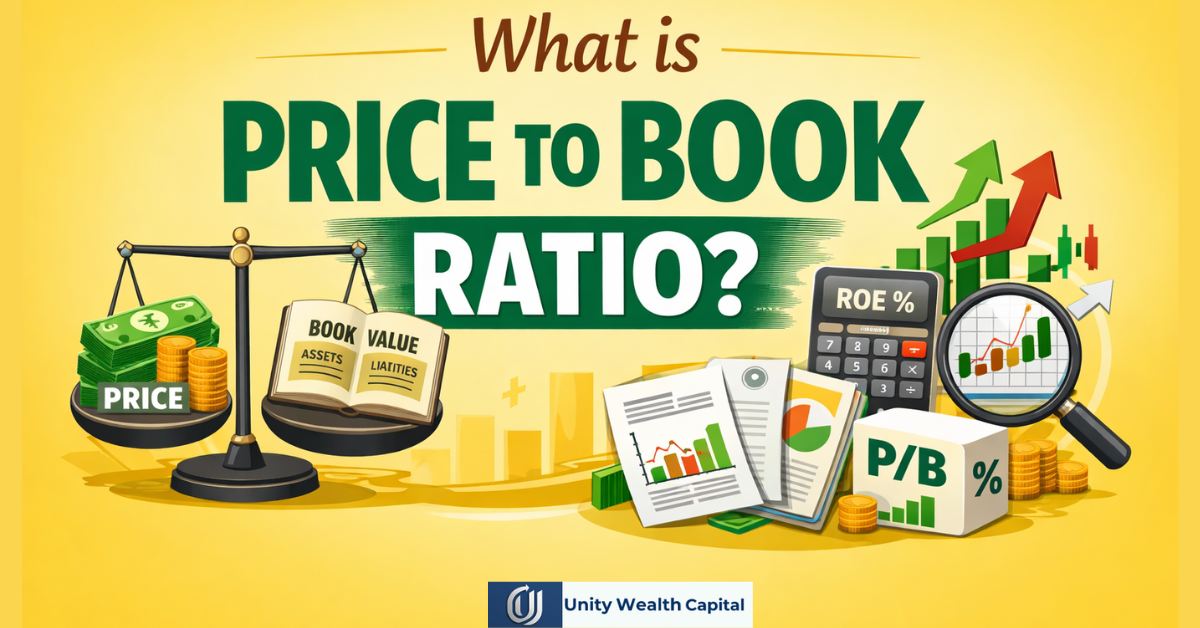
In the world of investing and finance, the price-to-book ratio is one of the most commonly used financial metrics by investors and analysts to determine whether a company’s stock is overvalued or undervalued relative to its book value. This value holds immense potential for investors seeking to make smart investment decisions.
In this article, we will cover everything, like the meaning of the P/B ratio, its formula, and how to calculate it, with its examples. It will provide a practical example to help it all make sense. So, let’s dive in.
What is The Price-to-Book Ratio?
P/B Ratio, Price-to-Book Value Ratio, is one of the most popular and important financial metrics tools that helps investors and analysts determine whether a company is overvalued or undervalued. This ratio is a valuable tool for investors who are looking for stocks trading at less than their true value. These stocks tend to create long-term wealth.
The price-to-book ratio is used by value investors to identify potential and undervalued investments. P/B ratios under 1.0 are typically considered solid investments by value investors.
Formula and Calculation of The Price-to-Book Ratio:
The price-to-book value ratio is calculated by dividing the current share price of the company to its book value per share.
P/B Ratio = market price per share /Book value per share
Here :
Market share price means – the current share price of the stock.
Book value per share = ( total assets – total liabilities) / total number of outstanding shares.
The price-to-book ratio is calculated based on market capitalisation and book value :
- Market Capitalisation: this method refers to the total value of a company in the market. It’s calculated by multiplying the current share price by the total number of diluted shares outstanding. It reflects the market’s perception of a company’s value based on how much investors believe it is worth.
Price to Book Value: Market capitalisation/ Book Value of Equity
- Book Value: Book value is calculated by the difference between the total asset value and total liabilities from the company’s balance sheet. This method shows the value of the assets that shareholders would receive if the company were hypothetically liquidated.
Price to book value: Market Share Price ÷ Book Value Per Share
Importance of Price-to-Book (P/B) Ratio :
The price-to-book ratio helps investors evaluate whether a stock is undervalued or overvalued compared to its book value, which represents a company’s net asset value (total assets minus liabilities) on its balance sheet. Many investors use the P/B ratio to find undervalued gem stocks in industries such as banking, NBFCs or real estate.
Generally, the P/B ratio means how many times a company’s stock price is greater than its book value per share. The lower the P/B ratio (lower than 1) in terms of investment, the better the company is for long-term investing. Because the lower p/b ratio suggests that the company is slightly undervalued means the market price is below the company’s actual asset value.
Investors use the P/B ratio to compare companies within the same industry. A high P/B ratio indicates that the stock is overvalued or that the company has strong future growth prospects that justify the premium. And the lower P/B ratio indicates that the comp any is undervalued.
Like most ratios, the P/B ratio compares by industry. A company should be compared with similarly structured companies in similar industries, then this will be the healthy comparison otherwise, the comparison results could be misleading.
Example of Price-to-Book (P/B) Ratio :
Suppose there is a company ABC LTD, whose balance sheet has assets of 1000 crores and liabilities of 600 crores. So the book value of the company is 400 crores (1000 crores-600 crores).
Suppose the company ABC Ltd has 40 crores of outstanding shares, so each share represents 10 book value. So if the share price of the company is Rs 40, then the price-to-book value ratio is 4 (40/10).
Therefore, the price-to-book ratio is valued at 4 times the multiple of their book value per share, which is overvalued. This would depend on how P/B ratios compare against other similarly sized companies in the same sector.
Why Is the Price-to-Book (P/B) Ratio Important?
Price to book ratio is important for investors who are looking for the value and financial health of the company. The price-to-book ratio is important because it can help investors understand whether a company’s market value is fair compared to its balance sheet. If a company exhibits a high price-to-book ratio, investors can examine whether that valuation is fair by looking at other measures, such as historical return on assets or earnings per share (EPS) growth.
What is a Good Price-to-Book ratio?
The question that most investors have is “What is a good P/B ratio?” A good P/B ratio depends on the company’s sectors/industries that inform valuations as a whole. An investor who is assessing a stock’s price-to-book ratio may choose to accept a higher average price-to-book ratio than an investor who is looking at a company’s stock in an industry where lower price-to-book ratios are the norm.
A good” P/B ratio is not one fixed number but rather one that is in line or slightly below the industry average P/B ratio. Good P/B ratio backed by strong fundamentals like high Return on Equity (ROE) and manageable debt.
Limitation of Using Price-to-Book (P/B) Ratio :-
Investors find the P/B ratio useful because the book value of equity provides a relatively stable and intuitive metric that they can easily compare to the market value.
The P/B ratio fails to consider the company’s future earnings, which is a crucial thing for investors. Investors must now understand that every ratio relies on historical data, which may not reflect the company’s growth.
The PB ratio is less useful in service and technology industries because it ignores intangible assets such as brand value, goodwill, and intellectual property. These assets can be highly valuable in certain industries and can significantly impact a company’s overall value. Ignoring them can give an incomplete picture of a company’s true value.
The book value can become negative because of a long series of negative earnings, making the P/B ratio useless for relative valuation. P/B ratio is worthless because recent acquisitions, write-offs, or share buybacks can distort the book value figure and affect the accuracy of the ratio. Investors should be aware of these potential distortions.
Final Conclusion :
The P/B ratio is one of the most important financial metrics for evaluating a stock, determining whether it is overvalued or undervalued. The P/B ratio is calculated by the company’s current share price/book value per share. Generally, a good P/B ratio is taken from the company’s industry average. If the P/B is less than 1.0, the market is considered to be undervaluing the stock, as the accounting value of its assets, if sold, would be higher than the market value of the shares. At this time, value investors are looking for these undervalued stocks for the long term growth. And with the help of the P/B ratio, investors also find the other overvalued stocks.