
If you do value investing in the stock market, you must have heard the term promoter holding while doing fundamental analysis of a company. Promoter holding is a factor that can have a significant impact on your investment returns.
Promoter holding is a share of a company that is held by the founders, promoter and their families or any other entity that directly controls the company. The concept of promoter holding provides deeper insight into the ownership and operational control of a company.
Therefore, if you are an investor or analyst, then it is important to understand the meaning of promoter holding, its functions, and why it matters to investors. Understanding the terms of promoter holding can provide a strong analytical view for any investor or market enthusiast who wants to make informed economic decisions.
What is Promoter Holding?
To understand the promoter holdings of any company, firstly, we need to understand the term “promoter” very well. Firstly, promoters are individual participants (owners, founders, co-founders, promoters) or it can also be a group of people (entities) who started the company or helped to build it in the initial years and kept deciding its direction. Usually, the promoters hold significant ownership in the company, and they control the business and its operations.
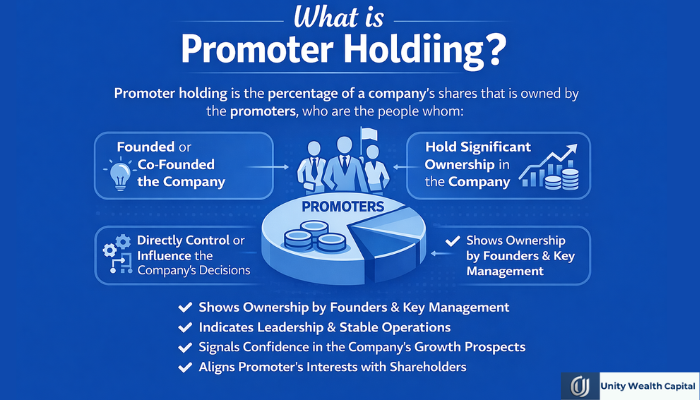
So, the promoter holding of a company refers to the percentage of equity shares of the company that is owned by the promoters of the company. And we know that promoters are the individuals, like founders, key management, etc. or entities who started and managed the company. Promoter holding shows how much share of the company is held by the promoters even after it is listed on the stock exchange.
Importance of Promoter Holding for every investor:
Promoter holdings hold vital importance for investors to make the right and meaningful decisions towards their investment journey. Let us discuss these points in detail.
It is an indicator of promoter confidence in the company:
Investors and institutions have faith in the company’s good performance, as they have observed that the promoters strongly believe in its growth prospects and hold a major share of ownership. The promoters hold more than 70% ownership in the company, indicating that they strongly believe in the company’s future growth. The low promoters’ ownership shows that the owners have doubts about the future success of the company. It can be a negative for investors.
Reflects good leadership:
A company with a high promoter stake reflects strong management and governance of the company. This means that the company is run and managed by its promoter or owners. A strong promoter represents transparency in reporting and decision-making towards the company and all the proper checks and balances. A company with high promoter ownership follows the rules and takes care of the interests of all stakeholders, from shareholders to general employees.
The Stable Operations:
The high stake of promoters in the company indicates that the promoters of the company believe in the growth of the company and have a high level of stability in terms of its operations. In fact, investors most of the time consider investing in these types of companies because of the promoters’ confidence in the company and their ability to run the company smoothly and maintain stability in operations.
The high promoter holding :
High promoters mean that the promoters hold a large portion of shares in the company. This reflects their strong belief in the company’s growth and development in the future. High promoter stake often increases investors’ confidence in the company. This strong promoter stake aligns the company’s interests with the interests of shareholders, promoting stability and effective decision-making.
An increase in promoter stake in the company can indicate positive growth, reassuring investors about the company’s growth potential in the future. A high promoter holding in a company is a healthy sign, which makes it a more attractive investment opportunity.
You can see that in large, established and mature companies, promoters always have a large stake in the company because they have full confidence in the company’s products, segment and growth. This way, you can invest in small businesses with high promoter holding for future and long-term growth.
But remember that investing based only on promoter stake can also cause you losses. So invest in any company only after thoroughly analysing all the financial aspects.
The Low Promoter Holding :
Low or declining promoter stake in a company can be a cause of concern for investors. Low or declining promoter ownership can be an indication of the promoters’ lack of confidence in the company’s future. Therefore, many investors raise the question of how, when the promoters themselves have no hope or faith in the company’s better future, how can investors trust the company?
Usually, a reduction in the promoter’s stake in a company can be a warning signal for investors. If the promoter’s stake in a company decreases from 70% to 80%, it means that the promoters and management have less confidence in the company. In such a situation, every investor should research the reasons for the reduction in the promoters’ stake in the company. Why are they taking such steps?
Impacts of Promoter Holding Changes on Stock Prices:
Changes in the promoters’ stake pattern can significantly impact share prices or their performance.
When promoters buy additional shares of a company (share buyback), it means they are increasing their stake in the company. This indicates that they have confidence in the company’s future growth prospects. This usually instils confidence in investors who know the company well. At such times, investors may cause a rise in share prices due to positive sentiment, as promoters’ moves are seen as a sign of strong prospects.
Similarly, when a promoter’s stake in a company reduces and promoters sell their stake over time, this can raise investor concerns about the company’s stability or growth prospects. Investors view a reduction in promoter stake as a negative thing, which can lead to negative market reactions. It is also important to analyse the reasons behind this reduction. It could be due to a planned dilution of stake to raise capital, meet regulatory norms, or bring in strategic investors. In such cases, a reduction in promoter stake does not necessarily mean a negative scenario.
Overall, tracking changes in promoters’ stakes is crucial for investors seeking to understand the underlying factors that influence stock prices and market sentiment.
Reasons why promoter holdings change after ipo
After an IPO, changes in promoter stakes in a company are very common. Many investors mistakenly believe that any reduction in promoter stake after an IPO is a bad sign, but in reality, there are several legitimate and strategic reasons behind such changes in promoter holdings.
Regulatory Requirements – This is one of the main reasons for a reduction in promoter holdings. According to SEBI regulations, every listed company in India must maintain a minimum public shareholding of 25%. This means that promoters cannot hold more than 75% of the company after listing.
Capital Raising – When a company raises capital to expand its business, it dilutes its stake by issuing shares to the public or institutional investors. If promoters do not sell their shares, their ownership percentage automatically decreases due to dilution.
How to analyse promoter holding?
It’s not necessarily true that only companies with high promoter holdings are good. There are many companies in the market with very low promoter stake, yet they are performing well and are large-cap stocks, such as ITC, HDFC Bank, L&T, Coforge, MCX, BSE, and ICICI Bank. All of these companies have very low promoter holdings, so we can’t judge them based on their promoter holdings. Before investing in these companies, analyse them in more detail.
Always perform trend analysis of promoter holdings?
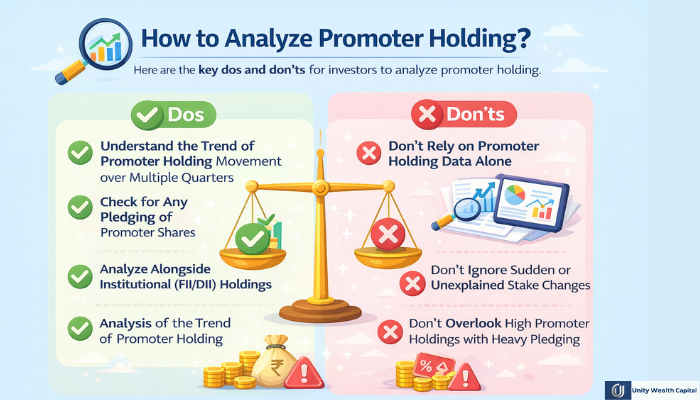
For long-term investors, analysing promoter holdings only once is not sufficient for accurate stock analysis. Investors need to analyse trends in promoter holdings over time rather than looking at a single data point.
Promoter shareholding data is disclosed in a company’s shareholding pattern filed with the stock exchanges every quarter. By analysing this data, investors can identify important behavioural signals from promoters. Whether promoter holdings remain stable, gradually increase over several quarters, or promoter holdings decline over several quarters, investors should analyse why this is happening to the company. While not every decline is negative, sudden selling without clear information often requires deeper investigation.
Pledge Risk in Promoter Holdings?
When a large portion of the promoter stake is pledged, it becomes significantly riskier. Pledged shares are those that promoters use as collateral to borrow money for personal or business funding. This can be done for a variety of reasons.
High promoter stake and high pledge levels are often considered red flags in fundamental analysis.
The main risk arises from margin calls. If a company’s share price falls sharply, lenders may demand additional collateral. If promoters fail to meet these margin requirements, the lender has the right to sell the pledged shares in the open market. This forced sale could cause a sharp decline in stock prices, further eroding investor confidence and increasing volatility.
Therefore, investors should not only look at promoter holdings but also analyze how much of that stake is pledged. A company with moderate promoter holdings and zero or minimal pledging is often safer than one with higher promoter holdings but heavy pledging.
Important Disclaimer for Investors

Promoter holding is an important indicator in stock market analysis, but it should never be used as a standalone decision-making tool. High or low promoter stake by itself does not guarantee future returns or business success.
Some stocks with high promoter holding :
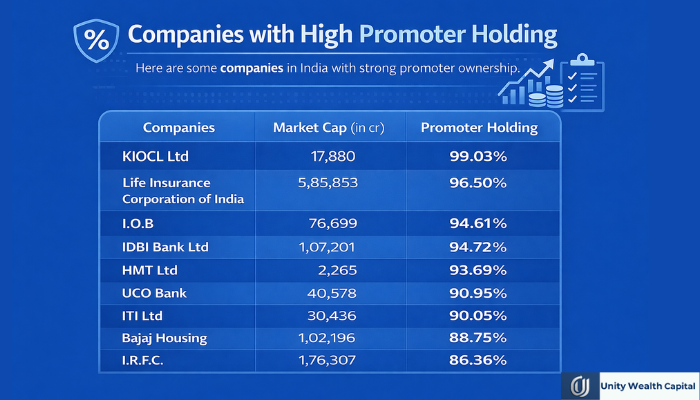
Many companies in the Indian market have strong promoter ownership. Here are some of them with their market capitalization or promoter stake:
| Companies | Market Cap (in cr) | Promoter Holding |
| KIOCL Ltd | 17,880 | 99.03% |
| Life Insurance Corporation of India | 5,85,853 | 96.50% |
| I.O.B | 76,699 | 94.61 % |
| IDBI Bank Ltd | 1,07,201 | 94.72% |
| HMT Ltd | 2,265 | 93.69% |
| UCO Bank | 40,578 | 90.95% |
| ITI Ltd | 30,436 | 90.05% |
| Bajaj Housing | 1,02,196 | 88.75% |
| I.R.F.C | 1,76,307 | 86.36 % |
The Conclusion :
Promoter holding is the most important factor to consider if you are an investor or analyst. Promoter holding represents the percentage of a company’s shares that are owned by the company’s promoters (people or institutions that build and run the business). If you invest in stocks, then promoter holding will affect your returns in the long run, or it can also affect them in the short run.
A carefully maintained promoter shareholding structure with minimal pledges and responsible governance practices indicates stability and growth of the company. For investors, understanding this dimension helps build a strong investment thesis, reduce risk and increase the chances of selecting fundamentally strong companies that can generate significant returns on their investments.
High promoter stakes are a positive sign of company performance. Or low promoter holding does not necessarily mean something negative. Yes, it is a useful metric for stock analysis, but do not invest in stocks based only on high or low promoter holding. Always use other financial metrics to evaluate the best and undervalued companies.
Frequently Asked Questions
What is Promoter Holding?
Promoter holding is the percentage of a company’s shares that are owned by the company’s promoters (founders, co-founders and entities who helped to build the business).
Who is a promoter in the share market?
Promoters are individuals (founders, co-founders, management) and Entities (owners’ family, organisations) who founded the company or helped build it in the initial years and continue to dictate its direction.
What is a good percentage of promoter holding?
There is no single suitable answer to this question, an ideal promoter holding varies as per the industry and their peers, but generally analysts and institutions prefer companies with high promoter holding (between 50% to 75%) with nominal pledge of shares.
What is the pledged promoter holding?
Pledged promoter holding is the amount of shares that promoters have used as collateral to borrow money. A high level of pledged promoter stake can be risky if the promoters do not pay back their loans. If the pledged shares are sold due to a default, the promoter may lose control of the company.
Why is the promoter holding important for investors?
High promoter holding reflects the level of confidence the promoters have in the business. High promoter holding generally indicates strong commitment and growth potential. Very low or declining holdings may raise concerns among investors about the long-term interest of the management.