
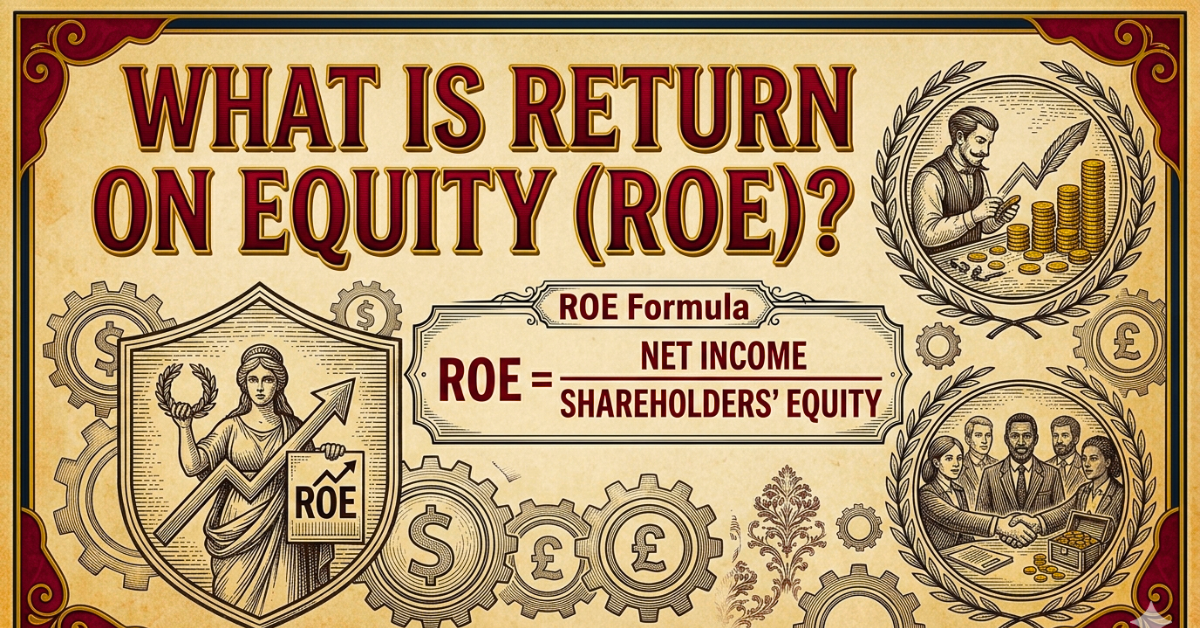
Return on equity (ROE) is important in investment and finance, as it measures a company’s financial performance. The return on equity ratio is a financial metric that measures a business’s profitability, i.e., how much net income it generates from its shareholders’ equity.
Let us learn in detail about Return on Equity (ROE), its meaning, definition, calculation, uses, and let’s do a quick comparison with other financial ratios.
What is Return On Equity (ROE)?
Return on equity, also known as ROE, is a financial ratio that measures the amount of net income a company generates from its shareholder equity. In simple terms, it tells how effectively a company is using the money invested by shareholders (shareholder equity) to generate profits.
The higher the return on equity ratio, the more it indicates that the company’s management effectively uses its equity financing to generate income. A lower return on equity ratio indicates that the company’s management is not using its equity financing effectively to produce income.
Generally, a company with a high return on equity is considered a healthy business to invest in. The good or bad ROE of a company is determined by comparing it with other companies in the same sector or peer companies. Peer-to-peer comparison means comparing technology companies to technology companies, utility companies to utility companies. Return on equity ratios (ROE) and other financial ratios are used to compare a business to its peers and sectors.
It is a percentage of profitability that helps investors or business owners assess their company’s performance compared to other companies in the same industry, so that they can better identify the strengths and weaknesses of their business and make accurate financial decisions for improvement.
Calculation of Return on Equity (ROE):
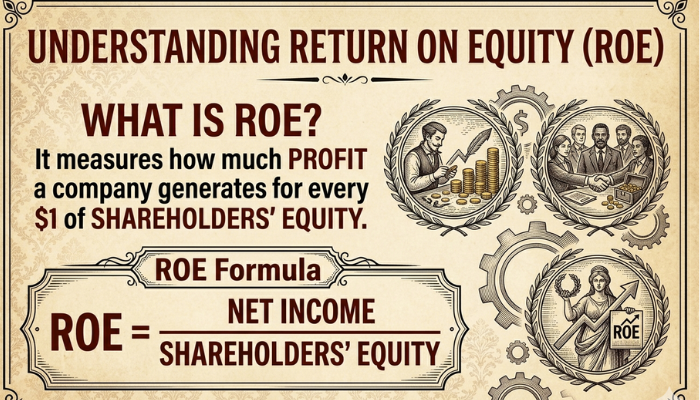
Return on equity is calculated by dividing a company’s net income by the amount of shareholder equity. Return on equity is only calculated when net income or equity in a company is positive. The Formula of Return on Equity is:-
Return on equity: Net Income / Shareholders’ Equity
Here, net income is calculated by the difference between net revenue and all expenses, such as interest, depreciation, or taxes. It is calculated before common stock dividends, after preferred stock dividends. You can find a company’s net income for a financial year in the profit and loss report below, where it is referred to as net income, net earnings, or net profit.
Shareholder equity is the amount of money that shareholders have invested in the company. Shareholders’ equity is calculated by taking all of a company’s assets and subtracting all of its liabilities, which is defined as the company’s net worth that would be returned to its shareholders if the company liquidated today and paid off its debts.
Calculation:
Let’s assume Company PQR Ltd. reported net income of 150cr in the FY25 report:
Net Income: 150cr
Total shareholder equity: 1000cr (after calculation)
Then the Return On Equity of company PQR Ltd is.
ROE = Net Income / Shareholder Equity
ROE = 150cr / 1000cr
ROE = 15%
The return on equity of the company PQR Ltd is 15% in the FY25. Means the company generates 15% profit from its shareholder equity. To determine the financial health of a company and whether it is managing its shareholder equity effectively and generating profits, we will compare the company’s performance with its peers within the same industry.
Using Return on Equity to Evaluate Stocks:
Return on equity is a powerful financial metric that helps investors evaluate companies and compare their performance to their peers. ROE provides insight into a company’s competitive strength, management effectiveness, and long-term sustainable future growth rate.
Growth Potentials:
ROE helps identify companies that are able to generate significant returns (income) from the capital invested by their shareholders.
Companies that have a 10-year track record of consistent growth rates and that maintain a good return on equity can be great businesses to invest in. To calculate a company’s share growth rate and the growth rate of its dividends, you need to multiply the ROE by the company’s retention ratio. (The retention ratio shows the portion of net income that is retained or reserved for future reinvestment.)
Sustainable Growth Rate (SGR):
Return on equity (ROE) assesses the sustainability of a company’s growth rate in the future. The sustainable growth rate (SGR) is the rate at which a company can grow without borrowing money to fund that growth. Investors can analyse potential areas of growth by comparing a company’s actual growth rate to its sustainable growth rate (SGR).
A stock that is growing slower than its sustainable growth rate is considered an undervalued stock, or the market may be taking major risks into account. And if a stock is growing faster than its sustainable growth rate, it may face challenges in maintaining momentum in the future.
The formula for the sustainable growth rate(SGR):
SGR = ROE x ( Retained Earnings ÷ Net Income )
Limitations of Return On Equity:
While analysing the stocks of a company, there are times when the return on equity ratio cannot indicate the profitability, sustainability, and performance of a company. Let us discuss some of these limitations.
Financial leverage: A company can artificially increase its return on equity by taking on more debt or reducing shareholder equity without increasing net income. These types of actions make the company appear more efficient in using equity capital, but in reality, they can expose it to significant financial risk. This is why comparing high ROE companies fails to distinguish between companies with impressive management and companies that are laden with debt.
Negative Return on equity: Due to the net loss or negative shareholder equity of the company, the return on equity value of the company also becomes negative. And this negative return cannot be used to analyse the companies.
Negative or very low equity: Sometimes companies accumulate losses, and they buy back their equity shares from their shareholders. This reduces the value of the company’s equity, which only shows us higher profits but does not increase the company’s net income.
Sustainability of earnings: A high ROE ratio cannot predict the future of a business or whether it will maintain such a high ROE indefinitely. The ROE ratio is calculated based on the net income of only one financial year. These are one-time events such as asset sales, tax benefits, or accounting adjustments that may not reflect the company’s actual operating performance.
Different Industries: Return on equity cannot be used across companies in different industries. Comparing ROE across different industries makes comparing different sectors a problem. ROE varies across sectors, and companies in each sector have different operating margins and financing structures.
Return on Equity (ROE) v/s Return on Invested Capital (ROIC)
Return on equity measures the net income earned by a company relative to its shareholder equity. This ratio tells us how effectively a company is using shareholders’ money to generate profits. This ratio is particularly important from the shareholders’ point of view because it shows the direct return on the equity invested by them.
Return on invested capital (ROIC) is a more comprehensive measure of a company’s performance. The main purpose of ROIC is to determine how much money a company earns (after dividends) based on all its sources of capital and debt. It evaluates how efficiently a company is using equity and debt capital, i.e., the entire amount invested in the business, to generate profits.
What is an Ideal Return on Equity (ROE)?
There is no fixed limit for a good return on equity ratio. No particular limit of ROE can be termed as a good return on equity. Different sectors have different ROE ratios. In fast-growing industries such as technology or FMCG, a return on equity (ROE) of 25% is considered a good sign for a business in some sectors. In contrast, for an asset-heavy business, an ROE of 10-15% is also considered a good fundamental sign.
Sometimes the return on equity of a stock may be low for a certain period of time, but this does not mean that the company is not able to earn a profit on its shareholder equity. The company may have purchased some investments, like machinery and equipment, that will help improve its business further. Due to these purchases, the return on equity of that business may decline in that particular year, but it will not be a permanent decline.
That is why every investor should not invest in any stock just by looking at the return on equity. We should invest in that stock only after analysing all the financial instruments and doing thorough research.
Frequently Asked Questions:
1. What is ROE in the Stock Market?
Return on equity is a financial metric that helps investors evaluate how much profit or income a company generates through its shareholder equity. The return on equity ratio is determined by dividing the net income of the company by its shareholders’ equity.
2. What does a high ROE indicate about a company?
A company’s high return on equity indicates that the company is efficiently generating profits from its shareholders’ equity. It shows that the company’s management is able to generate strong returns from the available equity capital invested by its shareholders. A high ROE business is generally positive, but other financial indicators and the company’s capital structure should be analysed before investing in it.
3. What is the difference between ROE and ROCE?
Return on equity (ROE) measures the profit earned by a company through its shareholders’ equity. On the other hand, return on capital employed (ROCE) measures both equity and debt capital to determine how efficiently the long-term capital is being used by the company to generate income or profit.
ROE does not measure the company’s debt; rather, ROCE provides a comprehensive view of operational and capital efficiency.
4. What Happens If the return on equity is Negative?
If a company’s ROE is negative, it means the company has recorded negative net income over a given period. If the company records a net loss or its shareholders’ equity becomes negative due to accumulated losses, a negative ROE indicates that the company is not making a profit. This means that shareholders are losing money on their investment in the company. Negative ROE can be expected in new companies, but a negative ROE can be a sign of trouble.
5. What is considered a good ROE?
No set return on equity ratio applies to every sector. ROE varies from industry to industry. Hence, it cannot be fixed or made uniform for every industry. In fast-growing industries like technology or FMCG, 15% ROE is considered best. Higher ROEs are common, while in capital-intensive sectors like utilities or infrastructure, ROEs between 10 -12% can also be considered good.
The Conclusion:
Return on equity is a financial metric that compares a company’s net income to its total shareholders’ equity. It provides investors with a clear and concise measure of how effectively a company is using its shareholders’ capital to generate a profit.
Return on equity is one of the financial tools; it alone does not paint a complete picture of a company’s financial structure, its performance relative to the industry, or the competition. Sometimes, a high ROE may not always be a sign of operational excellence—it may be affected by high debt, accounting adjustments, or short-term profitability spikes. Similarly, a low ROE in capital-intensive sectors does not necessarily mean a company is undervalued.
So every investor should analyse the stocks with ROE and other financial tools. Do a complete fundamental analysis of the company from every angle before considering the company for investment.