
If you’re new to the world of finance and investing, you’ve probably become intrigued by the asset called cryptocurrency because your friend made money in it, and now you’re wondering how you can make money in crypto. You may have heard of other examples of people losing everything in the crypto world, which may raise questions.
The question “Is it safe to buy Bitcoin in India?” is one of the most sensible questions you can ask before investing your money anywhere, not just in cryptocurrencies.
And the honest answer is: it depends on how you do it. Bitcoin itself isn’t a scam. But the crypto world surrounding it is full of traps—wrong platforms, wrong advice, wrong timing, wrong expectations.
Here, we’ll discuss whether it’s safe to buy Bitcoin in India. No hype. No “get rich quick” nonsense. Just what you really need to know.
The real reason behind the question “Is it safe to buy Bitcoin in India?”
Let’s start here—because understanding fear helps us better manage it.
1: “Is it even legal in India? Will I get into trouble if I buy it?”
This is the biggest question among all investors. For years, there was genuine confusion about whether crypto was even allowed in India. The RBI once tried to ban banks from dealing with crypto exchanges.
2: “What if I lose all my money in crypto?”
The fear is justified; you can lose. Bitcoin fell 70-80% in 2022 during the market correction. Those who invested at the peak suffered huge losses. The crypto market is more volatile than any other; you can lose every penny. The fear of complete financial loss is very real—and very valid.
3: “Is it a scam? Will someone run away with my money?”
No, Bitcoin isn’t a scam. It’s a digital form of currency(like paper money). Because of the lack of strict regulation or regualtory exchange, scammers stole cryptos worth billions of dollars. India has seen major crypto scams. Fake investment platforms have ruined people’s lives. Scammers hack platforms and steal investors’ crypto, leading people to believe it’s a scam.
All of these fears are understandable. Some of them are even justified—to a certain extent. Let’s address each one honestly.
Is Bitcoin legal in India in 2026?
Yes. Bitcoin is completely legal in India.
From 2026, you can legally buy, sell, hold, and trade Bitcoin in India through platforms. The government has not banned it. No law states that owning Bitcoin is a crime.
In fact, the Indian government has gone even further—they have officially classified cryptocurrencies as Virtual Digital Assets (VDAs) under the Income Tax Act. This classification means the government acknowledges that crypto exists, recognizes that people own it, and taxes it accordingly.
Because the government doesn’t tax things it wants to ban. The moment they created a tax category for crypto, they were essentially saying—”This is real, it’s allowed, and we want our share.”
What is the status of crypto taxes in India in 2026?
India has one of the strictest crypto tax systems in the world:
• A 30% flat tax on any profits made from selling crypto
• A 1% TDS (Tax Deducted at Source) on every transaction over ₹10,000
You can’t offset losses — means if you lose money on one coin, you can’t use that loss to reduce the tax on profits from another coin. So yes, it’s legal. But the government ensures they get a larger share of any profits. The
Understands the Real Risks of Buying Bitcoin in India
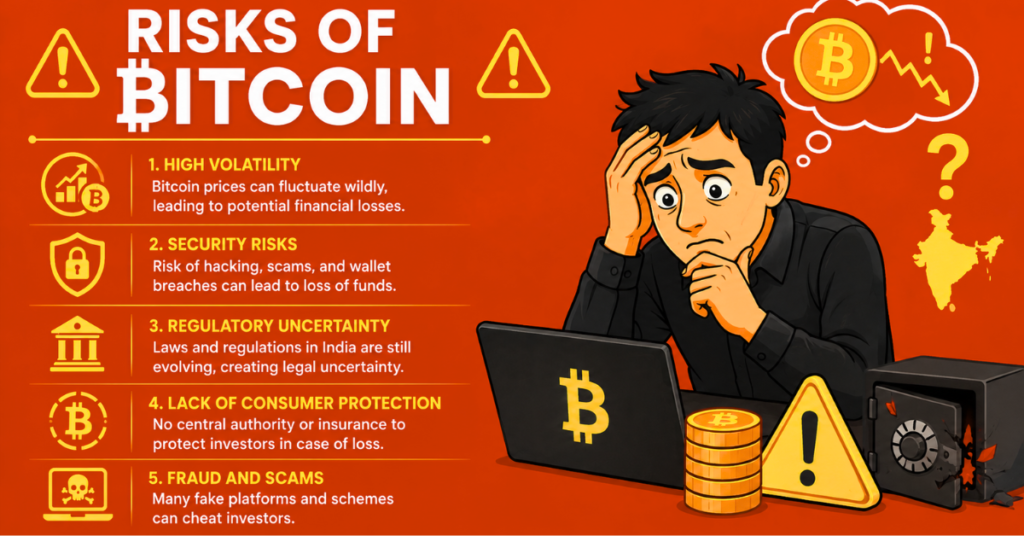
1: Cryptocurrency Price Fluctuations
The price of Bitcoin, or cryptocurrencies, fluctuates very rapidly—sometimes by 10-15% in a single day. In 2021, Bitcoin rose from $29,000 to $69,000 in a matter of months. In 2022, it fell back to $16,000. And in 2025, Bitcoin briefly reached $118,000, before falling back to $75,000 in 2026.
If you buy at the wrong time (at a high price) and panic-sell at the wrong time, you can lose a lot of money, or even empty your account. This is the most common way regular investors lose money with Bitcoin.
This is not a scam. This is how Bitcoin works. It’s a high-risk, high-reward asset. Those who made money understood this. Those who lost money often didn’t.Stole? Bankruptcy? Fraud
2: Platform Risk (Sack/Stolen/Bankrupt)
Crypto exchanges are riskier than crypto. Even one of the largest exchanges was shut down or hacked by scammers, causing investors to lose billions of dollars.
In 2022, FTX—one of the world’s largest exchanges—shut down overnight. Millions of users were unable to withdraw their funds. Indian exchange WazirX suffered a major hack in 2024, causing users to lose hundreds of crores of rupees.
If your exchange gets hacked, goes bankrupt, or simply disappears, your money could be gone forever. Only use FIU-IND registered exchanges. In India, all crypto exchanges must register with the Financial Intelligence Unit of India. Registered platforms follow strict security and KYC regulations. They’re not perfect—but they’re much safer than random.
3: Crypto Scams
This is the biggest real-world threat—not Bitcoin itself, but people pretending to offer Bitcoin investments.
Fake investment platforms: A website or app that shows “growing profits” in your account—but when you try to withdraw, they demand high fees, higher taxes, or a higher “processing charge.” Then they disappear. Your money was never actually in Bitcoin—it was in their pocket.
Telegram/WhatsApp Signal Groups: You follow their advice. You lose money. The expert was either incompetent or deliberately pumping and dumping the coin they already owned.
Influencer-Promoted Coins: A YouTuber or Instagram personality promotes a new coin with “10x potential.” You buy. They sell. The price drops. This is called a pump-and-dump scheme—and it’s very common in the Indian crypto space.
Your money was never actually in Bitcoin—it was in their pocket.
The rule is simple: if someone is guaranteeing returns, promising 10x profits, or asking for money to “unlock” your crypto—it’s a scam. Bitcoin doesn’t work that way. No one can guarantee profits.
4: Losing Access to Your Crypto
This is a unique risk that doesn’t exist with a bank account. If you store Bitcoin in a personal wallet and lose your private key (essentially your password), your Bitcoin is gone forever. No support team can recover it. Or if you transfer your coins to the wrong wallet address, it’s gone forever, and no one knows who’s behind the address.
Approximately $140 billion worth of Bitcoin is estimated to be lost forever because owners forgot their passwords or lost their recovery phrase.
How Do You Buy Bitcoin Safely in India?
Here’s a practical, step-by-step method that actually protects you.
1: Choose a Registered Exchange
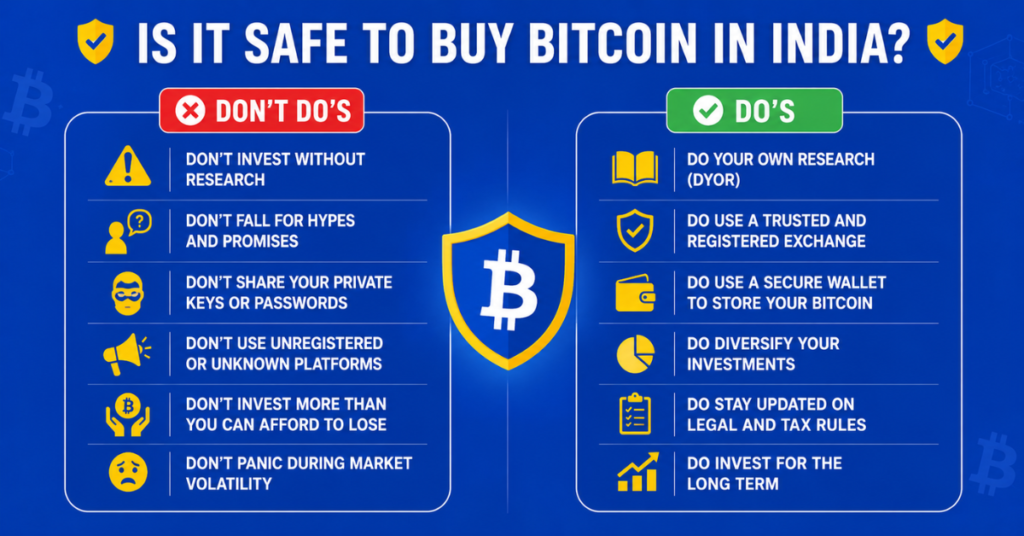
Only use exchanges registered with the FIU-IND. By 2026, the government requires all platforms serving Indian users to be registered and adhere to strict KYC/AML regulations. Use reputable names—CoinDCX, CoinSwitch, or ZebPay for Indian platforms.
2: Complete Your KYC Properly
You need to complete this process, or even every genuine Indian crypto exchange will ask for:
• PAN card
• Aadhaar card
• A selfie for verification
• Bank account details
Complete it properly. Don’t skip it. This KYC process actually protects you—it links your account to your real identity and makes fraud more difficult.
3: Start with an amount you can afford to lose completely
This is the most crucial step. Before investing in Bitcoin, ask yourself: If this money disappeared tomorrow, would I be okay? If the answer is no, keep reducing the amount until the answer is yes.
Most financial advisors recommend keeping crypto at a maximum of 5% of your total investment portfolio.
4: Use UPI or bank transfers—not P2P
When depositing funds into your exchange account, use UPI or bank transfers through the official exchange app. Don’t buy Bitcoin from strangers on peer-to-peer (P2P) platforms—these transactions are difficult to track, easy to scam, and can sometimes result in your bank account being flagged.
6: Keep a record of every transaction
Due to India’s 30% tax rule, you must report every crypto transaction—every purchase, every sale, every swap. Keep a simple spreadsheet or use the tax tools available on most Indian exchanges.
What Makes Bitcoin Different From Other Scam Investments?
Bitcoin isn’t some company selling you a scheme. It’s an open, decentralized digital currency that runs on a public blockchain. According to Satoshi Nakamoto, Bitcoin is a peer-to-peer electronic cash system. Because of blockchain technology, Bitcoin has no owner. No one controls it. The code is publicly visible. No one can secretly change or disable it. No one can hack it, destroy it, or recreate it.
When you hear about crypto scams, they’re almost always about people who use Bitcoin or fake crypto as a tool to defraud others. The scammers are the people, exchanges, and groups, not Bitcoin itself.
Think of it like cash. If someone runs off with your ₹100 note, the problem isn’t the ₹100 note. The problem is the scammer. Bitcoin is the same way.
Bitcoin has been around since 2009. It has survived government crackdowns, exchange collapses, hacks, bear markets, and numerous “Bitcoin is over” headlines. It’s still here. This doesn’t mean it’s risk-free – but it does mean it’s not going away anytime soon. Honest
Should You Buy Bitcoin in India?
Bitcoin is legal in India. Buying it on a registered exchange is safe in the sense that you won’t get arrested. The process is regulated and monitored by the exchange. You can store it in your cold wallet.
But Bitcoin is risky. The price can drop 50% and stay down for a year. You will pay 30% tax on profits. You need to stay informed.
You should consider buying Bitcoin if:
- You understand it’s a high-risk investment, not a savings account
- You’re investing money you don’t need for the next 3-5 years
- You’ve done some basic research, and you’re comfortable with volatility
- You’re using a registered exchange and following proper tax rules
You should not buy Bitcoin if:
- If you’re expecting guaranteed returns or quick profits
- You’re investing money you need — rent, EMIs, savings for emergencies
- Someone on WhatsApp or Telegram “guaranteed” you profits
- You’re buying because of FOMO (fear of missing out) after seeing prices go up
The Conclusion
The reason you asked “Is it safe to buy Bitcoin in India?” is because you’re a responsible person who thinks before spending or investing your hard-earned money. That’s already a better starting point than most people.
Bitcoin is not magic money. It’s not guaranteed to be profitable. It’s not a scam either. It’s a new kind of asset — one that came with more volatility, more potential, and more responsibility than anything that came before it.
Used the right way — legal platforms, small amounts, long time horizon, proper taxes — it’s a legitimate investment that millions of Indians are making in 2026.
The difference between those two outcomes is mostly information. And now you have it.
This article is for educational purposes only and does not constitute financial advice. Don’t invest in any asset based on tips. Consult a SEBI-registered financial advisor before making any investment decisions. All return figures are indicative and based on market conditions as of April 2026.
unity wealth capital

My name is Prabhat Mehta, and I’m from Jharkhand, India. I’m a CFA Level 1 candidate and currently pursuing a Bachelor of Commerce (B.Com) with a specific academic focus on financial analysis, corporate finance, and investment fundamentals.
I have a passion for studying and analysing financial markets, company valuation, and fundamental analysis. I feel immense joy and energy whenever I engage in these activities. I write articles to explain complex financial concepts simply and clearly, providing practical explanations to help investors avoid common mistakes and make better financial decisions.
Most retail investors struggle not because of a lack of funds, but because of a lack of clear financial understanding—they don’t know what investing is, how to get started, or how to select undervalued stocks with good growth potential. My work is to focus on solving those problems.
Investing isn’t just about investing in a single asset. I believe investing should be logical, disciplined, and knowledge-driven rather than emotional. Through continuous learning and real-world analysis, my aim is to foster sound financial thinking and share information that truly helps investors grow with confidence over time.