

In the world of investing and finance, people invest their capital in shares, and the return on investment can come from two main sources – capital appreciation and dividends. Capital appreciation depends on the increase in the price of the company’s shares, and dividends are paid directly by the company to its shareholders as profit distribution. Companies distribute dividends only to shareholders registered in the company’s books.
This article explores how dividends are paid on shares, who decides them, their types, timelines, and everything else you need to know before expecting your first dividend from the company.
Understanding Dividend :
Dividend is the part of the company’s earnings which is distributed by the companies to their existing shareholders. When companies earn a decent amount of profit they reserve some part of the profit for future projects, then they distribute the surplus money to their shareholders according to their stake in the companies. This is called dividend.
The payment of dividends is a return on investment in the company and an indication of the company’s financial position. A company decides the dividends, their amount, and the dates on which they are to be paid to its shareholders. All information related to dividends, such as the amount of the dividend and the dates associated with it, is usually determined after the company finalizes its income statement each quarter.
Types Of Dividends:
There are several methods for payment of dividends, that companies use for payment:
1. Cash Dividend: it is the most common methods for the payments, companies pays a certain amount per share directly to shareholders bank transfer or through cheque.
2. Stock Dividend: Instead of paying cash, the company issues additional shares to existing shareholders in proportion to their holdings, up to 25% of the previously issued shares.
3. Property Dividend: Sometimes companies distribute shares of subsidiaries or physical assets to their shareholders.
4. Special Dividend: A one-time large dividend paid during exceptionally profitable periods, often separate from the regular dividend schedule.
Dividend Payments Dates :
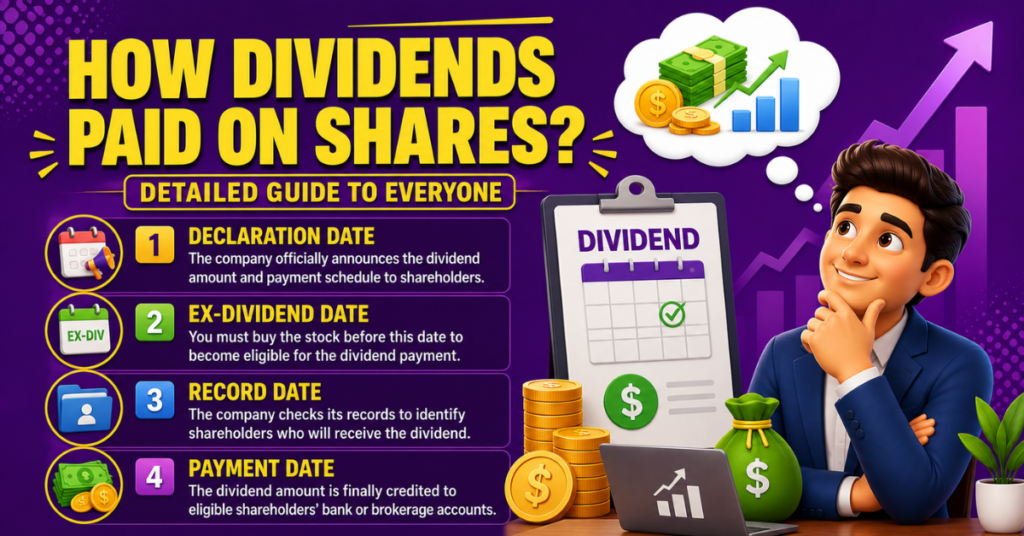
When companies decide to pay a dividend, they also announce 4 important dates for the dividend payment process. Investors should be aware of the four key dividend dates:
1. The Dividend Declaration Date : On this day the board of directors of the company declares the dividend and information such as dividend amount, ex-date, record date and payment date are announced on dividend declaration day. This date is recorded for accounting purposes.
2. The Ex-Dividend Date: To receive the upcoming dividend, the investor must buy the stock before the ex-dividend date. Only then will he be eligible for the dividends. If the investor has bought the stock after the ex-dividend date, he is not eligible to receive the dividend. The ex-dividend date is usually one or two business days before the record date.
3. Record Date : Record dates determine all shareholders of a company who are recorded as investors in the company’s shareholder register and are entitled to dividend payments.
This means, if you are on the company’s shareholder register on this date, you will receive the dividend.
4. The Payment Date : The payment date is the final stage of dividend payment. On this day companies issue dividend payments to their eligible shareholders. The dividend amount is deposited into shareholders’ bank accounts or brokerage accounts. This usually happens a couple of weeks after the record date.
How Dividends Are Paid on shares? :
Dividends are the distribution of a certain portion of a company’s earnings to its eligible shareholders. Dividends are automatically deposited into a registered bank account, brokerage account, or paid in the form of a dividend check. The alternative to a cash dividend is additional shares in the company. This is called dividend reinvestment.
Dividends are paid to shareholders according to their stake in the company. Dividends are declared on a per-share basis. Therefore, investors are paid dividends according to their ownership in the company.
“The company has a legal responsibility to pay the dividend when it’s been announced on the declaration date”
An Example :
Suppose on May 28, 2025, a company called XYZ Ltd declares a dividend of Rs 5 per share to its shareholders, payable on July 10, 2025. XYZ also declares a record date before June 15, 2025, and is entitled to receive the dividend. On the other hand, those who buy before the ex-dividend date will get the dividend. Suppose Prabhat is a shareholder of a company who holds 10000 shares of the company for one year.
Dividend = ₹ 5 per share
Declaration Date: May 28, 2025
Record Date: June 15, 2025
Ex-Dividend Date: June 15, 2025
Payable Date: JULY 10, 2025
SO, Prabhat has 10,000 outstanding shares of the company, and the company declares Rs 5 per share as a dividend.
Total dividend = dividend per share * number of holding shares
Total dividend = RS. 5 * 10,000 shares
Total dividend = 50,000 rupee
It means on the dividend payment day, Prabhat gets 50,000 rupees as a dividend from the company.
On Which Basis Companies Announced dividends? :
Dividend payments in India are announced after these things :
- Profitability: The first and most important factor is whether the company is making a profit. The more profit the company makes, the higher the potential dividend.
- Dividend Payout Ratio: This ratio tells us how much of its earnings the company distributes as dividend. If a company has a long history of dividend payments, its dividend amount will be stable and is considered favourable to shareholders.
- Debt Obligations: Highly indebted companies or companies that have a very high debt payment may avoid paying dividends to save cash.
- Growth Plans (Reinvestment): Sometimes the company has new business plans or business expansion. At such times the company retains profits to fund them instead of paying dividends.
- Economic Conditions: During a recession, economic downturn or any other uncertain economic times, companies may postpone dividend payments to conserve cash for safety.
If you are not able to choose stocks directly that give a high dividend yield, then you can choose dividend ETFs for your investments because these ETFs invest most of their money in high dividend-paying stocks.
The Conclusion :
A dividend is the portion of the company’s profit that is distributed among all its eligible shareholders. Some companies pay dividends consistently, and some companies do not pay dividend. Some companies may decide to retain their earnings to reinvest in growth opportunities. These are mostly small-cap or mid-cap companies that reinvest their profits in the business.
When a company declares a dividend, it also declares important dividend dates. Dividends are paid to shareholders who hold shares before the ex-dividend date, and then they will be paid accordingly on the upcoming payment date. Companies can pay dividends in the form of cash or additional shares.
Frequently Asked Questions
1. How often are dividends paid?
Dividends can be paid quarterly, half-yearly, or annually, depending on the company’s policy and applicable laws. Some companies also declare interim and final dividends in a financial year.
2. What is a good dividend payment?
Periodic and industry-equivalent dividends are considered good by investors. Investors prefer dividend stocks over stocks with regular dividends because they can provide periodic dividends. It is important to analyse whether the company’s earnings can sustain the dividend for a long period in the future.
3. Are dividends paid to all shareholders?
Dividends are not paid to all shareholders. Dividends are paid to shareholders who hold shares before the record date. Shareholders who purchase shares after the record date are not eligible for dividends.
4. Are dividend a Return on Investment?
Yes, dividends are considered as total return. The income produced by the investment in the form of dividends and interest as well as the increase in the price of the investment.
This article is for educational purposes only and does not constitute any financial advice. Don’t invest in any asset based on tips. Consult a SEBI-registered financial advisor before making any investment decisions. All return figures are indicative and based on market conditions as of 2026.
UNITY WEALTH CAPITAL

My name is Prabhat Mehta, and I’m from Jharkhand, India. I’m a CFA Level 1 candidate and currently pursuing a Bachelor of Commerce (B.Com) with a specific academic focus on financial analysis, corporate finance, and investment fundamentals.
I have a passion for studying and analysing financial markets, company valuation, and fundamental analysis. I feel immense joy and energy whenever I engage in these activities. I write articles to explain complex financial concepts simply and clearly, providing practical explanations to help investors avoid common mistakes and make better financial decisions.
Most retail investors struggle not because of a lack of funds, but because of a lack of clear financial understanding—they don’t know what investing is, how to get started, or how to select undervalued stocks with good growth potential. My work is to focus on solving those problems.
Investing isn’t just about investing in a single asset. I believe investing should be logical, disciplined, and knowledge-driven rather than emotional. Through continuous learning and real-world analysis, my aim is to foster sound financial thinking and share information that truly helps investors grow with confidence over time.