
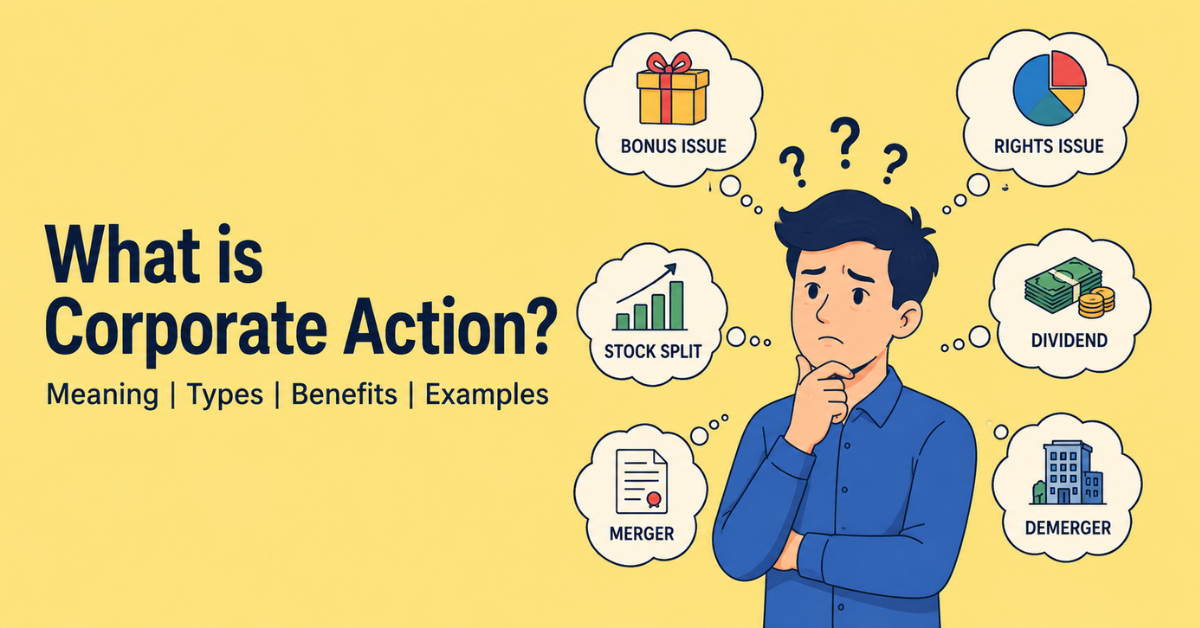
In the stock market, publicly listed companies are traded, i.e., they are bought or sold. These companies make financial decisions regarding their business and shares; this is called corporate action. It is influenced by a variety of events and decisions that directly affect companies and their shareholders. Understanding the different types of corporate actions gives you a clear knowledge of the ethical business conduct and financial health of the company.
In today`s article, we will cover everything about corporate actions, like what it is and how it impacts share prices or shareholders.
What Are Corporate Actions?
Corporate action refers to any activity undertaken by a public company that brings about some material changes in the company and impacts on its share prices, shareholders (both equity and preferred shares), as well as its bondholders. Corporate action is action taken by the board of directors and, in certain events, also authorized by shareholders.
In simple terms, a corporate action is an event that initiates a process that has a direct impact on the securities issued by that company. Corporate actions include changing the company’s name/brand, mergers and acquisitions, spinoffs, splits, bonuses, rights issues, liquidations, or dividend issues.
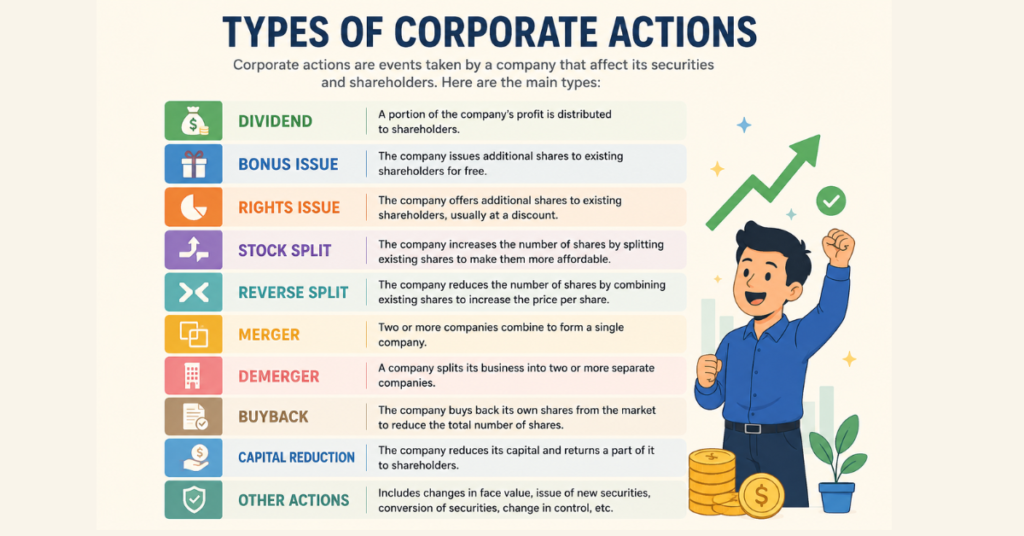
Some Important Corporate Actions :
There are various corporate actions that are initiated by the company. Let`s learn about some of the important corporate actions, among them:
1. Dividends
Dividends are a portion of a company’s profits that is distributed among its eligible shareholders according to their ownership/stake in the company. Dividends are paid on a per-share basis. Companies issue dividends in two forms: in cash or in the form of stock. Dividends are usually distributed on a quarterly or annual basis.
When a company issues a cash dividend, every shareholder receives the same amount per share he/she owns. For example, suppose a shareholder has 1000 shares of a company, namely UWC Ltd., and the company declares a cash dividend of Rs 20 per share, then the shareholders receive Rs 20,000 as a dividend. Cash dividend is an indication that the company has a strong financial position and a good level of retained earnings.
When the board of directors of a company announces a dividend, many investors start buying the company’s shares before its ex-dividend date so that they too can get the dividend. Due to more buying orders, the price of the company’s shares starts rising. And when the company pays the dividend, everyone starts selling their shares, and the company’s shares fall again.
Dividends are not paid only from profits. If a company has incurred losses during the financial year but has sufficient cash reserves, it can still pay dividends from its cash reserves.
2. The Stocks Split :
Stock splits are also a common corporate action that has an impact on companies’ share prices. When a company splits its stock, the number of outstanding shares increases by a specified multiplier, and the company’s face value per share decreases proportionately. But the company’s market capitalization does not change after the stock split.
Stock splits are done because they reduce the price of a company’s shares by a certain multiple, making it easier for many investors to purchase them at lower prices.
For example, suppose there is a company named ABC Limited whose share price is Rs 100 and the company has 1 crore outstanding shares, according to this the market cap of the company is Rs 1000 crore.
Now, if the company does a stock split of 1:2, then the price of the company’s shares will become 50, and the total number of shares will become 2 crore, but there will be no change in the market cap.
3. Bonus Issue :
A bonus issue is like a stock dividend that a company allocates to its shareholders as a reward. In simple words, bonus shares are free shares issued by the company to its shareholders, which are issued out of the retained earnings of the company. Shareholders get these free shares (bonus) as per their current holdings of shares in the company.
The latest traded price of the company UWC Ltd is Rs 200. An investor, Ram, has 100 shares of UWC Ltd. It means the value of his investment before the bonus issue was Rs 20,000. But after the bonus issue, the share price of the company becomes Rs 100, and the number of shares held by Ram doubles, which means he has 200 shares. But the value of his investment remains unchanged.
Companies issue bonus shares to encourage retail participation, especially when the company’s per-share price is very high, and it becomes difficult for new investors to buy in. Issuing bonus shares increases the number of shares outstanding, but the share price decreases as a result of the bonus issuance, as shown in the example above.
4. The Rights Issue :
Companies raise funds through rights issues. A rights issue is just like another IPO. In this, the company offers new or additional shares to its existing shareholders at a discounted price; however, before getting publicly listed, it gives its existing shareholders the first opportunity to buy or acquire these shares. The shareholders can subscribe to the rights issue in proportion to their shareholding.
For example, a 1:4 rights issue means that for every four shares held, the shareholder can buy one additional share. Under a rights issue, new shares will be issued at a price lower than the prevailing market price. For example, if a stock is trading at Rs 500 per share, the rights issue may be at a 20% discount, i.e., Rs 400 per share.
5. Merger And Acquisitions :
A merger takes place when two or more companies combine, and their officials agree on all the terms and conditions for combining the companies, or one company acquires another company. This is called a merger.
Shareholders can interpret a merger in two ways: either as a strategic move for business expansion, or as a sign that the industry is consolidating, forcing the company to absorb competitors to maintain long-term growth amid declining competition.
According to the Harvard Business Review. “Why are companies using mergers and acquisitions not just to grow, but to transform themselves?”
An acquisition involves a situation in which one company purchases a majority stake in another company without any merger. This process may be friendly or hostile. Friendly acquisitions are negotiated and accepted by both parties, while hostile ones occur without the consent of the target company’s board.
In contrast, an acquisition involves one company buying out another target company. The acquirer retains its identity while absorbing the operations of the acquired company.
6. Buyback Of Shares :
Buyback of shares means that a company buys its shares from other investors in the market. Buyback of shares reduces the number of shares outstanding in the stock market and thus increases earnings per share (EPS).
Companies usually buy back their shares from investors because they want to prevent other companies from taking over, they want to show the promoters’ confidence in their company, and they want to prevent the share price from falling in the markets.
When a company announces a share buyback, it may signal to the market that the company feels its shares are undervalued and may enhance shareholder value. However, these must be analysed carefully because excessive use of buybacks can hide fundamental weaknesses.
The Conclusion :
Corporate action is an internal decision of a company that is taken by the company’s board of directors. This is a significant event that causes material changes in the company, so every investor must be aware of these corporate actions to analyse the effects of these actions on their investments and the value of the company.
Some corporate actions provide or come with monetary benefits, such as dividends or share repurchases, while other corporate actions provide long-term value, such as rights issues or mergers and acquisitions. Investors who understand record dates, ex-dates, the company’s financial objective behind the action, and its effects on the share price are in a better position to make informed decisions about their investments.
Corporate actions are like windows to the future direction of the company. These actions create a potential opportunity for investors to increase their level of wealth. That is why, as an investor, you should always keep checking your markets or the company’s financial decisions and gather their information to analyse all actions from the company’s future perspective. Who knows, you may find your multi-bagger here.
Frequently Asked Questions
Are corporate actions taxable in India?
Yes, different types of Corporate actions have different tax slabs :
Dividends are taxable in the hands of investors. Buybacks are taxed under Section 115QA (tax paid by the company).
Capital gains tax may apply if shares are sold during rights issues, tender offers, or post-merger adjustments.
Do corporate actions affect share prices?
Yes, corporate actions affect the company’s share prices. It affects share prices both negatively and positively, depending on the actions. A good action against investors can have a positive effect on share prices. A bad corporate action affects the company and its shareholders negatively.
What should investors do when a corporate action is announced?
When companies announce dividends, here are the things every investor should do:
First, investors should read the companies’ official announcements on theirwebsites.
Then you should check every important detail related to the activities and dates, such as expiry dates, record dates, and payment dates.
Understand the economic trends, financial market, and tax implications on the stock market. Next, keep an eye on stock prices and their trends.
Then you can decide where you want to participate in the market, as per your knowledge or risk profiling.

My name is Prabhat Mehta, and I’m from Jharkhand, India. I’m a CFA Level 1 candidate and currently pursuing a Bachelor of Commerce (B.Com) with a specific academic focus on financial analysis, corporate finance, and investment fundamentals.
I have a passion for studying and analysing financial markets, company valuation, and fundamental analysis. I feel immense joy and energy whenever I engage in these activities. I write articles to explain complex financial concepts simply and clearly, providing practical explanations to help investors avoid common mistakes and make better financial decisions.
Most retail investors struggle not because of a lack of funds, but because of a lack of clear financial understanding—they don’t know what investing is, how to get started, or how to select undervalued stocks with good growth potential. My work is to focus on solving those problems.
Investing isn’t just about investing in a single asset. I believe investing should be logical, disciplined, and knowledge-driven rather than emotional. Through continuous learning and real-world analysis, my aim is to foster sound financial thinking and share information that truly helps investors grow with confidence over time.