

If you’re new to the financial world and want to invest in the stock market, this blog is for you. We’ll discuss how to start investing in the stock market for beginners in India. While the Indian stock market is full of opportunities, choosing the right stocks can be a bit daunting for beginners.
In this blog, we will explain to you in simple language the basics of investing in the stock market in India – from terms like Sensex and Nifty to choosing your first stock. Whether you want to save or grow your savings, protect your savings from inflation, or build long-term wealth, here you’ll find simple and practical information for beginner investors.
What is the Stock Market and How Does It Work?
If you are new to the stock market and don’t know how to choose a healthy company for investing, then don’t worry – this guide will break it down in simple terms so you can start investing with proper information and with confidence.
What is the Stock Market?
The stock market is a place where we can buy and sell shares (a small portion of a company ) of public companies. Companies need capital to grow, and investors seek to grow their wealth. By buying shares in India, there are two major stock exchanges where we can buy and sell shares :
- Bombay Stock Exchange (BSE) – It was started in 1875. This is Asia`s oldest stock exchange. It is the world’s fastest stock exchange with speeds of 6 microseconds.
- National Stock Exchange (NSE) – It was started in 1992. This is India’s largest stock exchange by trading volume, and it is the 3rd biggest stock exchange in the whole world.
Companies list their shares on these platforms to raise capital, and here you will buy shares and become a shareholder (Owner) of that company. When the company performs well, the share price of that company will rise , and all investors will make a profit on their investment.

How does the stock market work?
- Companies list their shares (IPO): A company offers its shares to the public for the first time through an IPO (Initial Public Offering). Companies raise some funds from us by providing some of their shares to us. It is known as the primary market .
After listing, these shares are traded on stock exchanges on the BSE and NSE.
2. Buyers and sellers trade shares : After listing the company, Investors can buy and sell shares through brokers (such as Zerodha, Groww, Angel One, ICICI Direct). It is the secondary market .
Why Should You Invest in the Stock Market?
If you are new to investing, you may wonder- Why should I invest in the stock market?” The answer is simple: if you want to grow your wealth faster than traditional savings methods. Then you need to invest in the stock market. Let`s understand the main reason why investing in the stock market is one of the best investment options for our country .
- Beat Inflation & Growth of Your Wealth
- Inflation reduces the value of money over time. Bank FDs (CDs) and savings accounts offer 4-6% returns to us, while the inflation in India is around 6-7%.
- Historically, the Indian stock market (Sensex & Nifty) has given 12-15% annual returns over the long term, and it has always beaten the bank’s FD and savings account rates. They are helping your money grow faster than inflation.
The stock market historically beats inflation , FD rate, savings account rate, gold-silver return , real estate returns, or any other asset class in the long run .
2. Dividend Income :
When companies make profit`s they give some parts of their profits to their existing shareholder as their shares (ownership %) of the company. This is called dividend income .
3. Liquidity and flexibility:
In the stock market, you can buy and sell your shares within a working day, but in real estate , gold, silver, and any physical asset, you can`t liquidate in a day.
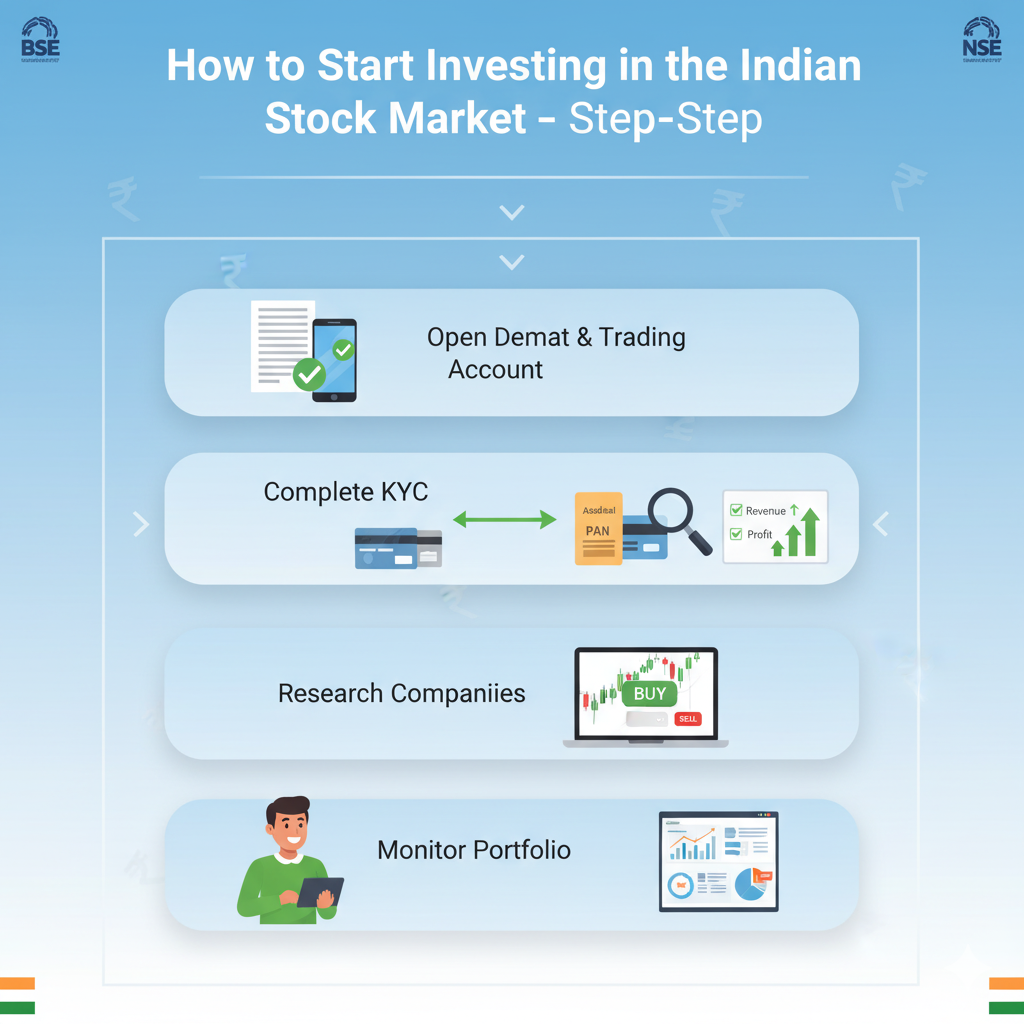
How to start stock market investing in India?
Step 1: Open a Demat & Trading Account
If you want to invest , you will need a Demat account (to hold shares electronically) and a Trading account (to execute buy/sell transactions). These can be opened through a registered (SEBI-registered) stockbroker like Groww, Zerodha, Upstox, or Angel One.
Step 2: Complete the KYC Process with your broker :
To activate your account, submit the essential documents, including:
- PAN Card
- Aadhaar Card
- Bank Account Details
- Income Proof (for derivative trading)
Step 3: Research and analysis of the good companies :
Start research on a good fundamental stock which have growth potential in the future .
- Fundamental Analysis: check financial statements, revenue growth, profitability, management efficiency, and what does company does.
- Technical Analysis: Utilize price charts, patterns, and indicators to assess potential price movements of the share of the company.
Step 4 : Buy a growth potential Company (share)
After opening a demat account and analysing the companies, you can start your investing journey by buying shares from your broker.
You can place the order ( market order, after-market order, limit order , stop-loss order, and bracket order) on your demat account.
Step 5 : Monitor and Optimize Your Portfolio
Then regularly track your investments, analyze market trends, read companies’ quarterly results, and analyze growth and rebalance your portfolio when it’s necessary.
Types of Investment in the Stock Market :
1 . Equity investment :
Directly owning the shares of a company is called equity share investment . It is directly connected with the growth of the company. Equity investments can be highly rewarding but come with inherent risks.
2 . Mutual fund investment :
Mutual funds are baskets of stocks. A mutual fund pools money from investors, which is professionally managed by a group of investors in a diversified portfolio. Mutual fund investment is the ideal investment for beginners
3. Exchange-Traded Funds (ETFs)
ETF is a type of investment fund that tracks indices like Nifty 50 , Nifty 100, Sensex, and many more. It holds a basket of assets—such as stocks, bonds, or commodities—and allows you to invest in multiple companies or sectors with a single purchase.
This is also the best investment option for beginners who want to invest in the stock market.
Basic Stock Market Terms Every Beginner Should Know :
Nifty 50 & Sensex : They are benchmark indices that represent the whole market performance .
Bull market : when prices of shares rise .
Bear market : when the prices of shares significantly slope.
Market capitalization: Total market capitalization of a company.
Dividend : profit share given to the shareholder by the company.
P/E Ratio : Price-to-Earnings ratio (helps to analyze if a stock is overvalued / undervalued)
Debt : When a company raises funds and pays interest on that amount, it is called debt .
Common Mistakes That Should Be Avoided As A Beginner:
Investing Without Research – Without any proper research, please don’t invest in the stock market . Investing in the market for speculation is going to be a bad investment. You can lose your hard-earned money.
Putting All Money in One Stock – Don’t put all your capital in one Stock. Diversify your portfolio with other asset classes. Putting all money in one stock is very risky.
Timing The Market – Don’t try to time the market; always focus on long-term investing .
Emotional Trading – Allowing fear or greed to drive investment decisions can lead to substantial losses.
Proven Investment Strategies For Beginners:
Long-term Wealth Creation – Always invest in fundamentally strong companies and hold them for years.
Mutual Fund (SIP) – Regularly invest in a mutual fund SIP to overcome market fluctuations.
Index Investing – Passive investing in index funds to achieve stable returns with minimal risk.
Dividend Investing – If you want to earn dividend income, then invest in those stocks that pay dividends more than others.
Value Investing – identify undervalued stocks with great financials and invest in them.
The Conclusion :
If you want to build massive wealth from the stock market, then always remember the stock market is not a -quick rich- scheme . The stock market is a journey that requires hard work, deep research , deep knowledge, patience, and discipline. It can help you achieve your financial goals and create long-term sustainable wealth from the market.
The stock market is not a “get-rich-quick” scheme or a gamble. You need to think big , start with small steps from today, and stay consistent, let compounding work its magic in your wealth building. Start investing from today.

My name is Prabhat Mehta, and I’m from Jharkhand, India. I’m a CFA Level 1 candidate and currently pursuing a Bachelor of Commerce (B.Com) with a specific academic focus on financial analysis, corporate finance, and investment fundamentals.
I have a passion for studying and analysing financial markets, company valuation, and fundamental analysis. I feel immense joy and energy whenever I engage in these activities. I write articles to explain complex financial concepts simply and clearly, providing practical explanations to help investors avoid common mistakes and make better financial decisions.
Most retail investors struggle not because of a lack of funds, but because of a lack of clear financial understanding—they don’t know what investing is, how to get started, or how to select undervalued stocks with good growth potential. My work is to focus on solving those problems.
Investing isn’t just about investing in a single asset. I believe investing should be logical, disciplined, and knowledge-driven rather than emotional. Through continuous learning and real-world analysis, my aim is to foster sound financial thinking and share information that truly helps investors grow with confidence over time.
Does your site have a contact page? I’m having trouble locating it but, I’d like to shoot you an email. I’ve got some suggestions for your blog you might be interested in hearing. Either way, great site and I look forward to seeing it improve over time.