
The stock market is exciting, and many novices get in with a big portfolio, and none of them can see it getting smaller.The stock market is very exciting, and many people start off with a big portfolio and never look back to see it get smaller. The issue is not so much intelligence as it is motivation or will. It’s just a lack of practice. Paper trading gets rid of that by allowing you to trade with fake money before putting your real money into it. The easiest place to learn to read charts, order types and strategies is a free paper trading app in India, as this allows you to learn without spending a paisa. In this guide you will learn the distinctions between paper trading and live trading as well as ways to move from paper trading to live trading in a responsible manner.
What Is Paper Trading and How Does It Works?
Simulated trading, also known as paper trading, is an example of paper trading. A virtual balance, say ₹10 lakh, is given to you and you buy and sell shares at live or slightly delayed market rates with the same.You are provided with a virtual balance (say ₹10 lakh) and use it for trading in shares at the current or slightly delayed market price. The receipts and payments of a real account are matched, but no real money is received or paid.
It originates from the times traders used to practice trading using paper. Today, apps can do the same thing in seconds, and have real-time charts, watchlists and performance reports.
Why Beginners Use Paper Trading
A simulator allows you to make mistakes without having to deal with the consequences. Understand how market, limit and stop-loss orders work, become familiar with the platform and test a strategy under various market conditions using a free paper trading app in India. Most important of all, you can find out what’s effective without putting your savings at risk.
Choosing a Free Paper Trading App in India
Not every simulator is equally useful. When you pick a free paper trading app in India, look for:
- Real-time or near real-time NSE and BSE data
- Support for equities, and ideally F&O and intraday trades
- Performance analytics and trade history
- A clean, beginner-friendly interface
- No hidden fees or forced account openings
Paper Trading vs. Real Trading: Core Differences
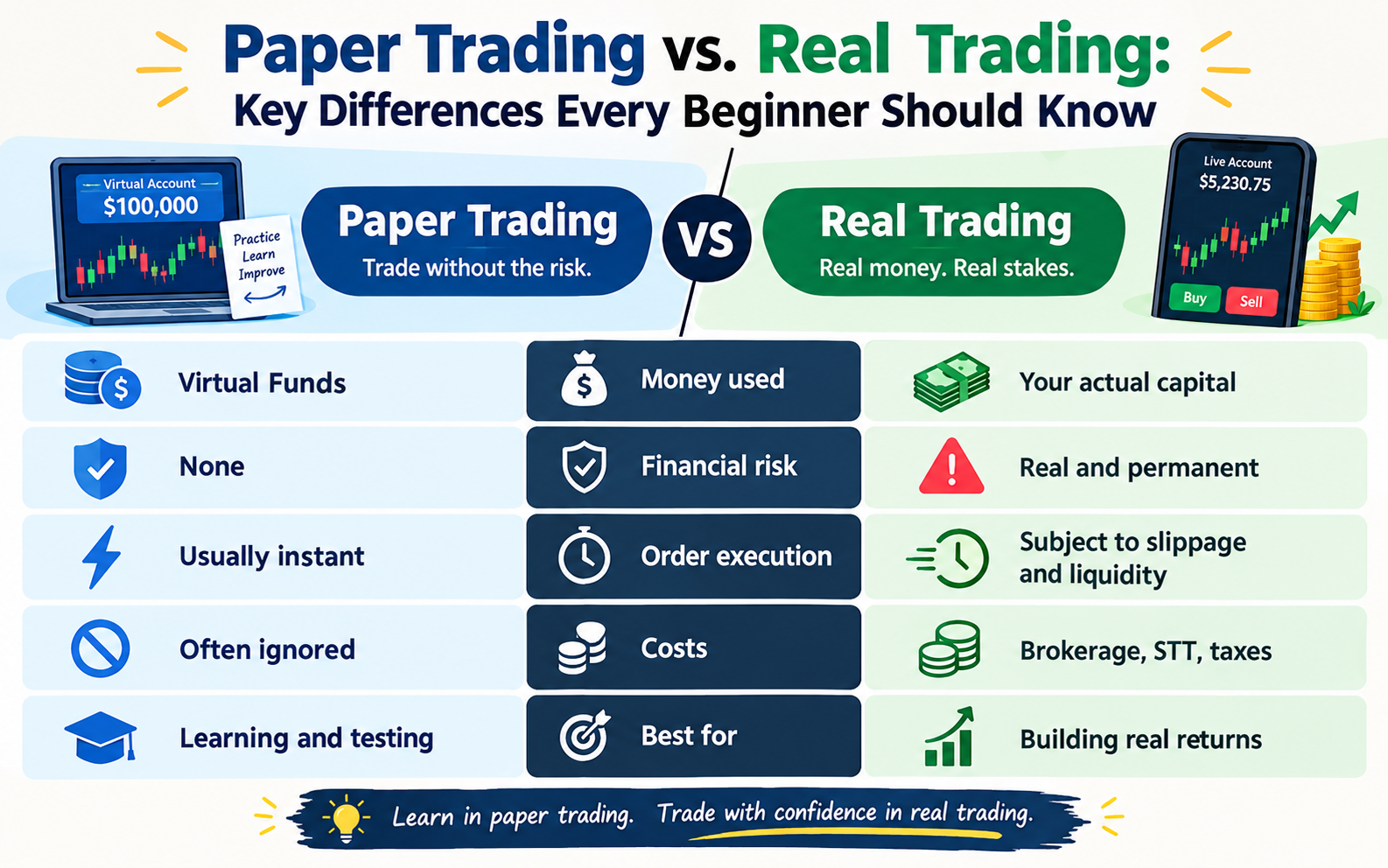
Both use the same charts and the same markets, yet the experience is very different. Here is a quick comparison.
| Feature | Paper Trading | Real Trading |
| Money used | Virtual Funds | Your actual capital |
| Financial risk | None | Real and permanent |
| Order execution | Usually instant | Subject to slippage and liquidity |
| Costs | Often ignored | Brokerage, STT, taxes |
| Best for | Learning and testing | Building real returns |
Financial Risk
The simplest distinction between paper trading and real money trading is that you can’t lose money in paper trading. In actual trading, each loss will cut down the capital and it cannot be recovered. Some of the costs of real trading that may not be covered in simulators are brokerage costs, Securities Transaction Tax (STT), exchange charges, and short-term/long-term capital gains tax. What seems to be a good business can become a mediocre one if these expenses are added.
Emotional Pressure
This is where newbies are thrown a curve ball. You remain composed when playing with virtual money. When the trade goes against you, your heart pounds when you play with real money. Fear makes you get out of profitable trades prematurely. When it comes to money, greed is what gets you to hang on too long. Many traders make hasty ‘revenge trades’ after losing a trade to make it up to them.
This pressure can’t be reproduced in paper trading, but you can get ready for it. Maintain a trading journal and record the reasons for entry/exit and emotions. Habits will become evident in a short period of time.
Order Execution and Market Reality
Orders typically execute immediately in a simulator at this price.Typically orders process at the current price in a simulator. It’s a dirty business when it comes to live markets. There’s a possibility of slippage which means that your order will execute slightly lower than what you put in. Large orders can be only partially filled and thinly traded stocks can have big bid/ask spreads.
The volatile moments, like the closing and opening of the market, results announcements or budget day, are particularly difficult to simulate. Paper performance results during these periods might be very different from what you can obtain live.
Limitations of Paper Trading Beginners Should Know
Paper trading can be a good teacher, but it’s no crystal ball.
- Overconfidence: It’s easy to think that the profit you make in the virtual world is easier than it really is.
- No real stakes: If there aren’t real stakes to be taken, then you can take risks that you wouldn’t take in real life.
- Positive outcomes: Excessive fills may be due to perfect outcomes and ignored expenses.
Paper trading is a way for you to get used to the process, but it is not a guarantee of profitability.
How to Transition from Paper Trading to Real Trading Responsibly
When relocating to live markets, it should be a step-by-step process and not a leap.
Set Readiness Criteria
It is important to have a strategy in writing with clear entry and exit rules, as well as risk rules, prior to activation. Try to practice this approach for two to three months, rather than a couple lucky weeks.
Start Small with Real Capital
Start with a sum of money that you can afford to lose. Play small size positions to learn without taking losses. The purpose of this is to get familiar with the feel of real money, not to make a lot of money.
Apply Strict Risk Management
Always use stop loss on all trades. At the start, many traders will choose to risk only about 1% to 2% of their capital per trade and it’s a good idea to stay away from leverage and complex derivatives in the early stages. If you keep your money safe, you’ll stay in the game long enough to get better.
Keep Learning and Reviewing
Read through your journal weekly. Check work against live work; identify any discrepancies. Don’t trade money on new strategies until you have had paper trading experience with them. Any good trader will never cease to practice.
Conclusion
Paper trading hones skill and real trading hones discipline. You need both. Start off with a free paper trading app in India to get to know the basics and test out your trading ideas, then gradually increase your investment amount and risk limitations. It’s OK to be patient at this point; you can save yourself a lot of years of expensive errors.
Not yet ready to practice if you don’t want to risk a rupee? Get a paper trading app for free and trade with virtual money of ₹10 Lakhs today in India.
Frequently Asked Questions
What is paper trading? Paper trading is practising buy and sell trades with virtual money in real market conditions.
Is paper trading really free in India? Yes, many platforms offer a free paper trading app in India with virtual funds and no charges.
How do I start paper trading as a beginner? Download a simulator, set your virtual capital, pick a strategy, and place practice trades while tracking results.
Is paper trading the same as real trading? No, paper trading lacks real financial risk, emotional pressure, and true order execution.
How long should I paper trade before using real money? Most beginners practise for two to three months, or until they follow their strategy consistently.
Can paper trading make me profitable in real markets? It builds skills and strategy, but profits depend on discipline and risk control once real money is involved.

My name is Prabhat Mehta, and I’m from Jharkhand, India. I’m a CFA Level 1 candidate and currently pursuing a Bachelor of Commerce (B.Com) with a specific academic focus on financial analysis, corporate finance, and investment fundamentals.
I have a passion for studying and analysing financial markets, company valuation, and fundamental analysis. I feel immense joy and energy whenever I engage in these activities. I write articles to explain complex financial concepts simply and clearly, providing practical explanations to help investors avoid common mistakes and make better financial decisions.
Most retail investors struggle not because of a lack of funds, but because of a lack of clear financial understanding—they don’t know what investing is, how to get started, or how to select undervalued stocks with good growth potential. My work is to focus on solving those problems.
Investing isn’t just about investing in a single asset. I believe investing should be logical, disciplined, and knowledge-driven rather than emotional. Through continuous learning and real-world analysis, my aim is to foster sound financial thinking and share information that truly helps investors grow with confidence over time.