
If you’re an investor or a finance student, you’ve likely heard headlines like “RBI warns of stagflationary risk,” or “Economists worry India could face stagflation,” and wondered what stagflation is and what it actually means.
Does stagflation mean India is heading for a recession? Is it worse than normal inflation? And why are economists suddenly using the term so frequently?
In this article, we’ll understand stagflation from the ground up—what it means, why it’s a uniquely painful combination for any economy, and why India’s current situation is being closely monitored for early signs of it.
What is Stagflation? Definition and Meaning
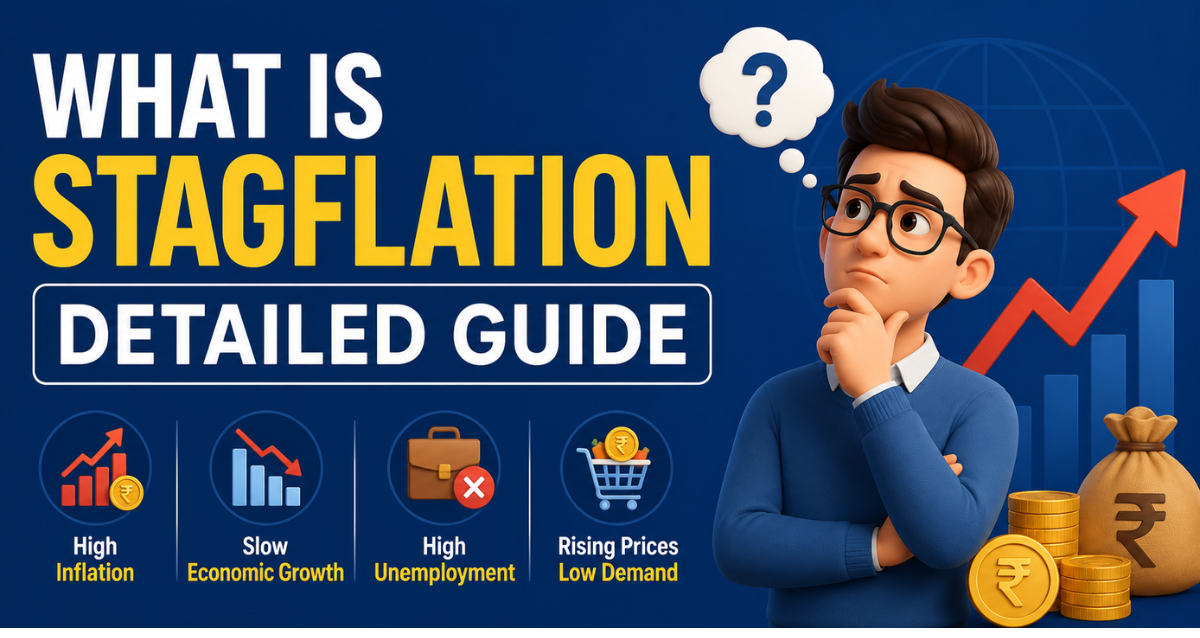
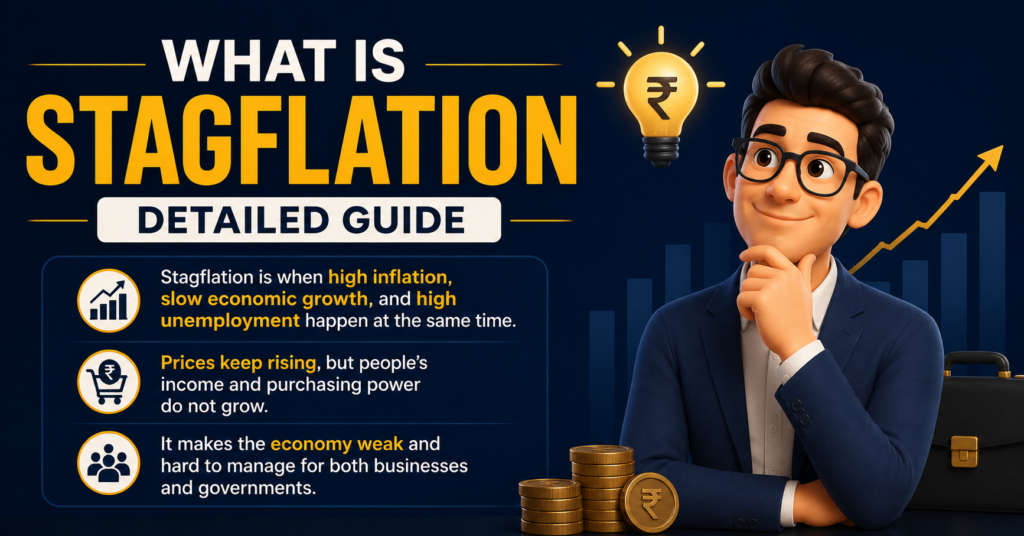
Stagflation is a term that describes an economic situation where a country experiences slow economic growth, high unemployment, and high inflation simultaneously.
Imagine a company whose revenue is falling every quarter—business is slowing down. Typically, when business slows, the cost of raw materials also decreases slightly because demand for those inputs, along with everything else, also decreases. Therefore, the company faces a sales problem, but it gets some relief in terms of costs. This is a typical recession—painful, but at least both sides are moving in the same direction.
Stagflation occurs when a company’s revenue is falling (growth is slowing), but its raw material costs continue to rise (inflation is rising)—meaning it is suffering from both sides at the same time. Sales are not increasing, and costs are not decreasing. This combination is what makes stagflation so strange and so difficult to fix.
(Slow growth + high inflation combined)
Normally, these two things don’t happen together. In a healthy, growing economy, demand is strong, which typically causes prices to rise slightly (normal inflation)—but growth itself remains healthy. In a slowdown or recession, demand falls, which typically causes prices to fall or remain low. Stagflation breaks this normal pattern—the economy is slowing, but prices continue to rise. Simple Way to Identify Stagflation Risk:
Why is Stagflation So Difficult to Deal With?
Here are some of the risks that make stagflation truly different from a normal slowdown or normal inflation, and why economists believe it is.
Normally, a central bank has two tools:
If growth is slowing, lower interest rates are used to encourage borrowing and spending. If inflation is too high, raise interest rates to reduce demand.
In stagflation, both problems occur simultaneously—so whichever direction the central bank takes worsens the other. Lowering rates to support growth will only exacerbate inflation. Raising rates to control inflation will further slow growth.
RBI Governor Sanjay Malhotra was in exactly this position during the June 2026 policy meeting. The RBI kept the repo rate unchanged at 5.25% for the second consecutive meeting, maintaining a “neutral” stance – essentially deciding to wait and watch rather than risk worsening any problems.
The Biggest Misconception About Stagflation
: Information like, Stagflation Means India Is Entering a Recession
This is where most investors directly jump to conclusions — and it’s important to separate the two.
A recession is when an economy actually shrinks — negative GDP growth. Stagflationary risk, as currently discussed for India, is not that. RBI’s own forecast is still a positive 6.6% growth for FY27 — cut down from 6.9%, but still comfortably positive and among the fastest growth rates for any large economy globally.
What “stagflationary risk” actually means here is that growth is decreasing while inflation is accelerating — a worsening combination, not a collapse. It’s a warning sign for economists and investors to watch closely; it is not a confirmed crisis.
For comparison, some global forecasters like Goldman Sachs have cut their India growth estimate even further, to 5.9%, showing that the international view carries slightly more caution than RBI’s own projection — but even that number remains solid growth by global standards, just not as strong as India was tracking earlier in the year. How Does This Affect an Investor?
When Stagflationary risk is rising:
If you invest in the Indian stock market, mutual funds, fixed income, or any other asset class, this combination changes the sectoral picture as follows:
• Rate-sensitive sectors like banking, real estate, and auto tend to underperform as the interest rate cuts that typically support them become less likely.
• Defensive sectors—FMCG, pharma, and utilities—often outperform comparatively because their demand is less tied to the economic cycle.
• Debt fund investors may see limited short-term rate cuts, which means existing high-yield instruments may remain attractive for longer than usual.
• Gold has historically performed well during global stagflationary periods because it acts as a hedge against both currency weakness and inflation.
• The picture for IT and export-facing services is mixed — a weak rupee helps their dollar earnings, but AI-driven disruption and soft global trade add different headwinds, as explained in our IT sector coverage.
Has India Faced Real Stagflation Before?
Yes — India faced real stagflation, and it’s worth knowing the history, because it shows what a genuine stagflation episode actually looks like compared to today’s “risk” discussion.
India experienced a serious stagflationary period in the early-to-mid 2010s, when GDP growth slowed sharply while retail inflation stayed stubbornly high, partly due to elevated global crude oil prices at the time and domestic supply constraints. That period saw growth fall well below its potential while inflation stayed in high single digits for an extended stretch — a much more severe combination than the “risk” being discussed in 2026, where inflation is still projected at 5.1%, not double digits, and growth remains well above 6%.
This historical contrast matters — it’s a reminder that current conditions are being watched as an early warning sign, not compared to India’s actual worst stagflation experience.
Why is India’s 2026 Situation Being Called Stagflationary Risk?
Oil prices rose above $90 per barrel following US strikes on Iran-linked targets and attacks on tankers in the Strait of Hormuz, raising tensions in West Asia. Since India imports over 80% of its crude oil needs, this directly increases India’s import bill and fuels inflation.
Weak Rupee: The rupee has weakened by approximately 6-7% against the dollar since the beginning of 2026, making all dollar-denominated imports—oil, electronics, and cooking oil—more expensive in rupee terms, further fueling inflation.
Foreign Capital Outflows: More than $13.7 billion has flown out of the Indian equity market since January 2026, reflecting waning investor confidence and exerting pressure on both the rupee and growth sentiment.
RBI Governor Malhotra specifically said that “rapidly rising energy prices and disruptions in global supply chains are hampering economic activity” – a sentence that captures both parts of the stagflation problem in a single statement.
The conclusion
To deeply understand what stagflation is, you need to understand how inflation, unemployment, and slow growth come together at once.
Stagflation is what happens when an economy’s biggest problems — slow growth, high inflation, and high employment rate— show up together, leaving a central bank with no easy lever to pull. foreign capital leaving Indian markets, and a downward growth revision alongside an upward inflation revision in the same RBI policy statement.
But being at risk of stagflation and being in a full-blown stagflationary crisis are very different things. India’s growth, even after the downward revision, remains among the strongest of any large economy in the world.
Frequently Asked Questions
Is India currently in stagflation?
No. India is not currently in stagflation. RBI’s own forecast still projects positive GDP growth of 6.6% for FY27, alongside an inflation forecast of 5.1%. What’s being discussed is stagflationary risk — a worsening combination of slowing growth and rising inflation — not an actual stagflation crisis, which would typically involve much weaker growth and significantly higher, more persistent inflation.
Frequently Asked Questions
What is stagflation?
Stagflation is a situation where prices keep rising, the economy grows slowly, and unemployment may increase at the same time. In simple terms, life becomes more expensive while jobs and business opportunities become harder to find.
What causes stagflation?
Stagflation can happen due to supply shocks, high energy prices, disrupted supply chains, excessive money supply growth, or policies that fail to control inflation while supporting economic growth. Often, several factors occur together.
How does stagflation affect everyday life?
People may notice higher grocery bills, fuel costs, rent, and utility expenses. At the same time, salary growth can slow down, job opportunities may become fewer, and families may find it harder to save money.
How is stagflation different from inflation?
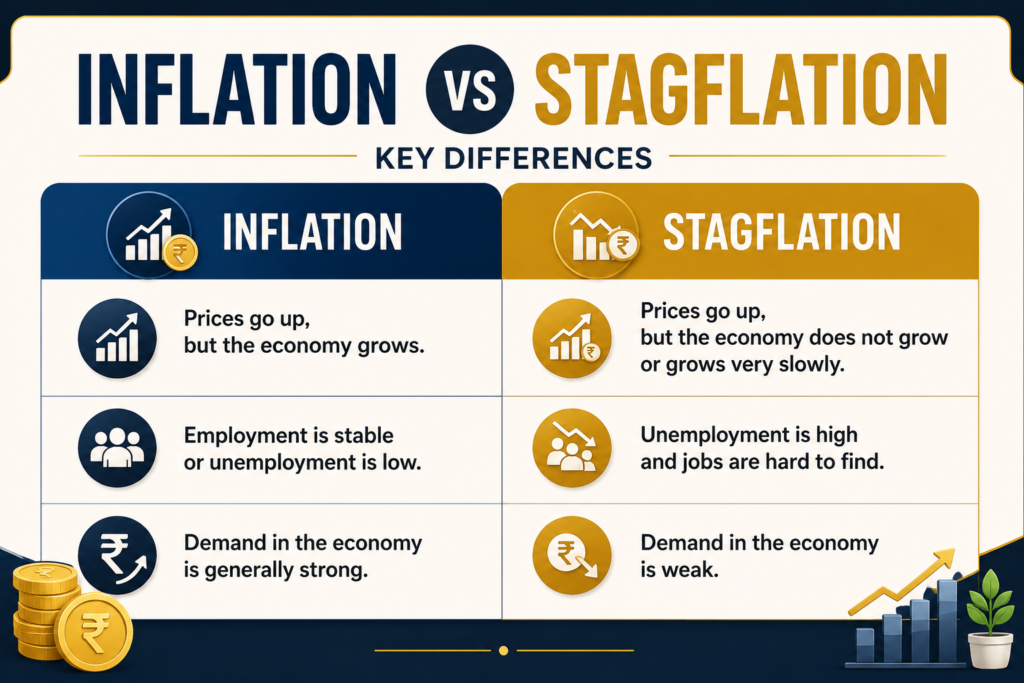
Inflation simply means prices are rising. Stagflation includes inflation plus slow economic growth and often higher unemployment, making it a much more challenging situation than inflation alone.
Which investments usually perform better during stagflation?
Historically, some investors look at assets such as gold, certain commodities, defensive stocks, and inflation-protected investments. However, no investment is guaranteed to perform well, and results can vary depending on the situation.
How does stagflation affect the stock market?
Many companies may face higher production costs and slower sales growth. This can reduce profits, which creates volatility in stock prices, although some sectors may perform better than others.
How does stagflation affect savings and fixed deposits?
If inflation rises faster than the interest earned on savings or fixed deposits, the purchasing power of your money can fall. This means your money may buy fewer goods and services over time.
What can governments do to fight stagflation?
Governments and central banks may try to control inflation, improve production and supply, encourage investment, and support employment. Balancing these goals is difficult because measures that reduce inflation can sometimes slow growth further.

My name is Prabhat Mehta, and I’m from Jharkhand, India. I’m a CFA Level 1 candidate and currently pursuing a Bachelor of Commerce (B.Com) with a specific academic focus on financial analysis, corporate finance, and investment fundamentals.
I have a passion for studying and analysing financial markets, company valuation, and fundamental analysis. I feel immense joy and energy whenever I engage in these activities. I write articles to explain complex financial concepts simply and clearly, providing practical explanations to help investors avoid common mistakes and make better financial decisions.
Most retail investors struggle not because of a lack of funds, but because of a lack of clear financial understanding—they don’t know what investing is, how to get started, or how to select undervalued stocks with good growth potential. My work is to focus on solving those problems.
Investing isn’t just about investing in a single asset. I believe investing should be logical, disciplined, and knowledge-driven rather than emotional. Through continuous learning and real-world analysis, my aim is to foster sound financial thinking and share information that truly helps investors grow with confidence over time.