
In this developing economy, where millions of people are opening Demat accounts and investing in the stock market for the first time, the sheer number of available asset classes makes it difficult for investors to make informed decisions. Investors, especially those who don’t understand the market and choose passive investing methods like mutual funds, SIPs, or ETF investing, often have concerns about whether ETF investing is safe in India.
“ETF” doesn’t automatically mean “safe”—it simply means the product is structured in a specific way. What’s inside it, and how actively it’s traded, matters just as much as the label itself.
Most investors who get into ETF investing believe that ETFs are low-cost, diversified, and simple, which is true. But somewhere along the line, the words “low-cost and diversified” become “safe” in people’s minds, and that’s where the real problems begin. So let’s actually answer the question—is an ETF a safe investment in India, and what does “safe” even mean?
First, What Are We Actually Asking? Is an ETF a Safe Investment in India?
As a student of finance, I’ve learned that there’s no single asset class in the world that can provide guaranteed, safe returns. There’s always risk. In fact, “safe” in investing isn’t a single thing. It usually refers to several concerns, such as whether I’ll lose my money entirely (default risk), whether there will be significant value fluctuations, and whether I’ll be able to withdraw my money if needed (liquidity). An ETF provides different answers to these three questions, and therefore, a simple “yes” or “no” answer misses the point.
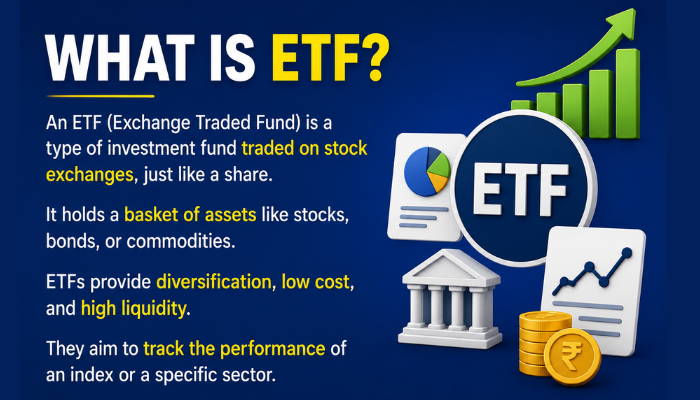
In simple terms, an ETF is a basket of assets such as stocks, gold, bonds, or other assets that trade on a stock exchange like the NSE or BSE, just like a common stock. Because it holds multiple assets instead of just one company’s stock, it spreads the risk across them. This is what we call diversification. But diversification protects you from a specific type of risk: the risk of a single company going bust, taking your money with it. It does almost nothing to protect you from the market crashing, or your chosen sector performing poorly, or from holding units that no one wants to buy from you at the right price.
Let’s understand The Risk Nobody Warns You About:
Liquidity
Liquidity refers to how easily you can buy or sell something without affecting its price. Simply put, liquidity is whether an investor can buy or sell a security at a defined price without any price impact.
Large, popular ETFs, such as the Nippon India ETF or the Nifty 50 ETF, trade with high volumes every day. You can buy or sell large quantities almost instantly, at a price that’s very close to their true value. But move beyond large, popular ETFs, and things change rapidly.
Smaller or newly launched ETFs—a niche sector fund, a thematic ETF built around a trending idea, or an international ETF that tracks a less-followed index—often have lower trading volumes. This increases the gap between what buyers are willing to pay and what sellers are willing to buy (called the bid-ask spread). You may place a sell order and find that the best available price is significantly lower than the ETF’s actual NAV, simply because there aren’t many active traders on the other side at that time.
During sharp market declines, this liquidity risk worsens, not improves, precisely when you’d most like to exit cleanly. A highly illiquid ETF may trade at a significant discount to its NAV during stressful periods, meaning you sell the underlying assets for less than their actual value—a hidden cost that’s never reflected on any expense ratio sheet.
Therefore, before investing in any asset, thoroughly analyze its terms, liquidity, and only then make any investment decisions.
Market Risk
All of the investors have already learned this risk from someone or because of something. An equity ETF tracking the Nifty 50 will also fall when the Nifty 50 falls. There’s no single stock or “ETF” that insulates you from a genuine market downturn. The whole point of an index ETF is that it moves with the market, both up and down in a similar way.
What surprises people is how this interacts with sector ETFs specifically. A broad Nifty 50 ETF spreads your risk across banking, IT, energy, FMCG, pharma, and more. If one sector has a bad year, others can offset it. But a sectoral ETF like A PSU bank ETF or an IT sector ETF doesn’t have that type of diversification benefit to pass on to your portfolio. If that one sector goes through a rough patch, regulatory changes, a global slowdown hitting IT exports, asset quality worries hitting PSU banks, your entire investment feels it directly, with none of the diversification benefit you were counting on when you heard the word “ETF” and assumed safety.
This is genuinely one of the most common mistakes I see: someone hears “ETF,” and they mentally file it under “safe, diversified investment,” then go and buy a single-sector or thematic ETF, thinking that it is safe; that’s really a concentrated bet dressed up in ETF packaging.
Tracking Error: The Quiet Gap Between Promise and Delivery
An ETF promises to track its index. It rarely tracks it perfectly, and this gap is called tracking error. Leading Nifty 50 ETFs in India typically keep this gap within 0.10% to 0.50%, which is so small that it’s barely significant for most investors. But it’s not zero, and it comes from a few important sources: the ETF maintains a small cash buffer to handle redemptions, there’s a lag when the fund rebalances its portfolio based on changes in the index, and the expense ratio also quietly decreases along the way, meaning the ETF will almost always return slightly less than the index it’s tracking.
For a large, well-run Nifty ETF, this is a rounding error that you can mostly ignore. For smaller or less well-managed ETFs, tracking error can be quite large, and it increases over the years you hold your investment—a small annual gap becomes quite large over a decade.
Premium and Discount: When the Price on Your Screen Lies a Little
This is something that confuses even long-term investors. The price you see fluctuating throughout the day on your trading app is the market price, set by market participants who are buying and selling on the exchange at that time. This price is not the same as the NAV, which is the fund’s actual calculated value based on its underlying holdings, published once at the end of the day.
Most of the time, due to a mechanism in which large institutional players called Authorized Participants constantly buy and sell to correct any mismatches, the market price remains very close to the NAV. But “very close” doesn’t mean “always the same.” During times of high volatility, low liquidity, or unusual market stress, an ETF may trade at a premium (above its true value) or a discount (below), and an investor who does not check this before placing an order may end up paying more than the ETF’s true value, or selling for less.
Problem with Gold ETF: A Real, Specific Problem
Because of the gold rally, gold ETFs have become so popular in India—and rightly so, given how important gold is to Indian household savings—it’s worth clearing up a bit of confusion I see frequently. People assume that gold ETFs and sovereign gold bonds (SGBs) are essentially interchangeable ways to gain “safe gold exposure.” But in reality, they’re not the same thing, and the distinction matters in terms of what “safe” means in each case.
A gold ETF tracks the market price of gold and can be bought or sold at any time during trading hours. However, as an ETF, it also has a typical expense ratio, and any capital gains are taxed under the regular rules for such instruments. An SGB, issued by the government, pays a small fixed annual interest based on gold price appreciation, and already offers some tax benefits if held to maturity—but it locks up your money for a very long time and doesn’t provide instant liquidity like an ETF.
Neither is “safer” than the other. They are different and address different problems, and choosing one should depend on your time horizon and whether you prioritize liquidity or the extra returns offered by holding SGBs for a longer period of time.
So is an ETF actually a safe investment in India, or not?
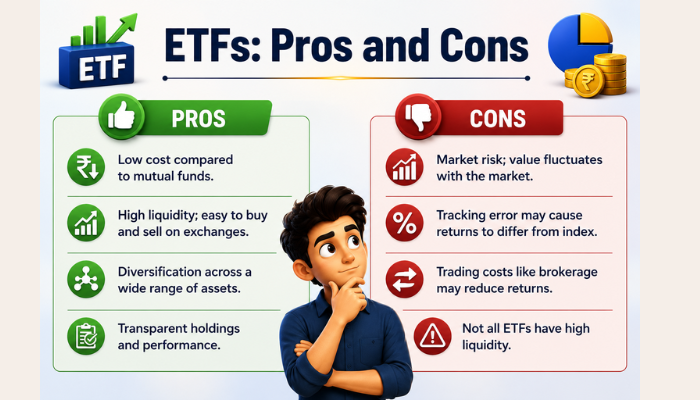
ETFs are a safer way to gain exposure to a market or asset class than picking individual stocks yourself, as they eliminate single-company risk through diversification across different assets. But simply reducing diversification risk doesn’t make it a safe investment in the sense of being low-risk or guaranteed. There’s still overall market risk, plus other risks specific to the ETF’s structure—liquidity risk, tracking error, and premium/discount risk.
Compare this to what people actually mean when they say “safe” in the Indian context, such as bank fixed deposits or government bonds, where the principal value isn’t at risk of falling (though inflation can quietly erode their real value). A broad-market equity ETF can lose 20-30% of its value in a bad year, just as the underlying stock market can. This isn’t a drawback to ETFs—it’s simply the essence of equity market exposure, and no matter how much diversification within a single asset class, this fundamental point remains unchanged.
Some Real Misconception at the Center of All This
“Diversified” and “Safe” are the same: This isn’t true.
This is the root of almost every disappointment I’ve encountered with ETFs. Diversification mitigates a specific type of risk—the risk that a single bad company decision could wipe out your entire investment. ETFs do nothing to protect you from major market downturns, economic crises, sector-specific problems, or the structural flaws of ETF trading described above.
The Nifty 50 ETF is truly one of the more sensible, low-dramatic ways to invest in Indian equities over the long term. A theme-driven ETF that simply follows whatever sector is trending in the financial news this month is a completely different thing, even if both carry the same “ETF” label. Believing them to be equally safe just because they have a similar product structure is the very mistake that causes people to lose money.
What this means for you as an investor
If you’re really trying to figure out where ETFs fit into your own money, here’s what really matters, based on everything mentioned above.
If ease and safety are your priority in equities, choose an ETF with high volume. A Nifty 50 or Sensex ETF from a large, well-known AMC with high daily trading volume is about as “boring and reliable” as equity investing can get, which is usually a compliment in investing.
Before buying any ETF, always check trading volume, especially any sector-specific, thematic, or newly launched ETF. If you can’t easily find recent daily volume data, that’s a warning sign about liquidity. Liquidity is a major problem; don’t ignore it as if it’s nothing.
Before placing a large order, especially with less popular ETFs, compare the live market price to the iNAV to avoid inadvertently paying a premium.
Understand what you’re actually diversifying for. A broad-market ETF diversifies you across sectors. A sector ETF diversifies you across companies within a single sector but focuses on that sector’s fortunes. Know which ones you’re holding and position accordingly.
Don’t confuse “lower cost than a mutual fund” with “lower risk than a mutual fund.” An index ETF and its equivalent index mutual fund have essentially the same market risk—the ETF simply costs less to hold and trades differently. While the cost advantage over time is real and relevant, it’s distinct from the inherent risk of the assets.
The Conclusion
ETFs don’t have a credit rating like companies do, so investors can make informed decisions accordingly. While an ETF isn’t necessarily unsafe, it’s also not inherently safe. It’s a structure, not a risk level. Whether a particular ETF is a sound, low-drama investment or a hidden, concentrated bet depends entirely on its contents, its liquidity, its expenses, who holds it, and many other such risks.
The real skill isn’t figuring out whether “ETFs” as a category are safe. It’s learning to look beyond the labels to see what’s actually in the basket, how easily you can move in and out, and whether the risk you’re taking matches what you’re actually signing up for.
Disclaimer: This article is for educational purposes only and is not financial or investment advice. Always consult a qualified financial advisor before making investment decisions.
Frequently Asked Questions
Can I lose all my money in an ETF?
It’s extremely unlikely for a broad market ETF like a Nifty 50 ETF to go to zero, since that would require every single company in the underlying index to become worthless at the same time. However, the value can still fall significantly during a market downturn, and sector-specific or thematic ETFs carry more concentrated risk than broad market ones, since they depend on the fortunes of a narrower set of companies.
Are gold ETFs safer than equity ETFs in India?
Gold ETFs generally see lower volatility than equity ETFs over most periods, and gold has historically acted as a hedge during stock market downturns. However, gold prices can still be volatile in their own right, and gold ETFs carry their own liquidity and tracking error considerations, so “safer” should be understood as relatively lower volatility, not risk-free.
What is the biggest risk with ETFs that most investors overlook?
Liquidity risk is the most commonly overlooked risk. Many investors assume all ETFs trade as smoothly as large, popular ones like Nifty BeES, but smaller or niche ETFs can have thin trading volumes, leading to wider bid-ask spreads and prices that can drift further from their actual NAV, especially during market stress.
Should a beginner invest in ETFs in India?
Broad, high-volume, index-tracking ETFs from established fund houses are generally considered reasonable starting points for beginners due to their diversification, low cost, and transparency. Beginners should be more cautious with sector-specific, thematic, or newly launched ETFs, which carry more concentrated risk and often lower liquidity, until they better understand what they’re holding.

My name is Prabhat Mehta, and I’m from Jharkhand, India. I’m a CFA Level 1 candidate and currently pursuing a Bachelor of Commerce (B.Com) with a specific academic focus on financial analysis, corporate finance, and investment fundamentals.
I have a passion for studying and analysing financial markets, company valuation, and fundamental analysis. I feel immense joy and energy whenever I engage in these activities. I write articles to explain complex financial concepts simply and clearly, providing practical explanations to help investors avoid common mistakes and make better financial decisions.
Most retail investors struggle not because of a lack of funds, but because of a lack of clear financial understanding—they don’t know what investing is, how to get started, or how to select undervalued stocks with good growth potential. My work is to focus on solving those problems.
Investing isn’t just about investing in a single asset. I believe investing should be logical, disciplined, and knowledge-driven rather than emotional. Through continuous learning and real-world analysis, my aim is to foster sound financial thinking and share information that truly helps investors grow with confidence over time.