
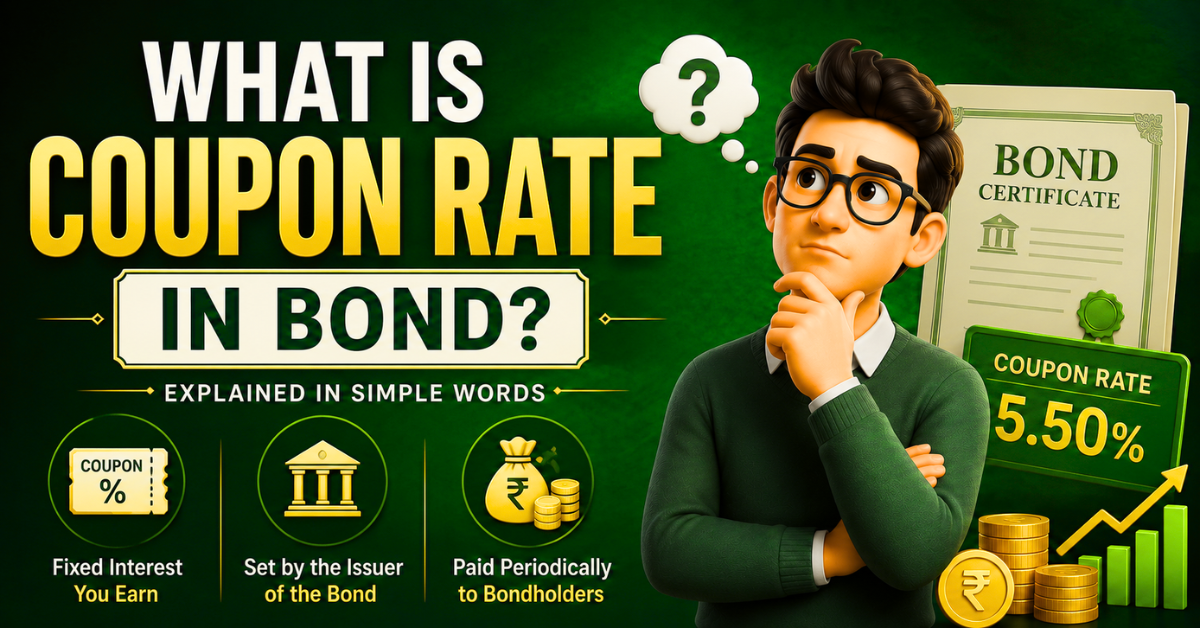
In the world of investing and finance, most of the investors hear about bonds. During the analysis of bonds, all the investors come to a thing just like “7.8% coupon rate” somewhere. And they got confused about this, like, ” What is that? and how does it work?
No, it is not the discount. Actually, it’s the opposite. Instead of getting a discount, you’re getting paid interest — money that goes into your bank account every year, like clockwork.
In this article, we will understand exactly what a coupon rate is, how it works, and how to use it to pick the right bond. No confusing jargon. Just simple math and examples.
Understanding coupon rate, what does this mean?
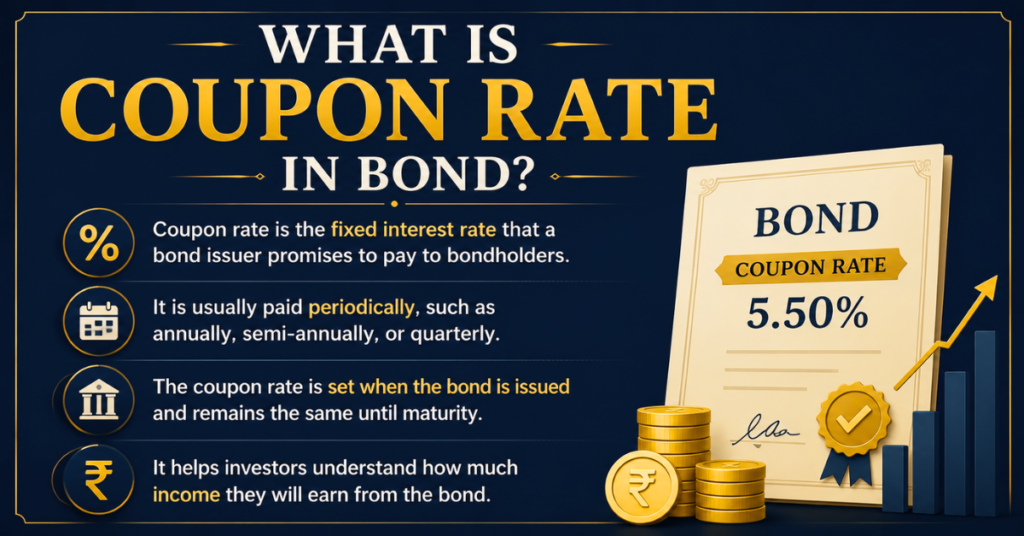
Bond investing means an investor allocate thier capiotal on other businesses or governments in the excahnge of fixed interest rate for a certain time. Coupon rate is the interest rate mentioned on the contract note. Companies pay the interest on time. And this interest payment is known as the coupon rate.
Like: You lend Rs. 1,000 to your friend. He says, “I’ll give you 10% interest every year for 5 years. After that, I’ll return your Rs. 1,000.”
That 10% he promised, that’s what a coupon rate is.
Coupon Rate = The percentage of interest you earn every year on your bond investment.
That’s it. So simple, coupon rate = interest rate
Why is it called “coupon”? Because long ago, bonds came as physical paper certificates. At the bottom, there were small coupons printed. When interest was due, you’d tear off a coupon and take it to the bank to get your money. Today, everything is digital, but the name stuck around.
How coupon Works?
Let’s understand the coupon rate with some wide examples.
Let’s say you invest Rs. 1,00,000 in an NHPC bond:
• Amount you invest: Rs. 1,00,000
• Coupon rate: 8% per year
• How long you hold it: 10 years
What does 8% coupon mean?
In simple terms: 8% of Rs. 1,00,000 = Rs. 8,000per year.
So every year for 10 years, IRFC will send Rs. 8000 directly to your bank account. Nothing more, nothing less. yes coupn payment depends on the basis that the company decided in the contract note, it can be annually. semiannually. or quarterly.
Year 1: You get Rs. 8000. Year 2: You get Rs. 8000. Year 3: You get Rs. 8000 …and so on, for all 10 years.
After Year 10, you also get your original Rs. 1,00,000 back.
Total earned = Rs. 8000 × 10 = Rs. 80000 in interest, plus Rs. 1,00,000 principal back = Rs. 1,80,000 total.
That’s how the coupon rate works. You earn interest every single year till you have invested.
Face Value vs Coupon Rate Differences (Common Confusion)
Many investors confuse these two terms, thinking they’re the same thing. Let me clarify this once and for all.
Face Value = Face value is the amount you invest in the company today (the original loan amount). Example: Rs. 100,000
Coupon Rate = The interest percentage you earn each year. Example: 8%
Coupon Payment = The actual rupee amount you receive each year. Example: 8% of Rs. 100,000 = Rs. 8,000 each year.
Face value and coupon rate are completely different things. They are three distinct entities. Don’t mix them up.
Let’s see how a semi-annual bond pays interest.
Government Bond (G-Sec)
• Investment: Rs. 1,00,000
• Coupon rate: 6.8% per year
• Tenure: 10 years
• Payment: Semi-annual (twice a year—every 6 months)
Annual coupon: 6.8% of Rs. 1,00,000 = Rs. 6,800 per year
Semi-annual coupon: Rs. 6,800 ÷ 2 = Rs. 3,400 every 6 months
You get:
• January: Rs. 3,400
• July: Rs. 3,400
• Same pattern for 10 years
Total interest over 10 years: Rs. 6,800 × 10 = Rs. 68,000
Plus: Your Rs. 1,00,000 back at maturity.
Like many other types of coupon payments, interest is also distributed.
Understanding: Why Do Different Bonds Have Different Coupon Rates?
Not all bonds have the same coupon payment. Every company pays diiffernt interst lets discuss the reason behind them.
Risk (Safety)
Companirs pay interest according to their credit score, decided by CRISIL in India.
Safer bonds = Lower coupon rate Riskier bonds = Higher coupon rate
| Organization | Safety | Coupon Rate |
| Government of India | Very Safe | 6.5% – 7.0% |
| Railways/Power Companies | Safe | 7.5% – 8.0% |
| Large Companies | Medium Risk | 8.5% – 9.5% |
| Small Companies | High Risk | 12% – 15%+ |
The government is most trusted, so they offer less interest because, at worst, sovereign governments print the money and pay your investment. But a company can not print money, so A small company needs to offer higher interest to convince you to take the risk.
2: Timeframe: How Long (Tenure)
Longer bonds usually have higher coupon rates because you’re locking up your money for longer.
- 2-year bond: 6.5%
- 5-year bond: 7.0%
- 10-year bond: 7.8%
- 20-year bond: 8.5%
Reason 3: Market Interest Rates
When the RBI cuts rates, new bonds offer lower coupons. When the RBI raises rates, new bonds offer higher coupons. This is why investors watch RBI decisions closely.
Real Life Problems
Does the coupon rate change after you buy a bond?
Absolutely not. Once you buy a bond, the coupon rate remains fixed. If you buy at 8%, you get 8% for the entire term. Except for floating-rate bonds. Generally, bonds come with fixed interest payments; the bond coupon rate never changes.
Exception: Coupons for floating-rate bonds change every 6 months, but most Indian bonds are fixed-rate.
What happens if I buy a bond mid-year? Will I get the full coupon payment?
Let’s say a bond pays a coupon in January and you buy it in July (mid-year).
You’ll definitely get paid the following January, but there’s a catch: the person who holds the bond from January to July doesn’t receive the interest. So, when you buy the bond, you have to pay them the interest they’ve earned but haven’t received—called accrued interest. This is an automatic process; you don’t need to worry about it.
Is the coupon rate the same as the yield?
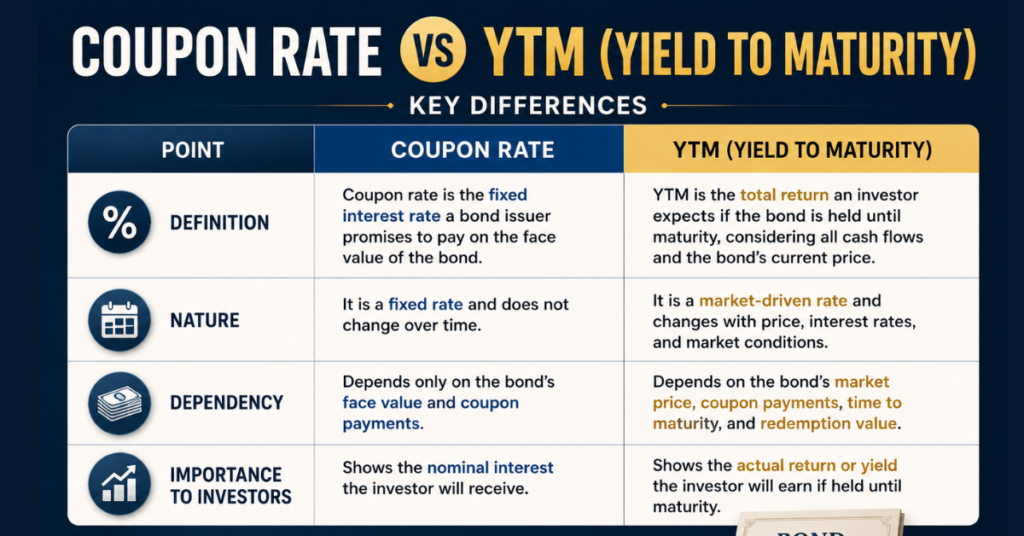
No. They cannot be the same because yield tells us the real total return earned every year. It also considers the amount you paid for each bond.
• Coupon Rate: The fixed interest % based on face value
• Yield: Your actual total return (changes based on the price you paid)
Example: You buy an 8% coupon bond for Rs. 900 instead of Rs. 1,000 (face value of the bond). Your coupon is still Rs. 80, but your yield is higher than 8% because you paid less.
What happens if the company defaults?
If the issuing company goes bankrupt, they may not be able to pay the coupon. That’s why credit ratings matter. Every company has a credit score, and even people have a credit score, which is based on their past performance. In India, CRISIL is the company that calculates credit scores for everything.
For companies, it looks like this:
• AAA: Almost zero default risk
• AA/A: Very low risk
• BBB: Fair risk
• Below BBB: High risk
Always check the rating before buying. Don’t chase high coupons without checking the safety.
What does a higher coupon rate tell us? Is a higher coupon rate always better?
A higher coupon rate sounds great to everyone, but should we base investment decisions on a higher coupon rate? Absolutely not, because companies with lower credit ratings typically pay higher interest rates because it’s a premium for credit risk.
No. A 12% coupon for a company on the verge of bankruptcy is worse than the government’s 7%.
Always check:
1. First, the credit rating
2. Then, compare coupon rates between similarly rated bonds
3. Consider taxes (some bonds are tax-free)
The Conclusion
As an investor, don’t just invest in bonds; diversify your portfolio across a variety of assets. When choosing bonds to invest in, don’t rely solely on one or a few pieces of information; conduct a high-level fundamental analysis. Use all your learning to choose the best bonds for your and your clients’ portfolios.
Frequently Asked Questions
I saw a bond with 15% coupon. Should I buy it?
First, check the credit rating. If it’s below A, that 15% is a danger signal. The company is risky and needs to pay high interest to attract buyers. Only invest if you can afford to lose this money.
How is a coupon paid if I buy a bond mid-year?
You’ll still get the full annual coupon when it’s due. The previous owner gets compensated for the interest they earned but won’t receive. Your broker handles this automatically.
What if interest rates fall after I buy my bond?
Good news for you. Your bond becomes more valuable because 8% is now better than what new bonds offer (say 6%). You can sell it at a profit if you want.
But if you hold till maturity, this doesn’t matter. You still get face value.
What happens if I sell my bond before maturity?
You get whatever the market price is at that time. Could be more or less than you paid, depending on interest rate changes. Only sell early if necessary. Hold till maturity for certainty.
Should I compare the bond coupon rate with the fixed deposit (FD) interest?
A: Not directly. Bonds are riskier than FDs (no DICGC insurance), so compare like with like:
Government bond (6.8% coupon) vs FD (7.0%) = Different risks
High-quality PSU bond (7.8%) vs FD (7.0%) = PSU bond is better, similar risk
Is buying bonds better than putting money in a savings account?
Absolutely. A savings account gives 3-4%. Even government bonds give 6.5-7%. Over 10 years, that difference compounds significantly.
Example:
Rs. 1 lakh in savings account for 10 years at 4% = Rs. 1.48 lakh
Rs. 1 lakh in bonds for 10 years at 7% = Rs. 1.97 lakh
Difference: Rs. 49,000 more with bonds
Can I buy bonds for my child?
Yes. Many parents invest in bonds for their children’s education or marriage. The returns are predictable and safe.
Your child can hold it in their name (you manage it as guardian).

My name is Prabhat Mehta, and I’m from Jharkhand, India. I’m a CFA Level 1 candidate and currently pursuing a Bachelor of Commerce (B.Com) with a specific academic focus on financial analysis, corporate finance, and investment fundamentals.
I have a passion for studying and analysing financial markets, company valuation, and fundamental analysis. I feel immense joy and energy whenever I engage in these activities. I write articles to explain complex financial concepts simply and clearly, providing practical explanations to help investors avoid common mistakes and make better financial decisions.
Most retail investors struggle not because of a lack of funds, but because of a lack of clear financial understanding—they don’t know what investing is, how to get started, or how to select undervalued stocks with good growth potential. My work is to focus on solving those problems.
Investing isn’t just about investing in a single asset. I believe investing should be logical, disciplined, and knowledge-driven rather than emotional. Through continuous learning and real-world analysis, my aim is to foster sound financial thinking and share information that truly helps investors grow with confidence over time.