
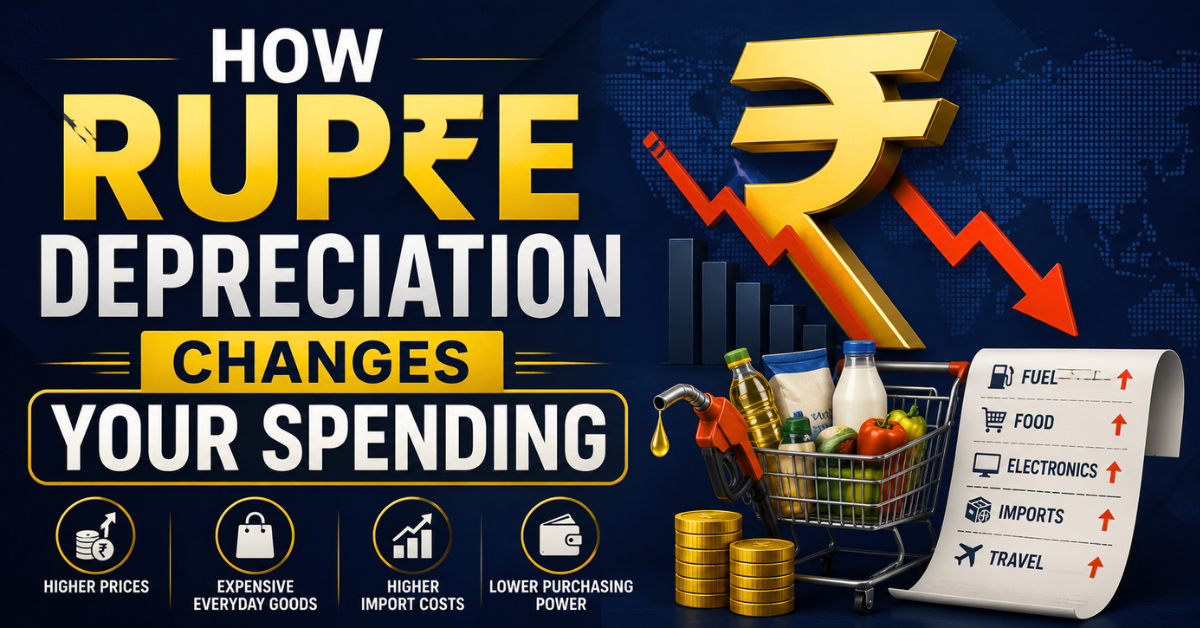
As an Indian citizen, you may know that the rupee is depreciating faster than other currencies. And there are large numbers of people who don’t even know what this is, how it can affect our lifestyle.
News like “rupee falls against dollar” does not feel personal. But the truth is, a weak rupee touches almost every rupee you spend, save, or plan to spend, often in ways you don’t immediately connect to the exchange rate.
If you have a child preparing for studies abroad and have been shocked by how much the tuition fee has jumped in rupee terms without the college changing anything, you have already felt the weak rupee.
As of July 2026, one US dollar is equal to ₹95, after briefly touching a record low of ₹ 96.6 in May. At the start of the year, in January 2026, the dollar was trading at around 90 rupees. That is close to a 6 to 7 percent fall in the rupee’s value in just six months.
In this article, we will walk through, step by step and with relatable examples, exactly how this plays out — from the fuel you buy, to your phone, your child’s education, your next vacation, your monthly grocery bill, and even your investments.
Understanding What Does “Weak Rupee” Mean?
Every currency has a value relative to other currencies, and the US dollar is the benchmark most of the world uses to price international trade, oil, gold, electronics, and much more. When the rupee is “weak” or has “depreciated against the dollar,” it simply means you need more rupees today to buy the same dollar than you needed before. Means you have to pay more rupees to buy a dollar.
I was also affected by the weak rupees. Actually, 1 year ago, in July 2025. I decided to do the CFA program at that time, the dollar INR rate was ₹85. And when I registered for the exam in April 2026, the rupee was weak against the dollar. At that time, the dollar inr rate was ₹ 93, so I registered at ₹93. Because of this, CFA became expensive for me by ₹10000, which I had to pay from my pocket.
Nothing about the product & service changed. What changed is how much your rupee is worth on the global stage. This is the entire problem in some sentence: your rupee buys less of the world than it used to.
Depreciating the rupee is a chain reation means if ruppee is started depreciating, then there is a high probability that the rupee (currency) depriciate more. It’s because governments, companies, FIIs, and people also do foreign businesses, so during payments, they need to sell the rupee and buy the dollar. Then, because of high demand, the dollar rises, and the rupee decreases, and then companies and institutions have to sell more rupees to buy a dollar. This process is always going on.
Why is this happening right now, in 2026 specifically?
Some reasons are behind it, and they are worth knowing because they are not going away soon:
• Crude oil prices have climbed past 76 dollars a barrel after tensions in West Asia escalated, following US strikes on Iran-linked targets and attacks on oil tankers in the Strait of Hormuz. India imports over 80 percent of its crude oil needs, so this hits directly.
• Foreign investors have been pulling money out of Indian markets. More than 13.7 billion dollars have left Indian equities since the start of 2026. When foreign investors sell Indian stocks and convert those rupees back to dollars to take home, it puts extra pressure on the rupee.
• The US Federal Reserve has kept interest rates high and is even hinting at further hikes, which makes the dollar more attractive globally, pulling money away from emerging markets like India.
• The RBI has been actively selling dollars through state-run banks to slow down the fall, and India’s forex reserves, at 682.3 billion dollars, give it the firepower to keep doing this. But firepower is not infinite, and RBI cannot fight the tide forever without cost.
None of these are things you or I control. But the ripple effects land squarely on our monthly budgets.
Fuel Prices — The First and Fastest Hit
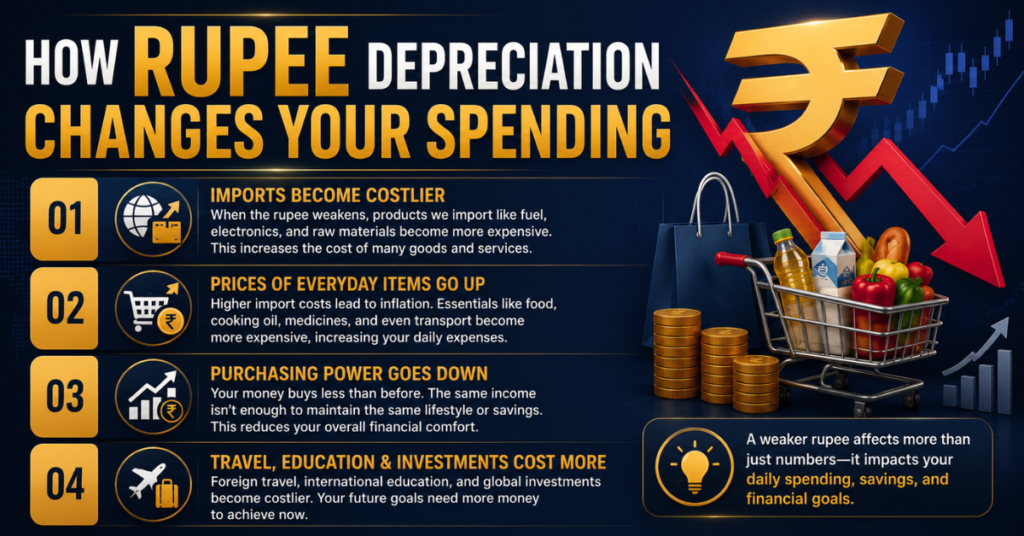
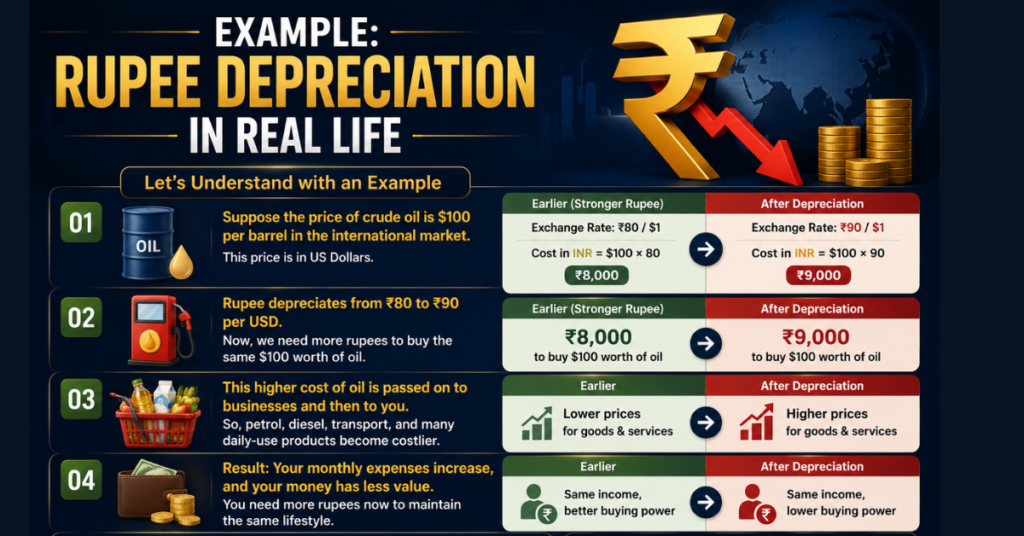
This is the direct observable thing, and everyone feels almost immediately because India buys crude oil in dollars. When the rupee weakens, the same barrel of oil costs more in rupee terms even if the dollar price of oil stays flat. Add to that the fact that crude itself has become more expensive due to the West Asia conflict, and you get a double hit — oil is pricier in dollars, and each of those dollars now costs more rupees.
Petrol and diesel prices at the pump reflect this cost. Every time you fill your bike or car, a part of what you’re paying is the rupee’s weakness working against you. And it doesn’t stop there. Diesel is the backbone of India’s transport and logistics network — trucks that carry vegetables or any goods from farms to your local market, delivery vans that bring your online orders, buses and rickshaws that take you to work. When diesel costs more, transport companies pass on that cost. It shows up later as a slightly higher price for tomatoes, a slightly higher delivery fee, and a slightly higher fare.
This is what economists call a “pass-through effect” — the cost doesn’t stay in one place, it travels through the entire supply chain and eventually lands in your grocery basket. means for the customer.
Your monthly grocery bill becomes more expensive.
Most vegetables and grains in India are grown domestically, so how does the rupee affect that? The connection is less obvious but very real, and it comes through three routes:
Fertilizers and farm inputs. India imports a large share of its fertilizers, especially phosphatic and potassic fertilizers, and also raw materials to manufacture urea. A weaker rupee makes these imports costlier. Farmers either absorb the cost (which hurts them and can reduce future yields as they cut back on inputs) or the cost eventually gets built into the price of produce.
When the rupee falls, cooking oil brands revise their MRPs upward within weeks, not months.
Pulses. India also imports a portion of its pulses, like tur dal and masoor dal, from countries like Myanmar, Canada, and Australia. Same story — costlier imports, costlier dal on your plate.
Recent inflation data backs this up directly.
In May 2026, food inflation in India jumped to 4.8 percent, the highest in 16 months. This jump has been directly linked to how the West Asia conflict has lifted both energy and fertilizer costs, both of which are deeply tied to import bills paid in weakening rupees.
Studying Abroad Suddenly Becomes more expensive then past.
If you or someone in your family is planning to study in the US, UK, Canada, or Australia, these are the countries where the weak rupee hits hardest and most visibly. Foreign tuition fees are almost always quoted and charged in the local currency of that country — dollars, pounds, or Australian dollars. When you convert rupees to pay that fee, a weaker rupee means you need to send more rupees for the same tuition amount. And we all know that the rupee depreciated further because of the reaction.
This is why many education loan advisors now tell families to factor in a currency buffer of at least 8 to 10 percent above the current fee estimate when planning finances for a multi-year foreign degree, because the exchange rate on the day you make the payment could be very different from the rate on the day you first calculated your budget.
It also affects students already studying abroad who depend on monthly remittances from home for living expenses. Parents sending 1,000 dollars a month for rent and expenses now need to send roughly 5,000 more rupees than they did six months ago for that same 1,000 dollars — money that has to come from somewhere in the family budget.
Electronic gadgets like Your Phone, Laptop Cost More Than the MRP suggests
Even if a smartphone, laptop, or any other machinery is “Made in India” or assembled here, there is a large share of its components — chips, displays, batteries, camera modules, and machines are imported, often priced in dollars. When the rupee weakens, the landed cost of these components rises for manufacturers. A sustained rupee slide of 6 to 7 percent over months is exactly the kind of move that triggers a price hike on the next product launch or price revision cycle.
This is the reason that imported goods and smartphone prices in India have generally trended upward year after year, even beyond what inflation alone would explain. The rupee’s gradual weakening against the dollar over the years is baked into that trend.
That International Vacation or travel just got more expensive
If a trip abroad is on your mind, a weak rupee hits you twice.
First, your actual spending money on hotel bookings, food, shopping, and cab rides. A trip that would have cost you 1.5 lakh rupees at the start of the year could now cost close to 1.6 lakh rupees for the same itinerary, purely because of the exchange rate shift.
Second, and less obvious, international flight tickets themselves are often priced with a dollar-linked component, because a large share of airline costs, such as jet fuel bought internationally, aircraft leasing, and maintenance parts, are dollar-denominated. which you pay for by selling rupees.
Car Loans Or Planning to take one
This connection is more indirect but still matters. A weak rupee adds to imported inflation through fuel, edible oil, and electronics, as covered above. When overall inflation rises, the RBI’s job of controlling prices becomes harder. In its June 2026 policy meeting, the RBI already raised its inflation forecast for the year to 5.1 percent, up from 4.6 percent earlier, largely citing crude oil prices and rupee pressure as key reasons.
Higher inflation forecasts generally make it harder for the RBI to cut interest rates, even if growth is slowing. For anyone hoping for lower home loan EMIs through repo rate cuts, a persistently weak rupee is one of the factors working against that hope, because it keeps inflation stubborn even when growth is cooling.
Transfer or receipt of international money
For the many Indian families with a member working abroad, a weak rupee is actually golden news on this one specific point. If you or your son or daughter is working in the US or the Gulf and sends home 1,000 dollars a month, that money converts into more rupees today than it did six months ago. Even content creators make money in USD, so after the decrease in the rupee, they earn more rupees for a dollar.
Remittances have historically been one of India’s most stable sources of foreign currency inflow for exactly this reason — a weaker rupee increases the rupee value of every dollar sent home, providing real relief to receiving families even as it raises costs elsewhere.
This is the two-sided nature of a weak rupee — it is not uniformly bad for everyone. Exporters, IT companies that bill clients in dollars, and families receiving remittances often benefit, while importers, students, travelers, and anyone buying dollar-priced goods bear the cost.
What Can You Actually Do About This? – Ways to protect your money
As we know, we cannot control the rupee’s exchange rate, but you can buy a dollar forward contract from a bank within a specific period of time, which will hedge your money against a weak rupee. Or you can also adjust your own financial planning around it.
If you are planning foreign education or travel, build in a currency buffer of at least 8 to 10 percent above your current cost estimate, and consider locking in exchange rates early through forward contracts if your bank or forex provider offers them, especially for large one-time payments like tuition fees.
If you invest, consider that some exposure to international equity funds or gold can act as a natural hedge, because if the rupee weakens, your foreign investment gain in rupee terms,
If you are close to taking a large loan, understand that a weak rupee, by keeping inflation elevated, reduces the near-term likelihood of interest rate cuts, so don’t bank your EMI planning on rates falling soon.
The conclusion
A weak rupee is not a number that only matters to traders or investors watching screens and financial reports. It is a silent killer that works like inflation that touches your fuel bill, your cooking oil, your child’s foreign tuition fee, your next phone upgrade, and your travel plans, or businesses. Understanding this connection is the first step to planning around it, rather than being surprised by it every time a price goes up and you’re not quite sure why.
A weak Rupee is both bad and good for people and companies. Because those who earn in US dollars are now getting more rupees for a dollar. But in the time of payment, in a foreign weak rupee becomes painful because you need to sell more rupees to buy a dollar.
Frequently Asked Questions
What does a weak rupee mean?
A weak rupee means the Indian rupee buys fewer foreign currencies, especially the US dollar. For example, if ₹83 becomes ₹86 per $1, the rupee has weakened. Imported goods usually become costlier.
Why does the rupee become weak?
The rupee can weaken due to higher imports, global uncertainty, inflation, or foreign investors taking money out of India. Demand for dollars increases in such situations. This pushes the rupee down.
How does a weak rupee affect petrol prices?
India imports a large amount of crude oil. When the rupee weakens, oil becomes more expensive in rupee terms. This can increase transportation and fuel-related costs.
Does a weak rupee increase grocery prices?
Some food items and products depend on imported fuel, fertilizers, or raw materials. Higher import costs can increase production and transport expenses. As a result, consumers may see higher prices.
How much more does a $1,000 trip cost?
If the exchange rate changes from ₹83/$ to ₹86/$, a $1,000 trip costs ₹83,000 earlier and ₹86,000 later. The difference is ₹3,000. This shows how a weaker rupee raises foreign expenses.
How does a weak rupee affect students studying abroad?
Tuition fees, rent, and living expenses paid in foreign currency become costlier. Families need more rupees to send the same amount abroad. This can increase the total education budget.
Can a weak rupee help Indian exporters?
Yes, exporters often receive payments in foreign currency. When converted into rupees, they may get more rupees for the same dollar amount. This can improve their earnings, although other costs also matter.
Should ordinary people panic when the rupee falls?
No, a small fall in the rupee is a normal part of the economy. Instead of panicking, focus on budgeting, reducing unnecessary foreign spending, and building long-term savings. A balanced financial plan is usually the best response.
Does a weak rupee affect online shopping and gadgets?
Many electronics, such as smartphones, laptops, and computer parts, depend on imported components. When imports become expensive, companies may increase prices. Consumers may end up paying more.

My name is Prabhat Mehta, and I’m from Jharkhand, India. I’m a CFA Level 1 candidate and currently pursuing a Bachelor of Commerce (B.Com) with a specific academic focus on financial analysis, corporate finance, and investment fundamentals.
I have a passion for studying and analysing financial markets, company valuation, and fundamental analysis. I feel immense joy and energy whenever I engage in these activities. I write articles to explain complex financial concepts simply and clearly, providing practical explanations to help investors avoid common mistakes and make better financial decisions.
Most retail investors struggle not because of a lack of funds, but because of a lack of clear financial understanding—they don’t know what investing is, how to get started, or how to select undervalued stocks with good growth potential. My work is to focus on solving those problems.
Investing isn’t just about investing in a single asset. I believe investing should be logical, disciplined, and knowledge-driven rather than emotional. Through continuous learning and real-world analysis, my aim is to foster sound financial thinking and share information that truly helps investors grow with confidence over time.
Great content! Keep up the good work!
Such a great explanation 🤠 thank you