
Have you ever wondered why a government bond in India yields around 6.8%, while a corporate bond yields 10% or more for the same term? Or why does a 10-year loan have a higher interest rate than a 1-year loan, even if it’s from the same bank?
The answer lies in something every CFA Level 1 candidate quickly learns: the interest rate isn’t a single number. It’s a combination of factors, each of which compensates the lender for a specific risk or cost.
Here, we’ll explain everything in detail, using market numbers, so it’s useful whether you’re preparing for the CFA exam or simply trying to understand why interest rates change the way they do.
Understanding What is an interest rate? Definition and Meaning
For an investor, the interest rate is the price a lender or investor earns from a borrower for using their money for a period of time. (Borrowing cost = return to lender).
For a borrower, the interest rate is the price a borrower pays for using someone else’s (investor’s) money.
The entire financial world is driven by interest rates. The stock market, the bond market, banking, and investing all operate solely on interest rates. In other words, interest rates exist because money has a time value. This means that a rupee today will be more valuable than a rupee a year from now, because today’s rupee can be used, invested, or spent immediately. But that’s just the beginning. In reality, the interest rate you see on any asset class, such as bonds, loans, or fixed deposits, is a combination of several factors stacked on top of each other.
As I learned in the CFA L1 program,
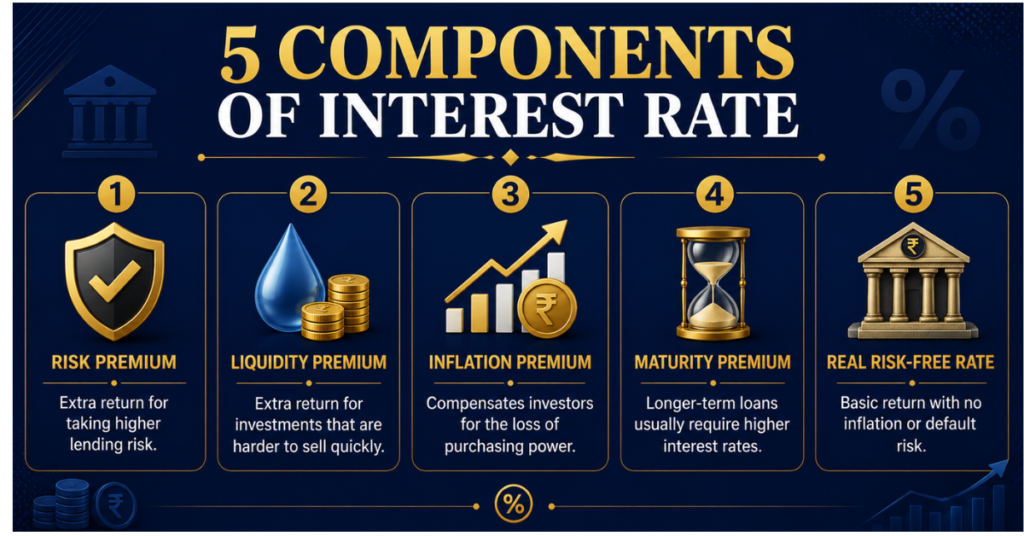
Nominal Interest Rate = Real Risk-Free Rate + Inflation Premium + Default Risk Premium + Liquidity Premium + Maturity Premium
Each of these five factors compensates the lender for a specific purpose. Understanding what each premium represents is key to understanding why interest rates vary so much across asset classes. Let’s discuss each of them deeply.
1. Real Risk-Free Rate
The real risk-free rate is the theoretical return an investor would demand for lending money, assuming zero risk of default and zero impact of inflation, with zero maturity risk simply to compensate for giving up the use of their money for a period of time.
It’s the purest form of compensation—if you lend or invest your money, even with the safest borrower in the world, you’re entitled to some return that the borrower will give you in exchange for using your money.
In fact, the real risk-free rate is never directly observed in the market—it’s a theoretical statistical data point that economists derive using long-term economic growth rates because, in a growing economy, the productive use of capital yields real returns close to the growth rate. Some factors that affect the real risk-free rate include:
• Expected long-term real economic growth rate for a country
• The total supply of savings relative to the demand for borrowing in the economy
2. Inflation Premium
The inflation premium is the extra return a lender demands to compensate for (nominal inflation ), the expected loss in purchasing power of money over the life of the loan.
Here, the borrower pays you more interest than the inflation rate so that your money keeps the same purchasing power.
For understanding: If you lend someone ₹100 today for one year, expecting to get back ₹105, but inflation over that year runs at 5%, your ₹105 next year buys exactly what your ₹100 buys today. You haven’t actually earned anything in real terms; you’ve just been protected against inflation. This is why lenders build an inflation premium into every interest rate quote, based on what they expect inflation to be over the period of the loan.
Real Risk-Free Rate + Inflation Premium = Nominal Risk-Free Rate
This nominal risk-free rate is the interest rate that you actually observe in the market on the safest investment instruments, like government treasury bills and fixed deposits, where default risk is considered negligible but possible.
As of June 2026, India’s consumer inflation (CPI) climbed to an 18-month high of 4.38%, while wholesale inflation (WPI) surged to 9.87%, its fastest pace since September 2022 — driven by higher food, fuel, and manufacturing costs tied to the ongoing West Asia conflict and its effect on crude oil prices. When inflation expectations rise like this, lenders across the market — banks, bond investors, NBFCs — demand a higher inflation premium, which is exactly why bond yields tend to rise when inflation data comes in hotter than expected.
3. Default Risk Premium
The default risk premium is the additional return an investor demands from a lender to compensate them if the borrower fails to make interest payments or fails to repay the principal.
This is where the biggest difference between interest rates comes from. A sovereign government, denominated in its own currency, is considered to have virtually zero default risk because, even in the worst-case scenario, governments can print money and repay the lender. In theory, it can always print more money or raise taxes to meet its obligations (although this has its own consequences).
On the other hand, a private or public company can truly go bankrupt and fail to repay its lender. This means that the riskier the borrower, the higher the default risk premium demanded by the market/investors.
The default risk of all companies, governments, and even individuals in India is measured through credit ratings assigned by agencies like CRISIL, ICRA, and CARE. The general rule of thumb for the default risk premium in the real Indian bond market is simple:
• Each step down on the credit rating scale adds approximately 100 to 200 basis points (1% to 2%) to investors’ demanded yield.
• Highly rated issuers (such as AAA) offer the lowest spreads over the risk-free rate. Therefore, they have a much lower default risk than lower-rated bonds.
• Lowly rated issuers (such as BBB) offer much higher spreads because the probability of default is much higher.
For this reason, a bond yielding 12% isn’t always “better” than a government bond yielding 6.8%. Its risk profile is simply different. Higher yields compensate for the greater uncertainty of getting your money back; they aren’t a free extra return.
Therefore, you need to conduct a high-level analysis of any asset class and always try to question things. Junk bonds have to pay higher coupon rates due to their lower credit ratings and higher default risk. This always involves risk. Why would companies with higher credit ratings pay you higher interest? Think about it.
This is one of the most important lessons in fixed income, and the CFA exam often tests this very misconception.
4. Liquidity Premium
The liquidity premium is the extra return a lender demands for holding an asset that cannot be easily and quickly converted into cash without a loss in value.
Liquidity means being able to buy and sell the instruments as soon as possible, like within 10 seconds or some minutes or within a day; it depends on a huge number of components for every asset class.
Some financial instruments are highly liquid — you can sell them almost instantly at a fair price. Government securities and highly traded listed bonds fall into this category because there is a large, active market of buyers and sellers at any given time.
Other instruments are illiquid — private company bonds, real estate-linked debt, or bonds from smaller, less-traded issuers — where finding a buyer and seller quickly, without accepting a lower and higher price, can be difficult.
Not getting the fair value of the instruments when buying and selling the securities is the main reason why an investor or lender demands liquidity premiums. Imagine you need cash urgently. If your money is in a highly liquid instrument, you sell it at close to its fair value with no trouble. If your money is in an illiquid instrument, you may need to sell it at a discount just to find a buyer quickly. Here, you can not sell huge quantities; you will lose more. Investors know this in advance, so they demand extra compensation upfront for taking on that illiquidity risk.
Example: Two corporate bonds, same issuer, same credit rating, same maturity — but one is listed and actively traded on the exchange, while the other is a privately placed bond with almost no secondary market. The privately placed bond will typically offer a higher yield than an actively tarded bond, purely because of this illiquidity, even though the default risk is identical.
5. Maturity Premium
A maturity premium is the extra return a lender demands for lending money over a longer period of time, because longer-term commitments involve greater uncertainty.
That’s why a 30-year government bond typically yields more than a 1- or 5-year Treasury bill, even though both are issued by the same government and have a (very low) default risk. This is because the longer you lock up your money, the more things can go wrong or change in the meantime. Interest rates can rise rapidly, making your locked-in bond less attractive. Inflation can spike suddenly. Everything can change over the long term. The economic and political environment can change in ways no one can predict a decade or three decades from now.
This maturity premium is why longer-term bonds typically yield more than shorter-term bonds, all other things being equal.
Putting it all together:
A master example
Let’s consider a realistic 10-year corporate bond yield using all the frameworks, based on data from India through mid-2026. Let’s assume a 10-year AA-rated corporate bond in India is yielding approximately 9%. This 9% is broken down as follows:
• Real risk-free rate: ~2%
• Inflation premium: ~2.5% (reflects the current inflation environment)
• Default risk premium: ~2.5% (AA-rated, moderate-low default risk)
• Liquidity premium: ~0.5% (trades well but not as liquid as G-Secs)
• Maturity premium: ~1.5% (10-year lock-in vs. a smaller bond)
Total ≈ 9%
Compare this to India’s actual 10-year G-Sec yield of approximately 6.8% as of July 2026—the difference of approximately 2.2 percentage points between AA corporate bonds and government bonds is essentially the default risk premium and a small liquidity premium, as both bonds have the same real rate, inflation premium, and maturity premium (same government, same country, same market). same time.
Understanding: Why Do Some Assets Have Higher Interest Rates Than Others?
It is one of the most important questions that every investor and every CFA candidate eventually asks. The table below shows exactly which premium is responsible for the difference, comparing common instruments side by side.
| Instrument | Typical Yield (India, 2026) | Why It’s Higher or Lower than others |
| Savings account | 3% – 4% | Very low risk, high liquidity, but real rate offered is deliberately low since banks need cheap short-term funds. |
| Fixed Deposit (1 year) | 6% – 7% | Slightly better rate for locking money for a fixed term (small maturity premium), still very low default risk |
| Government Bond (10-year G-Sec) | ~6.8% | Zero default risk premium, zero liquidity risk premium, but full maturity premium for the 10-year lock-in |
| AAA Corporate Bond | 7.0% – 8.3% | Small default risk premium added over G-Sec, since even top-rated companies carry some risk a sovereign doesn’t |
| AA Corporate Bond | 8.0% – 9.5% | Slightly higher default risk premium than AAA |
| A-rated Corporate Bond | 9.5% – 11.5% | Meaningfully higher default risk premium, reflecting real uncertainty about repayment |
| BBB Corporate Bond | 11.5% – 13%+ | Largest default risk premium among investment-grade bonds, often combined with a higher liquidity premium too. |
The pattern is clear: every step up in yield you see across this table is compensation for one specific thing — either you’re taking on more default risk, accepting less liquidity, or locking your money away for longer. None of it is a “free” extra return. This is exactly the mindset you need to build so that you can make better economic decisions, and it’s equally useful for anyone building a real investment portfolio.
Some Biggest Misconceptions About Interest Rate Components
Higher Interest Rate Always Means a Better Investment
Actually, no, this is where many new investors go wrong. A bond yielding 13% is not automatically greater than one yielding 7%. The 13% yield exists precisely because the market has judged that bond to carry meaningfully higher risk of default, of illiquidity, or both.
The right way to think about it: yield should always be evaluated relative to the risk being taken on, not in isolation. A BBB-rated bond at 12% might actually be a poor risk-adjusted choice compared to an AA-rated bond at 9%, depending on your risk tolerance and how confident you are in that specific issuer’s ability to repay.
This is also why, during periods of economic stress, credit spreads (the gap between corporate bond yields and government bond yields) tend to widen sharply — investors become more risk-averse and demand a bigger default risk premium to compensate for uncertain economic conditions, even if the company’s actual financial position hasn’t changed yet.
How Does This Apply to CFA Level 1?
This framework, breaking nominal interest rate into its five components, appears directly in the Economics and quants section of the CFA Level 1 curriculum, and it resurfaces again in Fixed Income, since bond pricing and yield analysis depend entirely on understanding these premiums.
How Does This Affect an Investor?
If you’re an investor or a finance enthusiast, understanding these components of interest rates isn’t just an academic exercise—it directly helps you make better portfolio decisions.
When choosing bonds with different credit ratings, you now know exactly what you’re paying for by choosing a higher-yielding bond over a lower-yielding one; this could be any risk premium the bond carries. Therefore, you need to position your portfolio based on how much of that particular risk you’re comfortable bearing.
When comparing fixed deposits to corporate bonds, you can see that the extra yield on bonds compared to FDs is largely a default risk and liquidity premium—this should only be taken if you’ve accurately assessed the issuer’s creditworthiness, not just chased after a high number. When you build a fixed income portfolio across maturities, identifying the maturity premium helps you decide whether locking in money for a little extra yield is worth the interest rate risk you’re taking—because if rates rise later, the market value of your long-term bonds falls more than that of short-term bonds.
When inflation expectations change, as has clearly happened in India with the CPI hitting an 18-month high by 2026, you can expect lenders across the market to demand higher inflation premiums, pushing up yields on new issues—which is exactly what has been seen in India’s corporate bond market this year.
The Conclusion
As we already understand, the interest rate is never just one number; it’s a layered stack of compensations, each addressing a specific risk a lender has about lending their money away.
Once you can look at any interest rate — a savings account, a fixed deposit, a government bond, or a risky corporate bond — and mentally break it down into these five pieces, you stop asking “why is this rate so high or so low” as a mystery, and start seeing it as a straightforward reflection of the specific risks involved. That’s true whether you’re sitting the CFA exam or simply deciding where to put your own money.
Disclaimer: This article is for educational purposes only and does not constitute financial or investment advice. Always consult a qualified financial advisor before making investment decisions.
Frequently asked questions
What are the five components of interest rate?
The five components are the real risk-free rate, inflation premium, default risk premium, liquidity premium, and maturity premium. Together, these make up the nominal interest rate on any bond or loan, with each component compensating the lender for a specific type of risk or cost.
Why do corporate bonds have higher interest rates than government bonds?
Corporate bonds carry a default risk premium that government bonds (in their own currency) essentially don’t have, since a government is considered far less likely to default than a private company. The exact size of this premium depends on the company’s credit rating — the lower the rating, the higher the default risk premium demanded by investors.
Is a higher interest rate always better for an investor?
No. A higher interest rate typically reflects higher risk — whether that’s default risk, illiquidity, or a longer maturity period. Investors should evaluate yield relative to the specific risks being taken on, rather than assuming a higher number automatically means a better investment.
Why do longer-term bonds usually have higher interest rates than shorter-term bonds?
This is due to the maturity premium, which compensates investors for the added uncertainty of locking their money away for a longer period. Over a longer horizon, there’s more room for interest rates, inflation, and economic conditions to change unexpectedly, so investors demand extra compensation for that added risk.

My name is Prabhat Mehta, and I’m from Jharkhand, India. I’m a CFA Level 1 candidate and currently pursuing a Bachelor of Commerce (B.Com) with a specific academic focus on financial analysis, corporate finance, and investment fundamentals.
I have a passion for studying and analysing financial markets, company valuation, and fundamental analysis. I feel immense joy and energy whenever I engage in these activities. I write articles to explain complex financial concepts simply and clearly, providing practical explanations to help investors avoid common mistakes and make better financial decisions.
Most retail investors struggle not because of a lack of funds, but because of a lack of clear financial understanding—they don’t know what investing is, how to get started, or how to select undervalued stocks with good growth potential. My work is to focus on solving those problems.
Investing isn’t just about investing in a single asset. I believe investing should be logical, disciplined, and knowledge-driven rather than emotional. Through continuous learning and real-world analysis, my aim is to foster sound financial thinking and share information that truly helps investors grow with confidence over time.