

If you’re an investor thinking about setting up an ETF SIP, you might think that setting up an ETF SIP works just like a mutual fund SIP: choose an amount, a date, a specific asset, and then forget about it. Believe it or not, an ETF SIP is not at all like a mutual fund SIP, and frankly, it can be a little confusing if someone doesn’t explain it properly first.
So, in today’s journey, we’ll look at whether you can actually do an ETF SIP in India, how it works behind the scenes, and how it compares to the two things people commonly compare it to: a regular mutual fund SIP and an index fund SIP.
Can You Do SIP in an ETF? Short Answer First
With the traditional method, you can not do SIP in ETFs. There is no SIP facility in ETFs. A amc comapny or fund house doesn’t provide SIP in ETFs.
But with the help of a broker, you can do a SIP in an ETF in India; yes, it does not work through the traditional bank auto-debit mandate system that mutual fund SIPs use. Instead, it works through your stockbroker, either by manually placing a buy order every month on a fixed date, or by using an “ETF SIP” feature that many brokers now offer, which automates this order placement for you.
There is a huge difference between mutual fund SIP and etf sip. A mutual fund SIP is built on a banking-side mechanism — a NACH mandate that auto-debits a fixed amount from your bank account on a set date, and that money gets converted into mutual fund units at that day’s NAV, with no manual action needed on your part after the initial setup.
An ETF, because it trades on the stock exchange exactly like a share trades on the exchange, doesn’t have this NACH-based purchase mechanism built into its core structure. Every ETF purchase is technically a trade, placed through a broker, during market hours, at whatever price the market is offering at that moment.
How ETF SIP Actually Works in Real life
There are two ways from that You can do SIP in ETFs
The manual way: you decide, say, that on the 5th of every month you’ll buy ₹5,000(any amount) worth of a Nifty 50 ETF. You open your broker’s app on that date, check the current price, and place the order yourself. This gives you full control, but it also means you need to remember to do it; you’re exposed to whatever the price happens to be at that exact moment you log in, and you can only buy whole units in most cases, not an exact rupee amount. It sounds like well, but there are also major risks behind this method which can stop your SIP.
The automated way is what most major brokers now offer under a feature usually labelled “ETF SIP” or “Smart SIP” — Zerodha, Groww, Upstox, and several others provide this. You set an amount and a date, and the broker’s system automatically places a buy order for you on that date each month, usually a market order placed at the prevailing price when the order executes. This removes the remembering-to-do-it problem, but the underlying mechanics — buying at whatever the live market price is, generally in whole units, with a transaction going through your Demat and trading account — remain the same as the manual approach. It’s automation layered on top of a stock-exchange transaction, not a fundamentally different mechanism like the mutual fund NACH mandate.

A few practical things this creates that a mutual fund SIP investor never has to think about:
• You cannot directly buy it from the fund house. You need an active Demat and trading account, not just a bank account, to do an ETF SIP.
• Most ETF purchases happen in whole units, so your monthly investment amount rarely gets invested exactly — if a Nifty 50 ETF unit costs ₹285 and you want to invest ₹5,000, you’ll end up buying 17 units for ₹4,845, with the remaining ₹155 left uninvested that month, unless your broker specifically supports fractional unit purchases.
• Every purchase counts as a trade, which may attract brokerage charges (though many brokers now offer zero or minimal brokerage on ETF purchases), along with regulatory charges like Securities Transaction Tax (STT), which applies on every ETF trade
• The price you pay depends on market timing during the day, not a single fixed NAV calculated after markets close. Well, that’s not a bad thing from the perspective of an investor.
None of this makes ETF SIP a bad idea. It just makes it a genuinely different mechanical process.
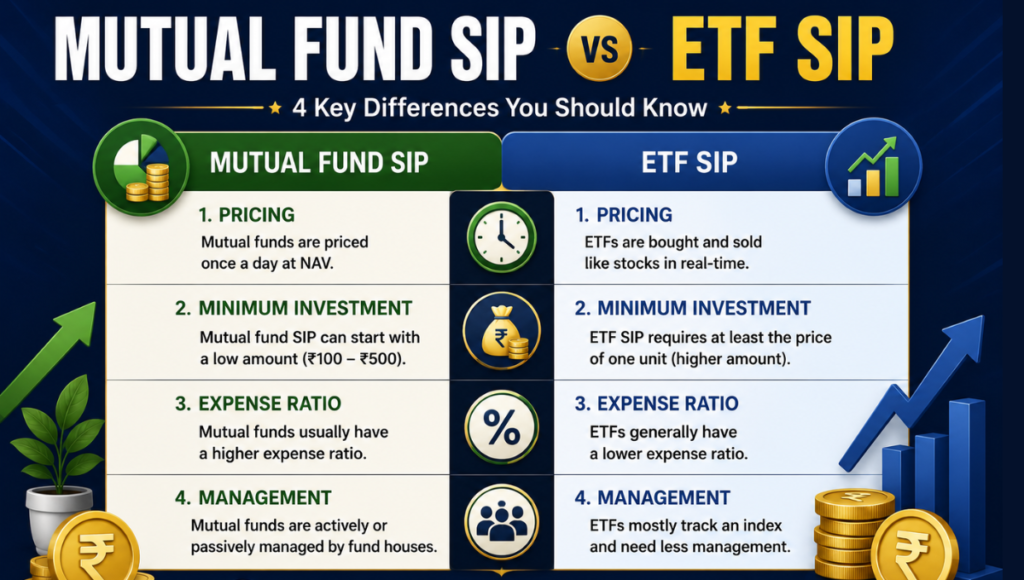
Difference between SIP in ETFs vs SIP in Mutual Funds
Let’s understand the difference between SIP in mutual funds and in ETFs so that you can make more meaningful investment decisions.
How the purchase itself works. A mutual fund SIP debits your bank account automatically through a NACH mandate and converts the exact rupee amount into fund units — including fractional units.
An ETF SIP, as covered above, generally buys whole units at the live market price during trading hours, which usually means a small leftover amount doesn’t get invested each cycle, and the price depends on the specific moment your order executes rather than a single official daily NAV.
Cost differences. This is where ETFs usually pull ahead. A typical Nifty 50 ETF in India carries an expense ratio as low as 0.04% to 0.05% annually. An equivalent Nifty 50 index mutual fund, even in its cheaper direct plan, usually runs in the 0.10% to 0.20% range, because running a mutual fund involves handling the NACH mandate system, investor servicing, and other operational costs that an ETF, trading like a simple listed security, doesn’t carry in the same way. Over a long investment horizon, this expense ratio gap compounds and can add up to a meaningful difference in your corpus.
Ease of automation. Mutual fund SIPs win clearly here. Once you set up the NACH mandate, it runs in the background for years without you touching it. Even a broker’s “ETF SIP” automation feature is still fundamentally placing a trade during market hours, and if that specific day happens to be a market holiday or there’s some technical hiccup, it can behave less predictably.
Requirement to get started. A mutual fund SIP only needs a bank account and completed KYC — you can start one through an AMC’s app or a mutual fund platform without ever opening a Demat account. An ETF SIP requires a full trading and Demat account setup with a stockbroker, which is an extra step, though a common one for anyone already investing in stocks.
Both are good for investing; choose anything that you belive fro long term invetments. You can choose according to your investment, your time horizon, and risk tolerance.
SIP in ETFs vs Index Fund
This comparison often gets confused with the one above, but it’s actually a slightly different question,
because an index fund is itself a type of mutual fund, one that passively tracks an index rather than being actively managed by a fund manager picking stocks.
Both Index and ETF track the same underlying index, but deliver it differently. A Nifty 50 ETF and a Nifty 50 index fund are both trying to replicate the performance of the same 50 companies. Neither involves active stock-picking or fund manager judgment calls. The difference lies entirely in how you buy them and what wrapper they come in, not in the investment philosophy itself.
Tracking error tends to be slightly tighter with ETFs, since they trade continuously against real-time market prices with Authorised Participants constantly working to keep the ETF’s price aligned with its underlying assets. Index funds, priced only once daily, can sometimes show marginally higher tracking error, particularly around the timing of when new investor money actually gets deployed into the market versus when it was received.
Cost usually favors ETFs slightly, for the same expense ratio reasons discussed above — a well-run Nifty 50 ETF’s 0.04% to 0.05% expense ratio typically undercuts even a low-cost direct index fund’s 0.10% to 0.20% range, though this gap has been narrowing in India.
NACH-based SIP system — exact rupee amounts, fractional units, automatic bank debits, no Demat account required, no whole-unit rounding, no dealing with live market prices during the day. If your entire goal is “set up a SIP once and never think about it again for 20 years,” an index fund SIP delivers that experience far more smoothly than an ETF SIP does, even though both are chasing the identical index.
A concrete way to see the difference: imagine investing ₹3,333 a month into a Nifty 50 index fund versus the same amount into a Nifty 50 ETF trading around ₹285 a unit. The index fund SIP invests the full ₹3,333 every single month, buying roughly 11.7 units in fractional terms. The ETF SIP, restricted to whole units in most broker setups, buys 11 units for ₹3,135, leaving ₹198 uninvested that cycle; that money either sits idle or needs to be manually tracked and added to the next month’s purchase.
Over years of monthly investing, this rounding friction is a real, if small, drag that index fund investors simply never encounter.
So Which Should You Actually Choose for your investments?
There isn’t a single universally correct answer here, because it depends on you and your risk tolerence. Time horizon and what you personally value more between cost efficiency and operational simplicity. It always depends on you what investments tend to be best for you.
You can choose an ETF SIP if: you already have an active Demat and trading account, or you’re comfortable with a broker’s automated ETF SIP feature, or don’t mind placing a monthly order yourself, and you want to squeeze out the lowest possible expense ratio over a long holding period, and you’re not overly bothered by small monthly rounding leftovers.
You can choose an index fund SIP if: you want the simplest possible “set it and forget it” experience, you don’t already have or want to manage a Demat account, you want every rupee of your monthly investment to actually get invested through fractional units, and the slightly higher expense ratio compared to an ETF doesn’t concern you enough to trade off that convenience.
Many experienced Indian investors actually end up using a mix — an index fund SIP for the disciplined, automated monthly investment they never want to think about, and occasional ETF purchases for tactical, opportunistic buying when they specifically want to time an entry.
The Conclusion
Yes, you can do a SIP in an ETF through a broker in India, but it’s clear that it’s a broker-assisted, exchange-based buying process that’s either manual or automated through the broker’s ETF SIP feature. Compared to a mutual fund SIP, it generally offers lower expense ratios but less operational smoothness, and purchasing whole units introduces some rounding friction. Especially compared to an index fund SIP—which is actually a more relevant comparison, as both are passive products tracking the same index—there’s a slightly better cost profile for an ETF and a smoother, fully automated investing experience for an index fund.
You can choose either or both for your investments. It’s important to choose the one that matches how much manual involvement you’re willing to endure over the years, because ultimately, the best investment vehicle is the one whose mechanics you’ll be able to stick with.
Disclaimer: This article is for educational purposes only and does not constitute financial or investment advice. Always consult a qualified financial advisor before making any investment decisions.
________________________________________
Frequently Asked Questions (Click here to see the FAQ)
Does ETF SIP work like a bank auto-debit, the same as mutual fund SIP?
No. ETF SIP works through your broker placing a buy order on the exchange, either manually by you or automatically via a broker feature, not through a bank-side NACH mandate like mutual fund SIPs use.
Do I need a Demat account for ETF SIP?
Yes. Since ETFs trade on stock exchanges, you need an active Demat and trading account with a registered broker to invest in them, unlike mutual fund SIPs which only require a bank account and KYC.
Can I invest an exact rupee amount in ETF SIP?
Usually not exactly. Most ETF purchases happen in whole units at the live market price, so a small leftover amount often remains uninvested each month, unless your broker specifically supports fractional unit purchases.
Is ETF SIP cheaper than mutual fund SIP?
Generally yes, in terms of expense ratio. A typical Nifty 50 ETF charges around 0.04% to 0.05% annually, while an equivalent index mutual fund usually charges 0.10% to 0.20%, so ETFs tend to be cheaper to hold over the long run.
Which has lower tracking error, ETF or index fund?
ETFs generally have slightly lower tracking error since they trade continuously with mechanisms in place to keep their price close to the underlying index value, while index funds are priced only once daily and can show marginally higher tracking error.
Can I stop or pause my ETF SIP anytime?
Yes. Since there’s no long-term mandate locking you in the way a bank NACH mandate technically involves a formal cancellation process, you can simply stop placing orders or turn off your broker’s automated ETF SIP feature whenever you choose.
Is index fund SIP better for beginners than ETF SIP?
For most beginners, yes, mainly due to convenience. Index fund SIPs don’t require a Demat account, invest your exact amount through fractional units, and run fully automatically, making them operationally simpler for someone just starting out.
Do ETF SIPs attract more charges than mutual fund SIPs?
ETF purchases attract Securities Transaction Tax (STT) on every transaction and sometimes small brokerage charges, though many brokers now offer zero or minimal brokerage on ETFs. Mutual fund SIPs don’t have STT but carry a slightly higher expense ratio baked into the fund itself.
Can I do SIP in a Gold ETF the same way as an equity ETF?
Yes, the same mechanics apply — you can set up a manual or automated monthly purchase of a Gold ETF through your broker, buying whole units at the live market price, just as you would with an equity ETF like a Nifty 50 ETF.

My name is Prabhat Mehta, and I’m from Jharkhand, India. I’m a CFA Level 1 candidate and currently pursuing a Bachelor of Commerce (B.Com) with a specific academic focus on financial analysis, corporate finance, and investment fundamentals.
I have a passion for studying and analysing financial markets, company valuation, and fundamental analysis. I feel immense joy and energy whenever I engage in these activities. I write articles to explain complex financial concepts simply and clearly, providing practical explanations to help investors avoid common mistakes and make better financial decisions.
Most retail investors struggle not because of a lack of funds, but because of a lack of clear financial understanding—they don’t know what investing is, how to get started, or how to select undervalued stocks with good growth potential. My work is to focus on solving those problems.
Investing isn’t just about investing in a single asset. I believe investing should be logical, disciplined, and knowledge-driven rather than emotional. Through continuous learning and real-world analysis, my aim is to foster sound financial thinking and share information that truly helps investors grow with confidence over time.