
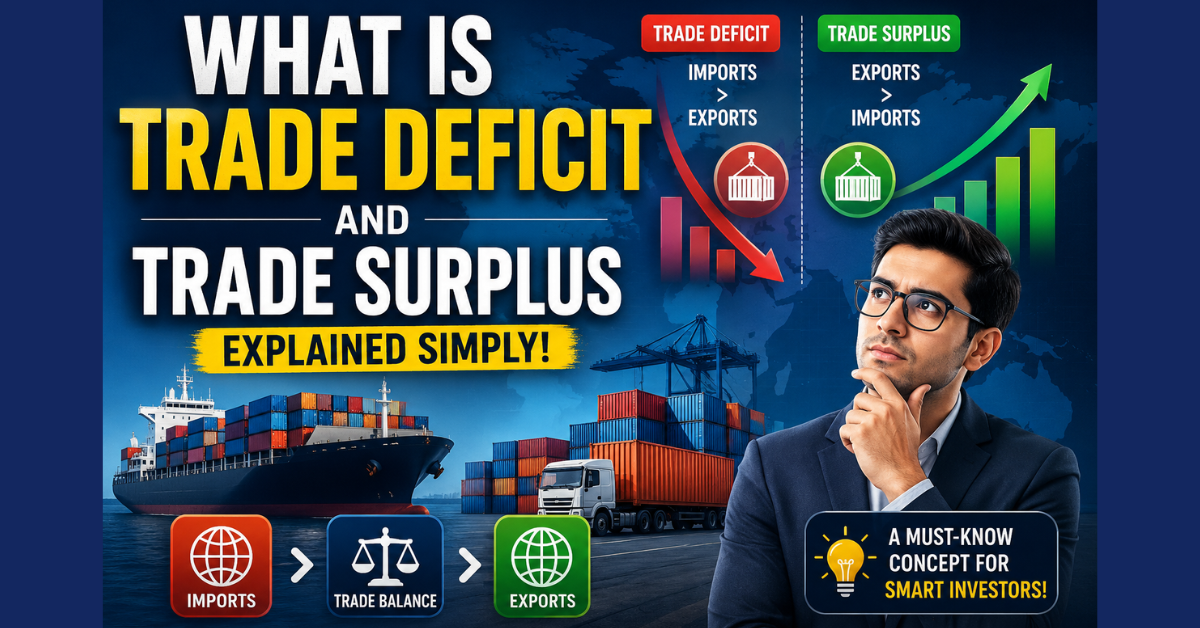
Have you ever seen or heard a topic/heading, article, or comment like, “India’s trade deficit has widened,” or “China’s trade surplus is too high,” or “Why is a trade surplus better than a trade deficit?” If so, you might be wondering what they actually mean.
Does a trade deficit mean India is going bankrupt, or is the Indian economy going into recession? Does a trade surplus mean a country is rich and powerful? And most importantly, why should a regular Indian investor care about any of this?
In this article, we’ll explain trade surplus and trade deficit from scratch—with examples from India, numbers, and practical context that will truly help you to make better financial o decisions. By the time you finish reading, you’ll understand these economic concepts.
What is Trade? Understands the basics
First, we need to understand what “trade” means at the country level so we can relate things properly.
Trade means buying and selling products and services from someone. Think of it like when you go to the market and buy a phone; it’s called a transaction. You pay someone money and get goods from them.
The same things happen with economies. Now imagine that India(any country) is one person, and the rest of the world is a huge marketplace where he can buy goods and sell his goods.
IMPORT: India buys goods from other countries—crude oil from Russia and Saudi Arabia, smartphones and electronics from China, semiconductors from the USA or Taiwan, gold from Switzerland, and machinery from Germany. These purchases are called imports.
Export: India also sells goods to other countries—software services to the USA, medicines (generic drugs/pharma) to Africa and Europe, textiles to the Middle East, and engineering goods worldwide. These sales are called exports.
The difference between what India earns from its exports to other countries and what it spends on imports from other nations is called the balance of trade, and this is where surpluses and deficits come into existence.
What is a Trade Surplus? Definition and Meaning
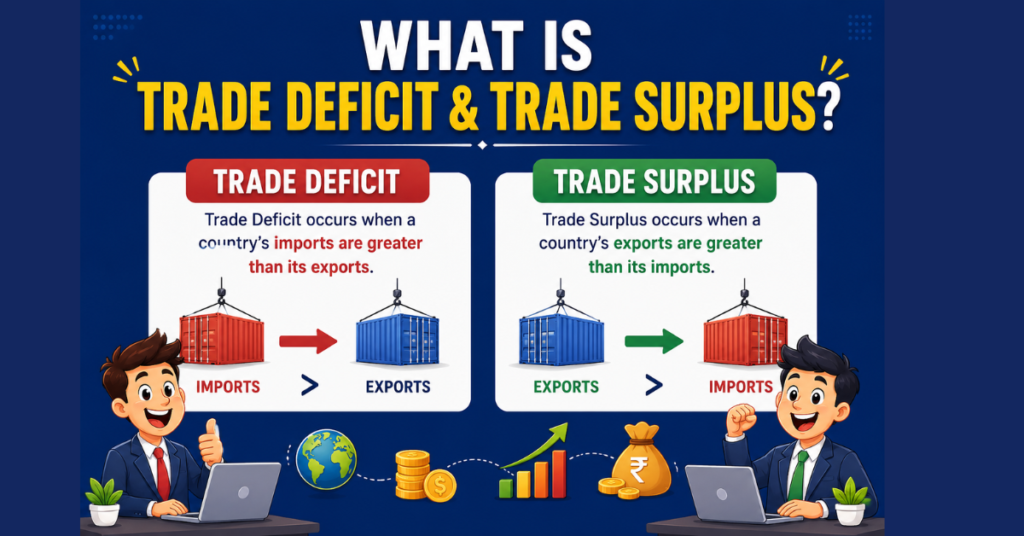
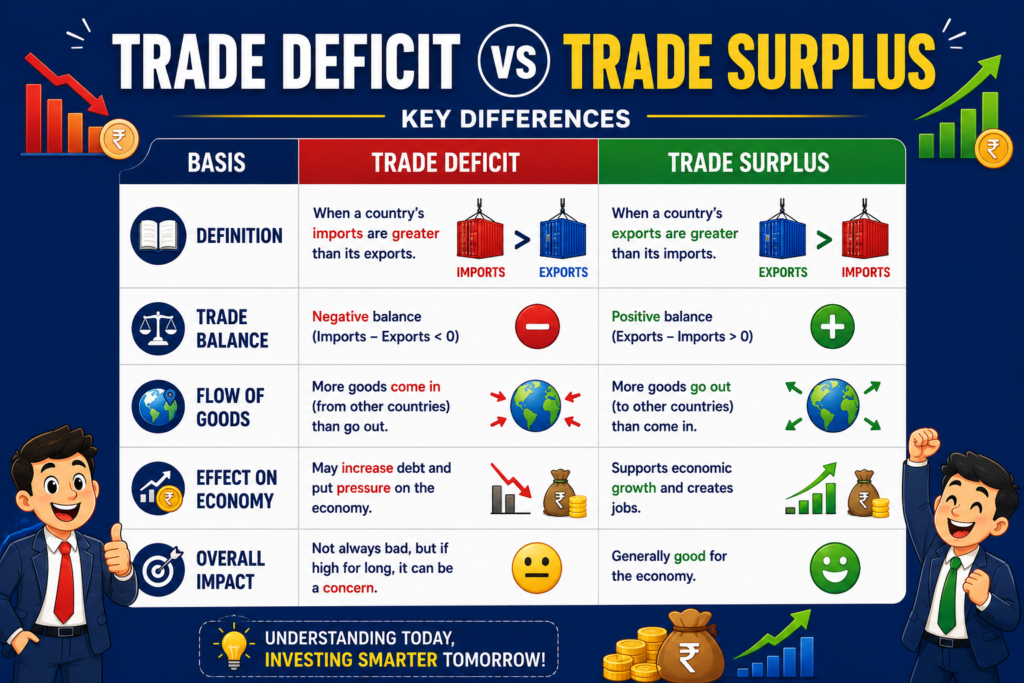
A trade surplus occurs when a country’s exports exceed its imports. This means that the country is selling more of its goods and services to the world than it is buying from the world. (When exports > imports)
Formula:
Trade Surplus = Total Exports − Total Imports
Example:
Suppose country X exports $200 billion worth of goods and imports $150 billion worth of goods in a year.
Trade Balance = $200B − $150B = +$50 billion (Trade Surplus)
“+$50 billion” means the country has earned $50 billion more from the world than it has spent. This is a positive trade balance.
Countries with Trade Surpluses
The two biggest examples worldwide are China and Germany.
China’s goods trade surplus reached nearly $990 billion in 2024—and surpassed a historic $1.2 trillion in 2025, the largest surplus ever recorded by any country. China achieves this by manufacturing and exporting large quantities of electronics, machinery, consumer goods, and solar panels at competitive prices worldwide.
Germany: According to Wikipedia, Germany recorded a trade surplus of $255 billion in 2024. Europe’s industrial powerhouse consistently runs trade surpluses thanks to its world-class automotive exports (BMW, Mercedes, Volkswagen) and precision machinery. In 2023, Germany’s trade surplus was the second-largest worldwide.
Japan also consistently runs surpluses, primarily through automotive and industrial exports.
What is a Trade Deficit? Definition and Meaning
A trade deficit occurs when a country’s imports exceed its exports. Simply put, a country is buying more goods and services from the world than it sells to the world. (When imports > exports)
Formula:
Trade deficit = total imports − total exports
Example:
Suppose India exports $440 billion worth of goods and imports $775 billion worth of goods in a year.
Trade balance = $440B − $775B = −$335 billion (trade deficit)
“−$335 billion” means that India spents $335 billion more buying from the world than it earns selling to the world. This is called a negative balance of trade.
India’s actual trade deficit numbers (FY2025–26) data are sourced from https://www.pib.gov.in/PressReleasePage.aspx?PRID=2252272®=3&lang=1
In FY2026 (April 2025 to March 2026):
• Exports: $441.78 billion
• Imports: $774.98 billion
• Trade Deficit: $333.20 billion
However, India also has a strong services export sector—primarily IT, software, and business services—which generated a surplus of approximately $213.89 billion in FY2026.
Therefore, India’s overall trade position (goods + services combined) is less worrisome than the merchandise figures alone.
The Biggest Misconception between trade deficit and trade surplus
Trade Deficit = Bad Country, Trade Surplus = Rich Country
This is where most people get confused—and frankly, many investors get it wrong too.
The United States of America has one of the largest trade deficits in the world. In 2025, the USA’s trade deficit was $901 billion. It imports far more than it exports each year. Is the USA a weak or poor country? Clearly not.
China runs the world’s largest trade surplus. Does this mean Chinese families are wealthy and consumption is high? Actually, no.
Domestic demand in China is very low—meaning people inside China don’t spend as much as you might expect—which is one reason China exports so much. As a businessman, when your own citizens aren’t buying enough, you sell your goods and services to other countries (foreign countries).
As Deloitte economists have observed, a trade deficit can sometimes be a sign of economic strength—it reflects strong domestic demand, meaning people have enough money to buy goods from around the world. Conversely, a trade surplus can sometimes indicate weak domestic consumption.
A trade deficit or trade surplus isn’t a definitive answer that can help you make straightforward decisions, but the truth is this: neither a surplus nor a deficit is inherently good or bad. What matters is why there’s a surplus or deficit, and what makes it up
How Does a Trade Deficit Affect the Indian Rupee?
This topic becomes directly relevant to Indian investors and everyday citizens.
When India imports more than it exports, so india needs to pay for those imports in foreign currency — primarily US dollars. This means India needs to buy dollars, which increases demand for dollars and increases selling pressure on rupees.
More demand for dollars + more selling of rupees = the rupee weakens against the dollar.
This is why you sometimes see rupee depreciation news linked to trade deficit announcements. When India’s trade deficit widens, the rupee comes under pressure.
A weaker rupee has a chain reaction:
• Imports become more expensive (you need more rupees to buy the same dollar amount of oil or electronics)
• This pushes up inflation inside India
• The RBI may need to intervene to stabilize the currency
However, a weaker rupee also helps India’s exporters:
• IT companies like TCS and Infosys earn in dollars but pay costs in rupees — so a weaker rupee directly boosts their profits; they earn in dollars and sell us dollars to convert them into rupees.
• Pharma exporters and textile exporters benefit similarly
This is why rupee depreciation is genuinely a double-edged sword for the Indian economy and stock market. Absolutely, this is best for some companies, not for every company.
How Does This Affect to an Investor?
When India’s trade deficit increases:
If you invest in the Indian stock market or any securities, trade surplus and deficit data can change your thinking as follows:
• The oil and gas sector may be pressured due to higher import costs.
• IT sector companies (TCS, Infosys, Wipro) often benefit because they earn in dollars and spend in rupees.
• Pharmaceutical companies and exporters benefit from a weak rupee.
• Auto and FMCG companies that import components face higher input costs.
• Currency-sensitive bonds and debt funds may be pressured.
When India’s trade data improves (deficit decreases):
• The rupee is stable or strong.
• Imported goods become cheaper (electronics, fuel, cooking oil).
• Inflation may decrease, giving the RBI more room to lower interest rates.
• This benefits bond investors and rate-sensitive sectors such as banking and real estate.
Can a Trade Surplus Ever Be Bad?
Yes — and this is a nuance most people miss entirely.
Consider this scenario: a country exports heavily but its own citizens cannot afford to buy much. Domestic consumption is suppressed. Workers produce for foreign customers but struggle at home. This is a real concern economists have raised about China’s export-driven growth model.
Traditional export nations like China and Germany have at times been criticized for running large surpluses — not because surpluses themselves are wrong, but because large, persistent surpluses can:
- Destabilize global trade by absorbing too much demand from the rest of the world
- Lead to tension with trading partners (as seen in US-China trade tensions and Donald Trump’s tariff wars)
- Keep domestic wages and consumption artificially suppressed to maintain export price competitiveness
The European Union has at various points pushed Germany to reduce its surplus by boosting domestic investment, raising wages, and cutting taxes — precisely because Germany’s surplus was seen as harming weaker EU economies that could not compete as exporters.
So a very large, very persistent trade surplus can be a sign of structural problems — not just economic strength.
Can a Trade Deficit Ever Be Good?
Similarly, yes.
A trade deficit can be perfectly healthy when:
- It reflects strong consumer demand — people have income and are buying goods freely
- It reflects investment-led imports — machinery, technology, and capital goods that build future productive capacity
- It is financed by strong foreign investment inflows — if foreign investors are pouring money into your country (FDI, FPI), they are effectively funding your deficit in exchange for future returns
India’s import of capital goods — machinery, industrial equipment — is often a positive sign. It means Indian factories are expanding, building capacity for the future. These imports today can drive export growth tomorrow.
The concern arises when a trade deficit is financed purely by debt, or when it reflects a structural inability to produce domestically what citizens need.
India’s Path Forward: Can the Deficit Be Reduced?
Make in India and PLI Schemes: Production-Linked Incentive (PLI) schemes are designed to boost domestic manufacturing in sectors such as electronics, semiconductors, pharma, and textiles — directly targeting the import dependence that drives the deficit.
India’s government and policymakers are actively working on several strategies:
Reducing China Dependency: India is diversifying its supply chains, seeking to source more from domestic producers or from alternative countries like Vietnam and Taiwan for electronic components.
Expanding Services Exports: India’s IT and services sector is growing steadily. Expanding digital services, fintech, and software exports helps counterbalance the goods deficit.
Boosting Merchandise Exports: India has set an ambitious target of $1 trillion in merchandise exports by 2030. Achieving this would substantially reduce the deficit.
Yes. The United States consistently runs one of the largest trade deficits in the world. It imports far more goods than it exports. Yet the USA remains the world’s largest economy — proof that a trade deficit does not define economic strength.
The Conclusion
Trade surplus and trade deficit are not just dry economic terms. They are real signals about how a country interacts with the world, how competitive its industries are, and how sustainable its economic growth is.
For India, the trade deficit is a story in transition. India imports a lot because it needs to — energy, technology, and capital goods fuel a fast-growing economy of 1.4 billion people. At the same time, India’s services export engine is globally competitive, and manufacturing is gradually being built up through policy initiatives.
The key takeaway: do not judge India’s trade deficit at face value. Look at what is being imported, whether those imports serve growth, and whether India’s export base is expanding. That is the nuanced story behind the numbers.
As an investor or a financially curious person, understanding trade data gives you an edge. It helps you anticipate rupee movements, understand inflation trends, and make smarter decisions about which sectors and stocks to watch.
Disclaimer: This article is for educational purposes only and does not constitute financial or investment advice. Always consult a qualified financial advisor before making investment decisions.
Frequently Asked Question
Is India’s trade deficit getting worse?
India’s merchandise trade deficit widened to $333.20 billion in FY2026, compared to $283.50 billion the previous year — an increase of about 17.5%. However, the widening was primarily driven by gold price increases (not more gold being imported) and rising electronics imports linked to India’s expanding manufacturing base.
Does the USA have a trade deficit?
Yes. The United States consistently runs one of the largest trade deficits in the world. It imports far more goods than it exports. Yet the USA remains the world’s largest economy — proof that a trade deficit does not define economic strength.
What is the difference between trade deficit and fiscal deficit?
These are two completely different things. A trade deficit is about a country’s imports vs exports — international trade. A fiscal deficit is about the government’s spending vs its revenue — domestic government finance. Both are important economic indicators but measure entirely separate things.
Which is better for India — surplus or deficit?
For India at its current stage of development, a moderate trade deficit is normal and manageable. India needs to import oil to power its economy, import capital goods to build factories, and import electronics components to assemble products. The goal is not to eliminate the deficit overnight, but to reduce structural dependencies (like China electronics), grow exports in new sectors, and ensure the deficit is financed sustainably.

My name is Prabhat Mehta, and I’m from Jharkhand, India. I’m a CFA Level 1 candidate and currently pursuing a Bachelor of Commerce (B.Com) with a specific academic focus on financial analysis, corporate finance, and investment fundamentals.
I have a passion for studying and analysing financial markets, company valuation, and fundamental analysis. I feel immense joy and energy whenever I engage in these activities. I write articles to explain complex financial concepts simply and clearly, providing practical explanations to help investors avoid common mistakes and make better financial decisions.
Most retail investors struggle not because of a lack of funds, but because of a lack of clear financial understanding—they don’t know what investing is, how to get started, or how to select undervalued stocks with good growth potential. My work is to focus on solving those problems.
Investing isn’t just about investing in a single asset. I believe investing should be logical, disciplined, and knowledge-driven rather than emotional. Through continuous learning and real-world analysis, my aim is to foster sound financial thinking and share information that truly helps investors grow with confidence over time.